The Intelligent Asset Allocator by William J. Bernstein — Summary & Key Lessons
What this book will teach you in the next 10 minutes — and why it matters for your long-term wealth and investment returns.
Written by a neurologist who taught himself portfolio theory from academic research — with nothing to sell and no conflicts of interest. This is one of the most honest books ever written about how investing actually works.
Book Snapshot
- Author – William J. Bernstein
- Category – Personal Finance / Investing / Portfolio Management
- Original Book – ~ 225 pages | Average read time: 6–8 hours
- Free Summary – 08 pages
- Premium Summary – 32 pages | Estimated read time: 35–45 minutes
The Big Idea
The entire investment industry wants you focused on the wrong question. It wants you picking stocks, chasing fund managers, and reacting to market news — because that behavior generates fees and engagement. William Bernstein cuts through all of it with a single, data-backed argument: the most important investment decision you will ever make is not what you buy, but how you divide your money across different asset classes. That one decision — your asset allocation — drives over 90% of your long-term returns. Everything else is noise.
Explore more evidence-based investing frameworks in our Investing Fundamentals category or see how this compares to other classics in our Investing Fundamentals Pack.
What You’ll Learn — Key Lessons Preview
- Why your portfolio’s architecture matters more than any stock you’ll ever pick — and how to build it correctly from the ground up
- How to use correlation between asset classes to reduce risk without sacrificing return — the only genuine free lunch in investing
- Why rebalancing is not just risk management but a systematic return-enhancing strategy — and how to automate it so you never skip it
- How to identify your real risk tolerance before a market crash reveals it the expensive way
- Why most active fund managers underperform a basic index fund over 15 years — and what to hold instead
Free vs Premium Comparison
| Free – $0 | Premium – $4.99 (Recommended) |
| ➡ Book Snapshot ➡ The Big Idea ➡ Key Lessons ➡ Power Quotes ➡ 08 Pages | ✔ Everything in free + ✔ Full Chapter Breakdown ✔ Key frameworks & diagrams ✔ Action steps ✔ Critical analysis ✔ One-page cheat sheet ✔ 32 pages |
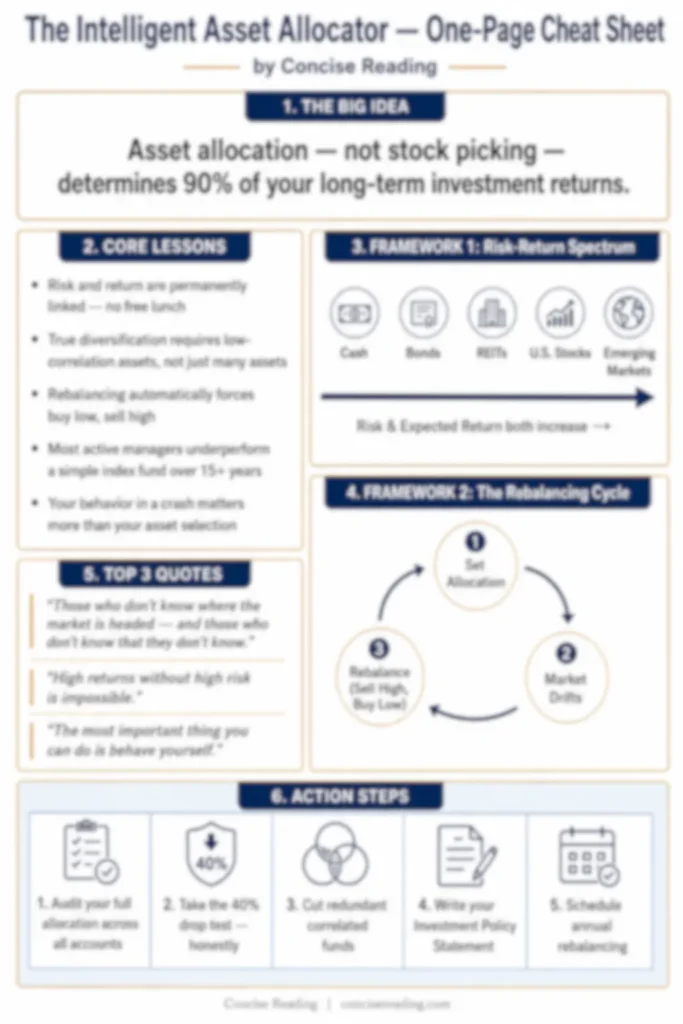
Premium Cheat Sheet Preview
About the Author
William J. Bernstein is a retired neurologist who taught himself portfolio theory by reading academic finance journals — with no Wall Street background and nothing to sell. He holds a PhD in Chemistry and an MD, and later co-founded Efficient Frontier Advisors, a fee-only investment firm. His conclusions are trusted precisely because they come from a scientist following data, not a financial industry insider protecting commissions. His other landmark book, The Four Pillars of Investing, is considered required reading in DIY investing communities worldwide.
Read our full Bernstein author profile or explore related summaries: A Random Walk Down Wall Street | The Bogleheads’ Guide to Investing | The Little Book of Common Sense Investing
Power Quote From the Book:
“There are two kinds of investors, be they large or small: those who don’t know where the market is headed, and those who don’t know that they don’t know.”
— William J. Bernstein, The Intelligent Asset Allocator
Who This Summary is For
- This is for you if…
- You are a self-directed investor managing your own 401(k), IRA, or brokerage account and you suspect your allocation was never actually thought through
- You want a proven, evidence-based framework for building a portfolio — not tips, predictions, or stock picks
- You are financially literate enough to be dangerous but haven’t yet studied portfolio construction at a serious level
- You have made at least one emotional investing decision — panic-sold, chased a hot stock, ignored rebalancing — and you want a system that prevents the next one
- You have read foundational books like The Psychology of Money or Rich Dad Poor Dad and are ready for the next level of investing knowledge
- Skip this if…
- You are looking for stock recommendations, market predictions, or short-term trading tactics. This book and this summary are about long-term portfolio architecture — not market timing. If that’s not what you need right now, browse our full library to find a better fit.
Testimonials
We’re building something worth talking about — and we’d love to hear from you. If you read this summary (free or premium), drop a comment below and share what landed for you, what changed how you think, or what question it raised that you hadn’t considered before. Real feedback from real readers is the most useful thing on any page like this — and your comment helps the next investor who lands here decide whether this is worth their time. We read every one.
Already a reader? You might also enjoy our Investing Playbook — which synthesizes 10 investing classics, including this one, into a single unified system.
The Intelligent Asset Allocator took William Bernstein years of independent research across hundreds of academic papers to write. The premium summary gives you the complete system — every framework, every action step, a critical analysis, and a one-page cheat sheet — in 22 focused pages.
Not sure where this fits in the bigger picture? Visit our Start Here page or browse the Wall Street & Financial Markets and Investing Fundamentals categories to build your full reading plan.
Related Summaries
If The Intelligent Asset Allocator resonated with you, these three summaries go deeper into the same territory:
- A Random Walk Down Wall Street — The definitive case for why passive, indexed investing beats active management over time. Pairs directly with Bernstein’s framework.
- The Psychology of Money — Where Bernstein is quantitative, Morgan Housel is behavioral. This summary covers why human psychology destroys returns — and how to protect yourself from your own decisions.
- The Bogleheads’ Guide to Investing — The most practical, step-by-step application of the principles Bernstein lays out. If you want to go from theory to implementation, this is the next read.