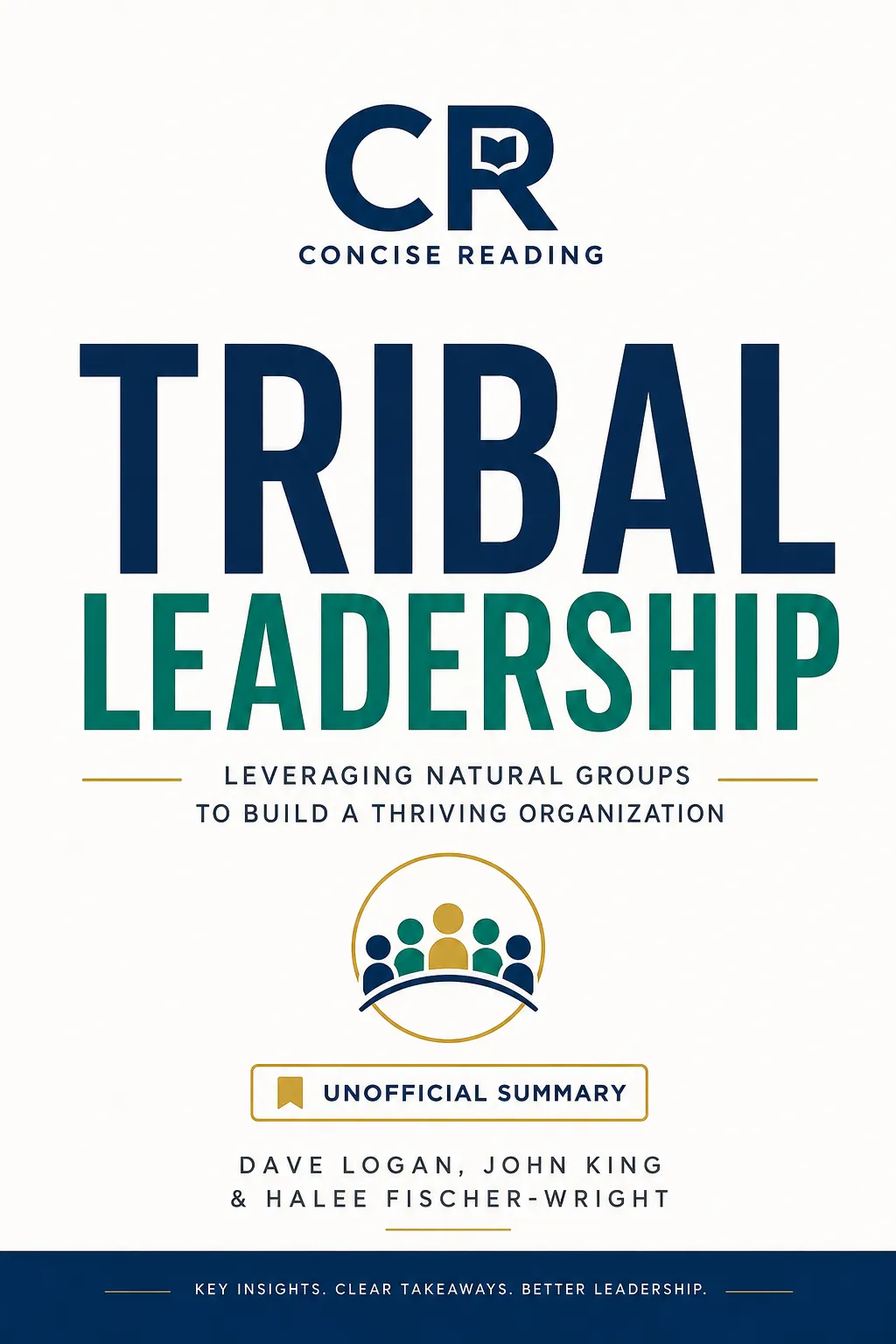
Tribal Leadership by Dave Logan, John King & Halee Fischer-Wright — Summary & Key Lessons
What this book will teach you in the next 10 minutes — and why it matters for your team’s performance, culture, and long-term results.
Based on 10 years of research across 24,000+ people. Summarized for leaders who want the insight without the 320-page investment.
Book Snapshot
- Author – Dave Logan, John King, Halee Fischer-Wright
- Category – Leadership & Organizational Culture
- Original Book – ~ 320 pages | ~6–7 hours average read time
- Free Summary – 08 pages
- Premium Summary – 32 pages | ~35–45 minutes estimated read time
The Big Idea
Every organization runs on tribes — informal groups of 20 to 150 people — and every tribe is stuck at one of five cultural stages that determine how much people care, collaborate, and perform. The stage your tribe occupies isn’t a personality problem or a hiring problem. It’s a language problem. The words your team habitually uses reveal — and reinforce — their cultural ceiling. Change the dominant language patterns, and you change the stage. Change the stage, and performance, loyalty, and innovation follow. Most culture initiatives fail because they target strategy or individuals. Tribal Leadership targets the root cause: the tribe itself.
What You’ll Learn — Key Lessons Preview
- Diagnose exactly which of the five cultural stages your team is operating at — using nothing more than the language you hear in everyday conversations and meetings
- Understand why nearly half of all workplace teams are stuck in a culture of quiet, individual competition — and what it’s costing your organization in performance, trust, and retention
- Apply the precise leadership moves that shift a tribe from “I’m great” to “we’re great” — without motivational speeches, retreats, or expensive culture consultants
- Build a network of relationships that sustains your culture even when you’re not in the room — so your leadership impact outlasts your direct involvement
- Discover the Noble Cause framework — the only thing that makes high-performing individuals willingly give up personal competitive advantage for a shared team mission
Free vs Premium Comparison
| Free – $0 | Premium – $4.99 (Recommended) |
| ➡ Book Snapshot ➡ The Big Idea ➡ Key Lessons ➡ Power Quotes ➡ 08 Pages | ✔ Everything in free + ✔ Full Chapter Breakdown ✔ Key frameworks & diagrams ✔ Action steps ✔ Critical analysis ✔ One-page cheat sheet ✔ 32 pages |
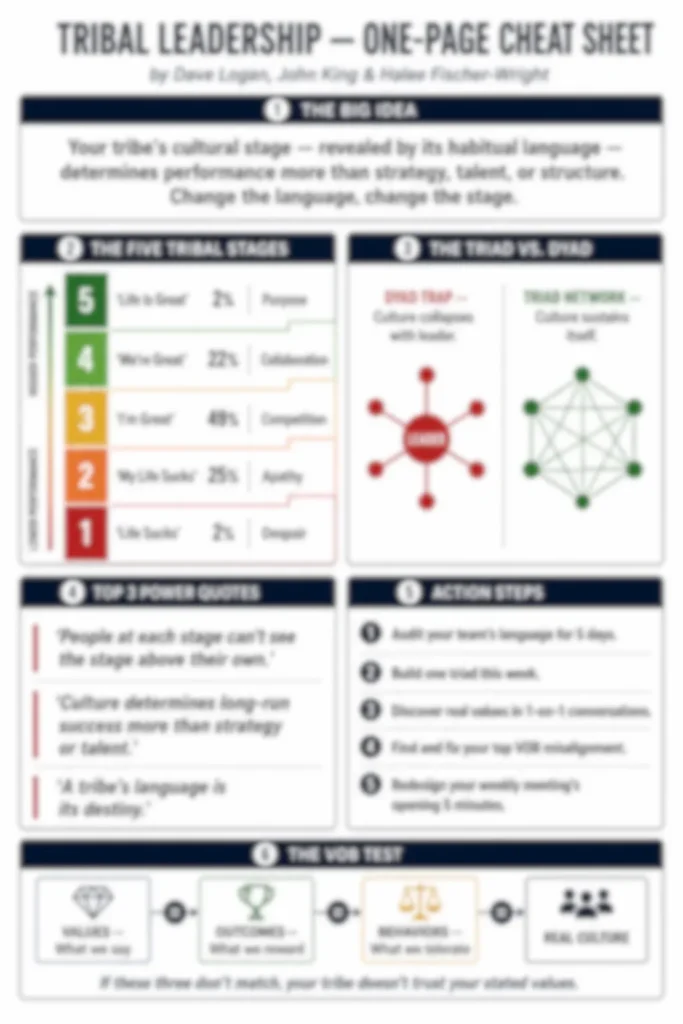
Premium Cheat Sheet Preview
About the Author
Dave Logan is a clinical professor at USC Marshall School of Business and co-founder of CultureSync, a management consulting firm. He led a decade-long research study of more than 24,000 people to produce the evidence base behind this book. Co-authors John King and Halee Fischer-Wright bring hands-on consulting experience and frontline healthcare leadership respectively, making Tribal Leadership one of the most research-grounded and practically tested books in organizational culture. Learn more about other books from top leadership thinkers in our Leadership & Management library.
Power Quote From the Book:
“Culture — not strategy, not tactics, not even talent — determines the long-run success of any organization.”
— Dave Logan, Tribal Leadership
Who This Summary is For
- This is for you if…
- You are a manager or founder who has hired talented people and still can’t figure out why the team underperforms
- You are an HR or People Ops leader who has run culture initiatives that produced slide decks but zero behavioral change
- You want a precise, research-backed vocabulary for diagnosing and fixing team dynamics — not another generic framework about “psychological safety”
- You are scaling a team past 20 people and feel the culture starting to slip out of your control
- You want to understand why your best individual performers aren’t translating into a high-performing collective
- Skip this if…
- You are a solo operator with no team, or you are looking for an instant fix — this framework rewards honest self-diagnosis and patient, relational leadership. It is not a hack.
Testimonials
Have you read this summary — free or premium? We’d genuinely like to know what landed for you. Drop a comment below: which stage does your current team operate at, and what shift are you going to make first? Your experience helps other leaders find the insight that matters most to them — and it helps us keep making these summaries sharper. Every comment, reaction, and piece of honest feedback is read by a real person here at Concise Reading.
Tribal Leadership took Dave Logan and his co-authors ten years and 24,000 research subjects to write. The premium summary gives you the complete diagnostic system, five actionable frameworks, a chapter-by-chapter breakdown, and a one-page cheat sheet you can use this week — in under 45 minutes, for $4.99.
If culture is the variable that most determines your team’s long-run success — and the research says it is — this is the lowest-cost, highest-leverage investment you will make this month. While you’re here, explore the full Leadership & Management Pack which includes 14 of the most important leadership books ever written, or browse the Leadership Playbook for a synthesized, cross-book system you can implement immediately.
Related Summaries
- The Culture Code — Daniel Coyle – Goes inside the world’s highest-performing groups (Navy SEALs, Pixar, the San Antonio Spurs) to decode the specific behaviors that build psychological safety and cohesion. The perfect companion to Tribal Leadership — where Logan gives you the stages, Coyle gives you the daily habits.
- Leaders Eat Last — Simon Sinek – Explores why some leaders build environments where people feel safe and give their best, while others create cultures of fear and self-preservation. Directly reinforces the Stage 3-to-4 transition — moving from “I” to “we” — with deep biological and organizational evidence.
- The Five Dysfunctions of a Team — Patrick Lencioni – A practical, story-driven diagnosis of why teams fail — absence of trust, fear of conflict, lack of commitment, avoidance of accountability, inattention to results. Maps closely onto the tribal stage model and gives you a dysfunction-by-dysfunction repair framework.