You Can Be a Stock Market Genius by Joel Greenblatt — Summary & Key Lessons
What this book will teach you in the next 10 minutes — and why it matters for finding investments the market has mispriced in your favor.
Part of the Investing Fundamentals collection at Concise Reading — where serious investors come to read smarter.
Book Snapshot
- Author – Joel Greenblatt
- Category – Investing / Value Investing / Special Situations
- Original Book – ~ 240 pages — approximately 5–6 hours average read time
- Free Summary – 08 pages
- Premium Summary – 31 pages — approximately 35–45 minutes estimated read time
The Big Idea
Most investors lose not because they’re uninformed — but because they compete in the wrong places. Joel Greenblatt’s argument is precise: there are specific corporate events — spinoffs, restructurings, mergers, bankruptcies — where the market temporarily prices securities far below their real value, not due to poor analysis, but due to structural mechanics. Institutions are forced to sell. Funds can’t hold what doesn’t fit their mandate. The result is a window of mispricing that a prepared individual investor can walk through. This is not a theory. Greenblatt ran it live for a decade and generated roughly 50% annual returns doing exactly this. The edge isn’t genius — it’s knowing where to look when everyone else looks away. Explore the full Wall Street & Financial Markets library to see related titles.
What You’ll Learn — Key Lessons Preview
- Why spinoffs consistently beat the market — and how to identify the ones worth buying before institutional selling pressure clears
- How to read a proxy statement to find insider ownership signals that tell you more than any analyst report ever will
- Why owning six focused, high-conviction positions beats a diversified portfolio of forty mediocre ones — and how to build that kind of concentration without reckless risk
- How to evaluate merger securities, rights offerings, and restructuring situations that Wall Street won’t touch — and turn that neglect into your advantage
- The exact mental framework for deciding whether a complicated corporate situation is a hidden opportunity or a genuine trap
If you want more of the foundational context behind these ideas, our summary of The Intelligent Investor and One Up on Wall Street pair directly with this one — Greenblatt builds on both.
Free vs Premium Comparison
| Free – $0 | Premium – $4.99 (Recommended) |
| ➡ Book Snapshot ➡ The Big Idea ➡ Key Lessons ➡ Power Quotes ➡ 08 Pages | ✔ Everything in free + ✔ Full Chapter Breakdown ✔ Key frameworks & diagrams ✔ Action steps ✔ Critical analysis ✔ One-page cheat sheet ✔ 31 pages |
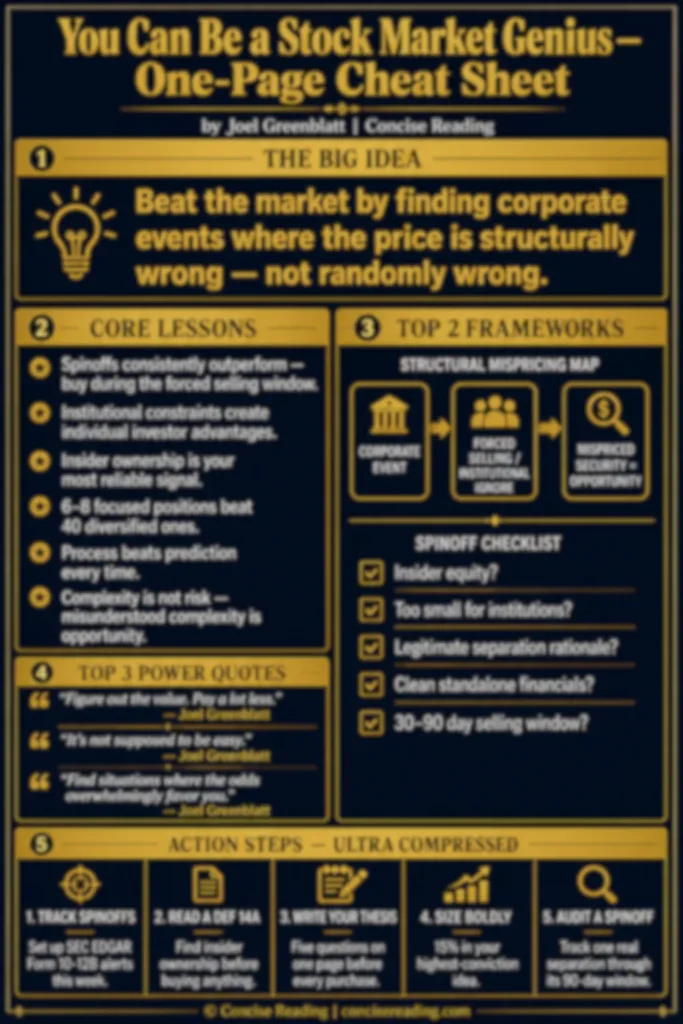
Premium Cheat Sheet Preview
About the Author
Joel Greenblatt founded Gotham Capital in 1985 and ran it for a decade, generating annualized returns of approximately 50% — one of the most remarkable live track records in investment history. He later taught value investing at Columbia Business School in the tradition of Benjamin Graham, and created the “Magic Formula” strategy detailed in his follow-up book. Everything in this book is drawn directly from strategies he used with real capital, in real markets, over real time.
Power Quote From the Book:
“The secret to investing is to figure out the value of something — and then pay a lot less.”
— Joel Greenblatt
Who This Summary is For
- This is for you if…
- You are a self-directed investor who has read the basics and wants a genuine, research-driven edge beyond index funds — see our full Investing Fundamentals category for where this fits in your reading path
- You want to understand how corporate events like spinoffs and restructurings create mispriced opportunities — and you are willing to do the research to find them
- You are tired of competing in the most crowded, most efficiently priced corners of the market and want to know where the crowd isn’t looking
- You are a student of value investing who wants to go deeper than Graham’s principles into specific, actionable event-driven strategies
- You manage your own portfolio and want a framework that tells you not just what to buy, but where to find ideas in the first place
- Skip this if…
- You want a passive strategy that requires no research — this book is for active investors who enjoy the work. If that’s where you are right now, our summary of The Little Book of Common Sense Investing or The Bogleheads’ Guide to Investing is a better fit.
Testimonials
Every summary at Concise Reading is written to be worth your time — not just a retelling of what’s already on the back cover. If this summary helped you think differently about where investment opportunities actually live, we’d genuinely like to hear it. Drop your thoughts, questions, or key takeaways in the comments below. Your feedback helps other readers decide whether this is the right book for their stage of the investing journey — and it helps us keep making these summaries better. We read every comment.
You Can Be a Stock Market Genius took Joel Greenblatt a decade of live investing and a career of rigorous research to distill — the premium summary gives you the complete system, every framework, and five specific action steps you can execute this week, in 31 pages.
At $4.99, it costs less than a cup of coffee and replaces six hours of reading. If you are serious about finding an investing edge that most retail investors will never bother to develop, the premium version is the most efficient next step you can take today.
Not ready to go premium yet? Browse the rest of the Wall Street & Financial Markets library, explore the full Investing Playbook, or visit our Library to find your next read. And if you want to understand how Concise Reading summaries are built, Start Here.
Related Summaries
- One Up on Wall Street — Peter Lynch’s guide to finding great investments in everyday life, with a similarly approachable, individual-investor-first mindset that complements Greenblatt’s special situations focus perfectly.
- The Intelligent Investor — Benjamin Graham’s foundational text on value investing and margin of safety. Greenblatt builds directly on Graham’s framework; reading both together gives you the philosophical foundation and the tactical edge.
- Common Stocks and Uncommon Profits — Philip Fisher’s deep dive into qualitative analysis of businesses. Where Greenblatt focuses on situations, Fisher focuses on business quality — together they cover both sides of the superior investment decision.