Good to Great by Jim Collins — Summary & Key Lessons
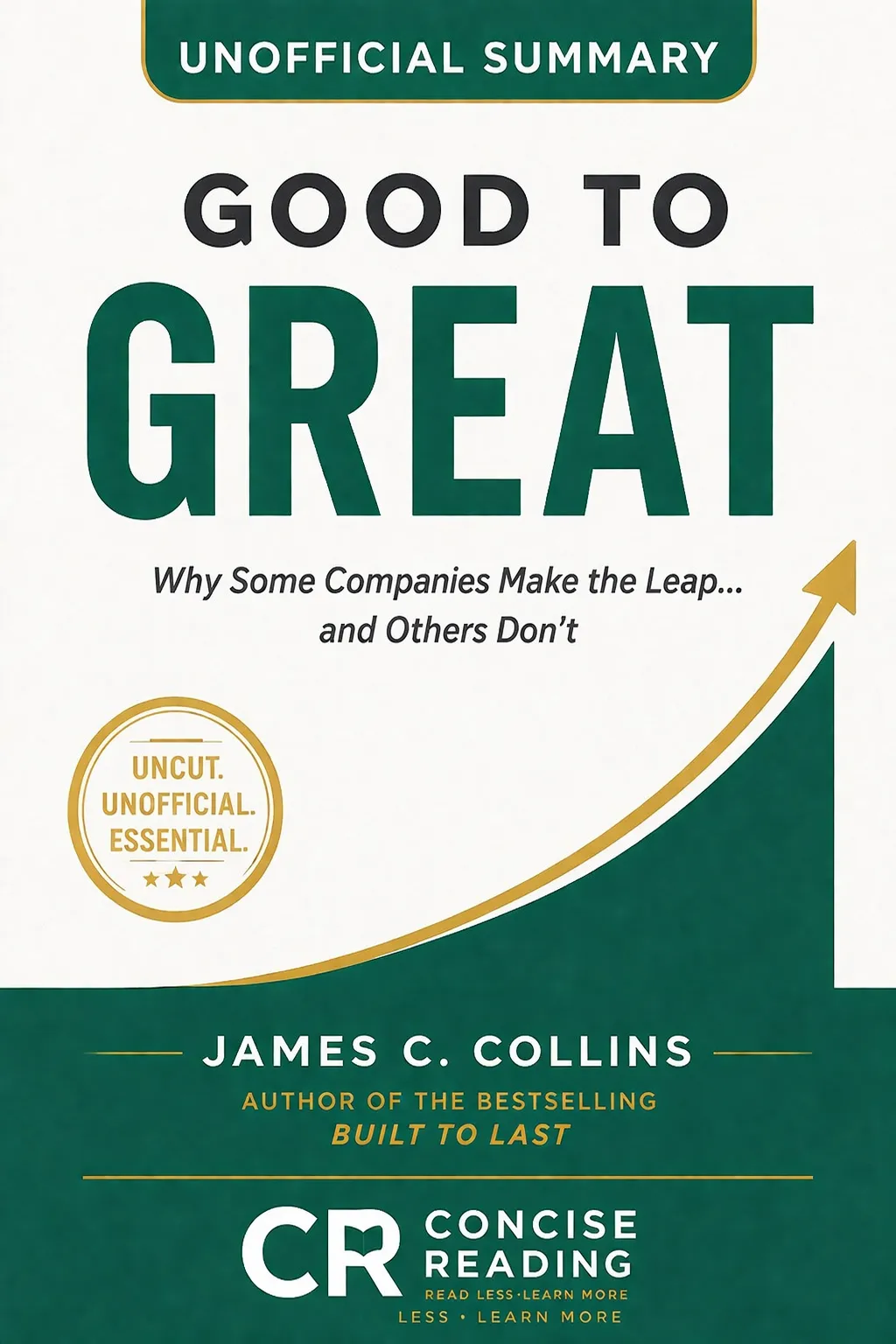
What this book will teach you in the next 10 minutes — and why it matters for building a business that actually lasts.
Based on a 5-year study of 1,435 companies. Written by a Stanford researcher. Still the most cited business strategy book of the past 25 years.
Book Snapshot
- Author – James C. Collins
- Category – Business Strategy & Leadership
- Original Book – ~ 320 pages | ~ 6–8 hours average read time
- Free Summary – 08 pages
- Premium Summary – ~ 24 pages | ~ 35–45 minutes read time
The Big Idea
Most businesses never become great — not because they fail, but because being good is comfortable enough to stop trying. Jim Collins and his research team spent five years systematically studying 28 companies to find out what actually separates the great from the merely good. What they found was not charismatic leadership, lucky timing, or brilliant strategy. It was three ruthlessly simple disciplines: getting the right people in place before deciding on direction, confronting brutal reality without losing hope, and focusing relentlessly on the single thing your organization could genuinely be the best in the world at. Greatness, it turns out, is not a circumstance. It is a choice — made over and over again, quietly, over years.
What You’ll Learn — Key Lessons Preview
- Why “good” is actively killing your business — and the specific mindset shift that breaks you out of the trap of comfortable mediocrity
- The one hiring principle that predicts long-term success — great companies get the right people on the bus before they figure out where the bus is going, and the difference in outcome is dramatic
- How to find your Hedgehog Concept — the single intersection of what you’re passionate about, what you could be world-class at, and what drives your economic engine — and why most businesses are operating outside it right now
- The Stockdale Paradox: how to lead through a crisis without slipping into either naive optimism or paralysing cynicism — a technique used by POW survivors and Fortune 500 CEOs alike
- Why breakthroughs are an illusion — and how the Flywheel model explains why consistent, compounding effort in one direction always beats bold pivots, flashy launches, and strategy overhauls
Free vs Premium Comparison
| Free – $0 | Premium – $4.99 (Recommended) |
| ➡ Book Snapshot ➡ The Big Idea ➡ Key Lessons ➡ Power Quotes ➡ 08 Pages | ✔ Everything in free + ✔ Full Chapter Breakdown ✔ Key frameworks & diagrams ✔ Action steps ✔ Critical analysis ✔ One-page cheat sheet ✔ 24 pages |
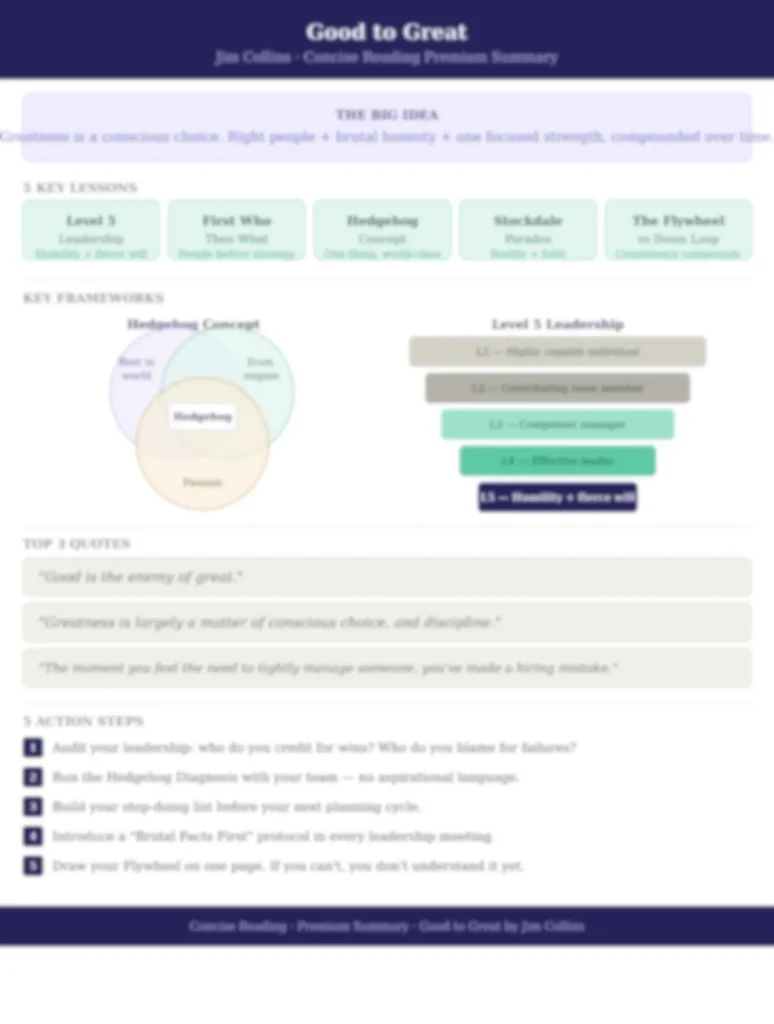
Premium Cheat Sheet Preview
About the Author
Jim Collins is a researcher, author, and faculty member at Stanford Graduate School of Business whose career has been dedicated entirely to one question: what makes great companies endure? He is best known for Good to Great and its companion volume Built to Last, both of which are based on rigorous multi-year comparative research — not interviews or opinion. His work has sold over 10 million copies worldwide and is required reading in business schools across the globe.
Power Quote From the Book:
“Good is the enemy of great. And that is one of the key reasons why we have so little that is great. We don’t have great schools, principally because we have good schools. We don’t have great government, principally because we have good government. Few people attain great lives, in large part because it is just so easy to settle for a good life.” — Jim Collins, Good to Great
Who This Summary is For
- This is for you if…
- You are a founder, CEO, or senior manager who has built a functioning business and suspects it has quietly plateaued — but cannot put your finger on exactly why
- You want a framework for making long-term strategic decisions that compound, instead of reacting to whatever the market throws at you each quarter
- You are hiring for key roles right now and want a concrete, research-backed standard for what “the right person” actually means — beyond skills and experience
- You want to understand why some businesses seem to build unstoppable momentum over time while others stay permanently stuck at the same level despite genuine effort
- You have read business books before and are tired of motivational fluff — you want frameworks that are based on data, not anecdotes
- If you are drawn to books like Start with Why by Simon Sinek, Principles by Ray Dalio, or The Hard Thing About Hard Things by Ben Horowitz — you will find Good to Great sits comfortably alongside them as essential reading for anyone building something serious.
- Skip this if…
- You are in the first 6–12 months of starting a business and still figuring out your model. The frameworks in this book require an existing organization with some track record to be fully actionable — come back to this one once you have traction. If you need early-stage guidance, our Startup & Entrepreneurship Pack or the Startup Playbook may serve you better right now.
Social Proof
We are building the Good to Great summary community here at Concise Reading, and we want to hear from you. If you have read this summary — free or premium — scroll to the comments below and tell us: which framework hit hardest for your situation? Was it the Hedgehog Concept, the Level 5 Leadership audit, or something else? Your experience helps other readers decide whether this is the right summary for them — and it helps us make every future summary better. Every comment gets read. We respond to all of them.
(You can also browse what readers are saying about other summaries in our library — or check our FAQs if you have questions about what the premium version includes before you decide.)
Good to Great took Jim Collins and his team five years of full-time research across 1,435 companies to write. The premium summary gives you the complete system — every framework, every chapter, four download-ready visual diagrams, five discomfort-inducing action steps, a forensic critical analysis, and a one-page cheat sheet worth pinning above your desk — in under 45 minutes.
Related Summaries
- Built to Last — Jim Collins & Jerry Porras (The prequel to Good to Great. Explores what makes visionary companies endure across generations.)
- Start with Why — Simon Sinek (Complements the Hedgehog Concept perfectly — understanding your “Why” is the foundation of lasting differentiation.)
- Principles — Ray Dalio (Another research-backed, systems-level approach to building organizations and making decisions that compound over time.)
[…] Good to Great in our Free Summaries […]
[…] our summaries of other popular books such as The Psychology of Money, The Intelligent Investor, Good to Great, and Antifragile, which are available in our Free Summaries […]
[…] can develop these abilities further through insights from Never Split the Difference, Good to Great, and Start with […]
[…] Good to Great […]
[…] and business thinkers worldwide and complement concepts found in books like Zero to One, Good to Great, and The Lean […]
[…] principles align with many ideas discussed in books like Atomic Habits and Good to Great, which emphasize the power of consistent effort and disciplined […]
[…] powerful insights like those found in summaries such as Outliers, The Psychology of Money, and Good to Great, then this book will transform how you think about […]
[…] that improve decision-making, explore more summaries in our Library, including popular titles like Good to Great, The Lean Startup, and Zero to […]
[…] Good to Great […]
[…] you enjoy business classics like Good to Great, Built to Last, and The Lean Startup, you can explore more summaries in our Free Summaries library […]
[…] Good to Great […]
[…] if you’ve read Good to Great or Start with Why, without visibility, your business won’t […]
[…] Instead of doing everything, specialize in one niche—something also emphasized in Good to Great. […]
[…] immediately, you can explore similar insights in our Free Summaries section, where books like Good to Great, The Lean Startup, and Measure What Matters expand on execution, systems, and […]
[…] idea is also reinforced in Good to Great and Built to Last, which you can find in our Business Development & Entrepreneurship […]
[…] managed carefully. This concept aligns strongly with ideas found in books like The Lean Startup and Good to Great available in our Free […]
[…] The success of fair systems shows that trust is a competitive advantage. This aligns with ideas from Good to Great. […]
[…] Reading, we simplify such complex ideas into actionable insights. Just like our summaries of Good to Great and Blue Ocean Strategy available in our Free Summaries, this summary helps you understand strategy […]
[…] to business optimization strategies discussed in Good to Great, improvement creates […]