
Customer Centricity by Peter Fader — Summary & Key Lessons
What this book will teach you in the next 10 minutes — and why it matters for how you spend every marketing dollar from here forward.
Summarized by the team at Concise Reading — built for people who apply what they read, not just collect it.
Book Snapshot
- Author – Peter Fader
- Category – Marketing Strategy / Customer Analytics / Business Growth
- Original Book – ~ 128 pages | Average read time: 3–4 hours
- Free Summary – 08 pages
- Premium Summary – 30 pages | Estimated read time: 35–45 minutes
The Big Idea
One short paragraph.
What You’ll Learn — Key Lessons Preview
- 3-5 Bullet Lessons.
Free vs Premium Comparison
| Free – $0 | Premium – $4.99 (Recommended) |
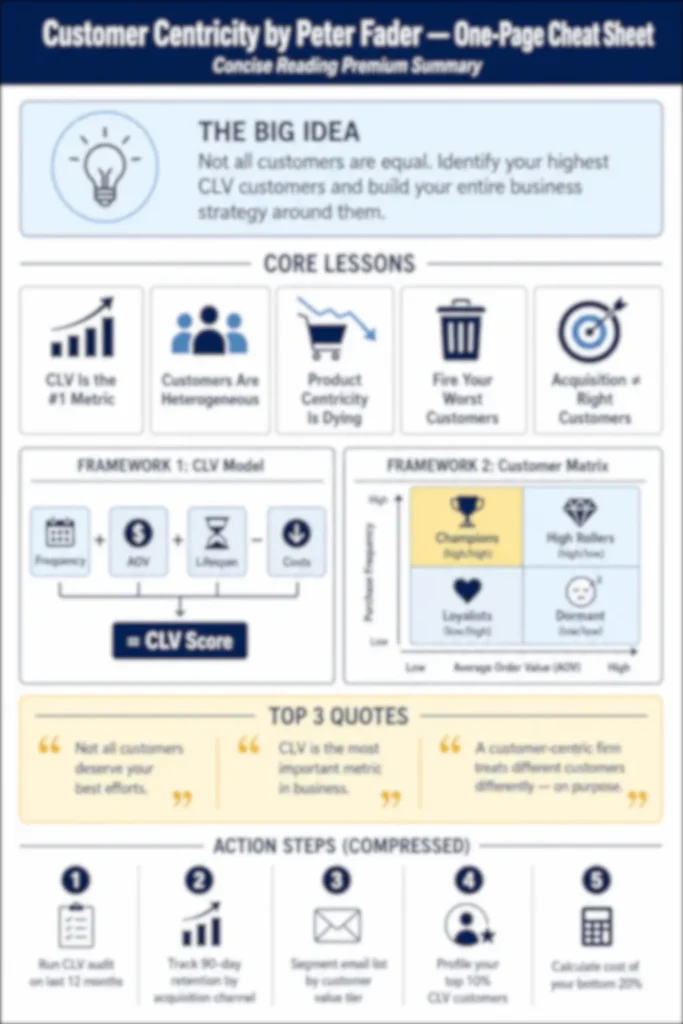
| ➡ Book Snapshot ➡ The Big Idea ➡ Key Lessons ➡ Power Quotes ➡ 08 Pages | ✔ Everything in free + ✔ Full Chapter Breakdown ✔ Key frameworks & diagrams ✔ Action steps ✔ Critical analysis ✔ One-page cheat sheet ✔ 30 pages |
Premium Cheat Sheet Preview
About the Author
Peter Fader is a Professor of Marketing at the Wharton School, University of Pennsylvania, and one of the world’s leading researchers in Customer Lifetime Value and buyer behavior modeling. He co-founded Zodiac, a customer analytics company acquired by Nike in 2018, and later co-founded Theta Equity Partners, which uses CLV models to value public companies. His academic work has been cited thousands of times and directly shaped how major corporations build customer strategy. When Fader makes an argument, it is not opinion — it is backed by thirty years of quantitative research.
Power Quote From the Book:
“Not all customers deserve your best efforts.”
— Peter Fader, Customer Centricity
Who This Summary is For
- This is for you if…
- You are a business owner or founder who is spending on customer acquisition but cannot clearly explain which segments are actually profitable
- You are a marketer or CMO who needs a rigorous, data-grounded framework for justifying retention investment over short-term acquisition spend
- You are building a subscription, membership, or any recurring revenue model and want to understand the metric that should be driving every decision you make
- You want to understand what Amazon, Starbucks, and Nike actually did differently in how they think about customers — and how to apply the same logic at your scale
- You have read books like Building a StoryBrand or This Is Marketing and want the analytical layer underneath the marketing strategy
- Skip this if…
- You are looking for a customer service or customer experience playbook — this book is about business architecture and analytics, not frontline service tactics. If your business is pre-revenue with no customer data yet, bookmark this for six months from now when the framework becomes immediately actionable.
Testimonials
This summary was built to be used, not just read. If you have gone through the free or premium version, we would genuinely like to know what landed for you — which lesson shifted how you think, which framework you are already applying, or which idea you are bringing to your next strategy meeting. Drop your experience in the comments below. Your feedback helps other readers decide whether this summary is worth their time, and it helps us keep building summaries that are actually worth reading. The first few readers always set the tone — be one of them.
Peter Fader spent over thirty years researching, modeling, and field-testing everything in this book. The premium summary gives you the complete system — every framework, every action step, and a one-page cheat sheet you can implement this week — in under 45 minutes.
If you found the free version useful, the premium version is where it becomes a working strategy. At $4.99, it costs less than a cup of coffee and is likely worth more than your next full-day strategy session.
And if you are building a complete marketing and business strategy toolkit, explore the Marketing Mastery Pack — which bundles 15 of the most important marketing strategy summaries, including this one, at a fraction of the individual price. Or go deeper with The Marketing Playbook, which synthesizes 12 marketing masterworks — including the ideas in Customer Centricity — into one unified, actionable system.
Related Summaries
- Building a StoryBrand by Donald Miller — If Customer Centricity teaches you who to focus on, StoryBrand teaches you how to talk to them in a way that actually converts. Essential pairing for any business owner.
- This Is Marketing by Seth Godin — Godin’s central thesis — that great marketing is about finding the smallest viable audience and serving them deeply — is essentially customer centricity applied to brand building. Complementary at every level.
- Contagious by Jonah Berger — Once you’ve identified your highest-value customers, the next question is how to get more of them. Berger’s research on why things spread gives you the tools to turn your best customers into your best acquisition channel.
[…] mindset aligns with ideas from Start with Why and Customer Centricity, which you can explore in our Best Sellers […]