
The Black Swan by Nassim Nicholas Taleb — Summary & Key Lessons
What this book will teach you in the next 10 minutes — and why it matters for every financial decision, business bet, and long-term plan you’ll ever make.
Part of the Concise Reading Library — business & money book summaries, written for people who act on what they read.
Book Snapshot
- Author – Nassim Nicholas Taleb
- Category – Risk & Decision-Making, Behavioral Economics, Philosophy of Probability
- Original Book – ~ 480 pages · ~ 9–11 hours average read time
- Free Summary – 08 pages
- Premium Summary – 32 pages · ~ 45–55 minutes read time
The Big Idea
The world isn’t shaped by predictable trends. It’s shaped by rare, extreme events that nobody saw coming — and that everyone claims to have predicted the moment they’re over. Nassim Taleb calls these Black Swans. The real problem isn’t that they’re rare. It’s that our entire financial, strategic, and intellectual infrastructure is built on the false assumption that tomorrow will look like yesterday. The moment it doesn’t — a market crash, a technological disruption, a pandemic — that infrastructure collapses. This book doesn’t just diagnose the problem. It gives you a framework for surviving, and even profiting from, the unpredictable.
What You’ll Learn — Key Lessons Preview
- Why your risk models are lying to you — and the specific condition under which every bell curve, forecast, and historical average becomes dangerously useless
- How to identify which domain you’re actually operating in — and why applying the wrong mental model to your investments or business is the single most expensive mistake most people make
- The Turkey Problem — and how to stop being the turkey — understand why long streaks of stability are often the most dangerous signal of all, not a sign of safety
- The Barbell Strategy for your money and career — a concrete, structural framework for positioning yourself to survive any Black Swan and profit when the next one hits in your favor
- Why the “lessons” you’re learning from success stories are probably fiction — and how survivorship bias and the Narrative Fallacy are actively making you less prepared, not more
Free vs Premium Comparison
| Free – $0 | Premium – $4.99 (Recommended) |
| ➡ Book Snapshot ➡ The Big Idea ➡ Key Lessons ➡ Power Quotes ➡ 08 Pages | ✔ Everything in free + ✔ Full Chapter Breakdown ✔ Key frameworks & diagrams ✔ Action steps ✔ Critical analysis ✔ One-page cheat sheet ✔ 32 pages |
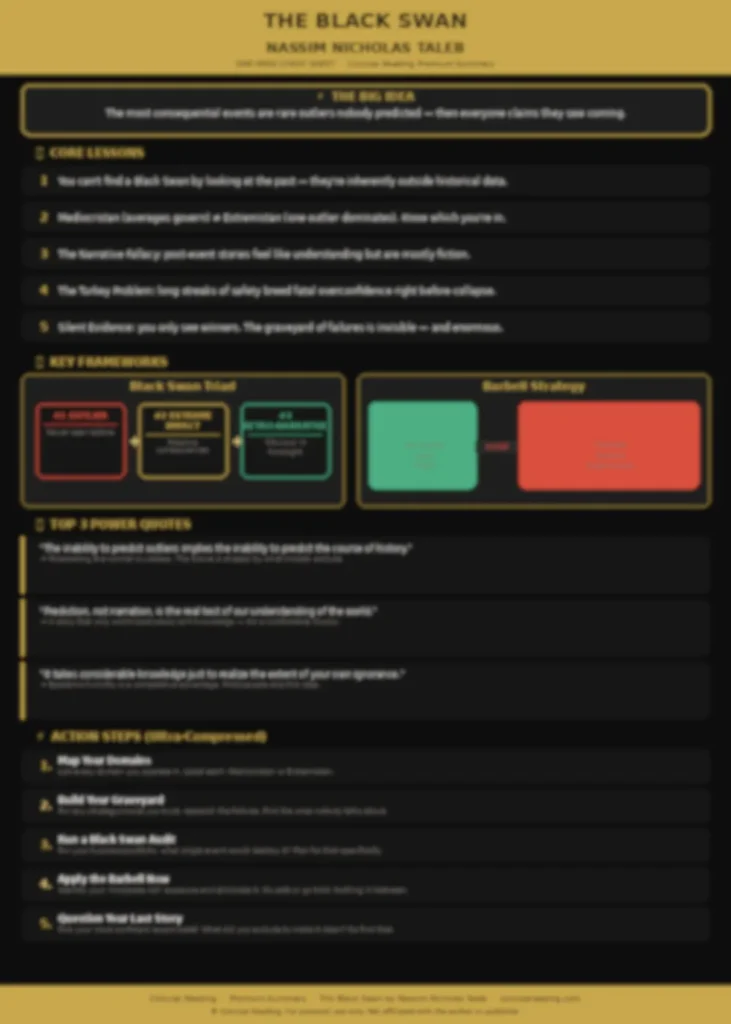
Premium Cheat Sheet Preview
About the Author
Nassim Nicholas Taleb spent over 20 years as a derivatives trader on Wall Street before becoming the world’s leading thinker on uncertainty and risk. He holds a PhD in Management Science and has served as Distinguished Professor of Risk Engineering at NYU. His Incerto series — including Antifragile and Fooled by Randomness — is among the most cited works in modern finance and strategic thinking. The Black Swan spent 36 weeks on the New York Times bestseller list and has sold over 3 million copies worldwide.
Power Quote From the Book:
“The inability to predict outliers implies the inability to predict the course of history.” — Nassim Nicholas Taleb, The Black Swan
Who This Summary is For
- This is for you if…
- You are an investor, trader, or portfolio manager who relies on historical data, models, or expert forecasts to make financial decisions
- You are an entrepreneur or business owner with a growth plan built on projections — and no serious contingency for catastrophic disruption
- You want to understand why the 2008 financial crisis, COVID-19, and every major market shock were “obvious in hindsight” to the people who never predicted them
- You are a strategic thinker, executive, or consultant who makes high-stakes, hard-to-reverse decisions and wants a more honest framework for uncertainty
- You’ve read Thinking, Fast and Slow or The Psychology of Money and want the risk and uncertainty argument taken further and harder
- Skip this if…
- You’re looking for a step-by-step tactical playbook with clean checklists and immediate to-do lists. Taleb is a philosopher of uncertainty, not a productivity coach — and he’s deliberately provocative about it. If you want the fully distilled, action-ready version of his ideas, the Premium Summary does that work for you. If you want zero philosophical depth, this may not be your starting point — though browsing our Investing Fundamentals Pack or the Wealth Playbook might be a better fit.
Social Proof
We’re building something together at Concise Reading — and your experience with this summary matters. If The Black Swan summary changed how you think about risk, uncertainty, or how you make decisions, we’d genuinely like to hear about it. Leave a comment below: What was the single idea that hit hardest? What are you going to do differently? Real reader responses help other people decide whether this is the summary they need next — and they help us make every future summary sharper. No fluff. Just tell us what landed.
The Black Swan took Nassim Nicholas Taleb two decades of trading, research, and intellectual refinement to write. The Premium Summary delivers his complete framework — every key chapter, all five mental models with visual diagrams, five curated power quotes, five discomfort-inducing action steps, a full critical analysis, and a one-page cheat sheet you’ll want to keep on your desk — in under an hour. If that ratio doesn’t make the decision obvious, nothing will.
New to Concise Reading? Start here to understand how our summaries are structured — or browse the full library of summaries by category.
Related Summaries
These three summaries pair directly with The Black Swan:
- Antifragile — Nassim Nicholas Taleb — Taleb’s follow-up masterpiece. Where The Black Swan diagnoses the problem of fragility, Antifragile gives you the complete system for building a life and business that gains from disorder and volatility.
- Thinking, Fast and Slow — Daniel Kahneman — The definitive deep dive into the cognitive biases and mental shortcuts that make us so vulnerable to Black Swans. Kahneman and Taleb are the two most important thinkers on human irrationality — read them together.
- The Psychology of Money — Morgan Housel — Applies the lessons of randomness, uncertainty, and humility directly to personal finance and investing. Practical, accessible, and directly actionable for anyone building wealth in an unpredictable world.
[…] The Black Swan – about rare and unpredictable events with massive consequences (also available in our Free Summaries) […]
[…] The Black Swan […]
[…] clear lessons you can apply immediately—alongside connections to other powerful summaries like The Black Swan and Antifragile, both available in your Free Summaries […]
[…] you’ve explored books like Antifragile or The Black Swan in our collection, you’ll see how uncertainty creates […]
[…] you’ve explored books like The Black Swan or Antifragile, this summary will complement your understanding of risk, systems, and long-term […]