Basic Economics by Thomas Sowell — Summary & Key Lessons
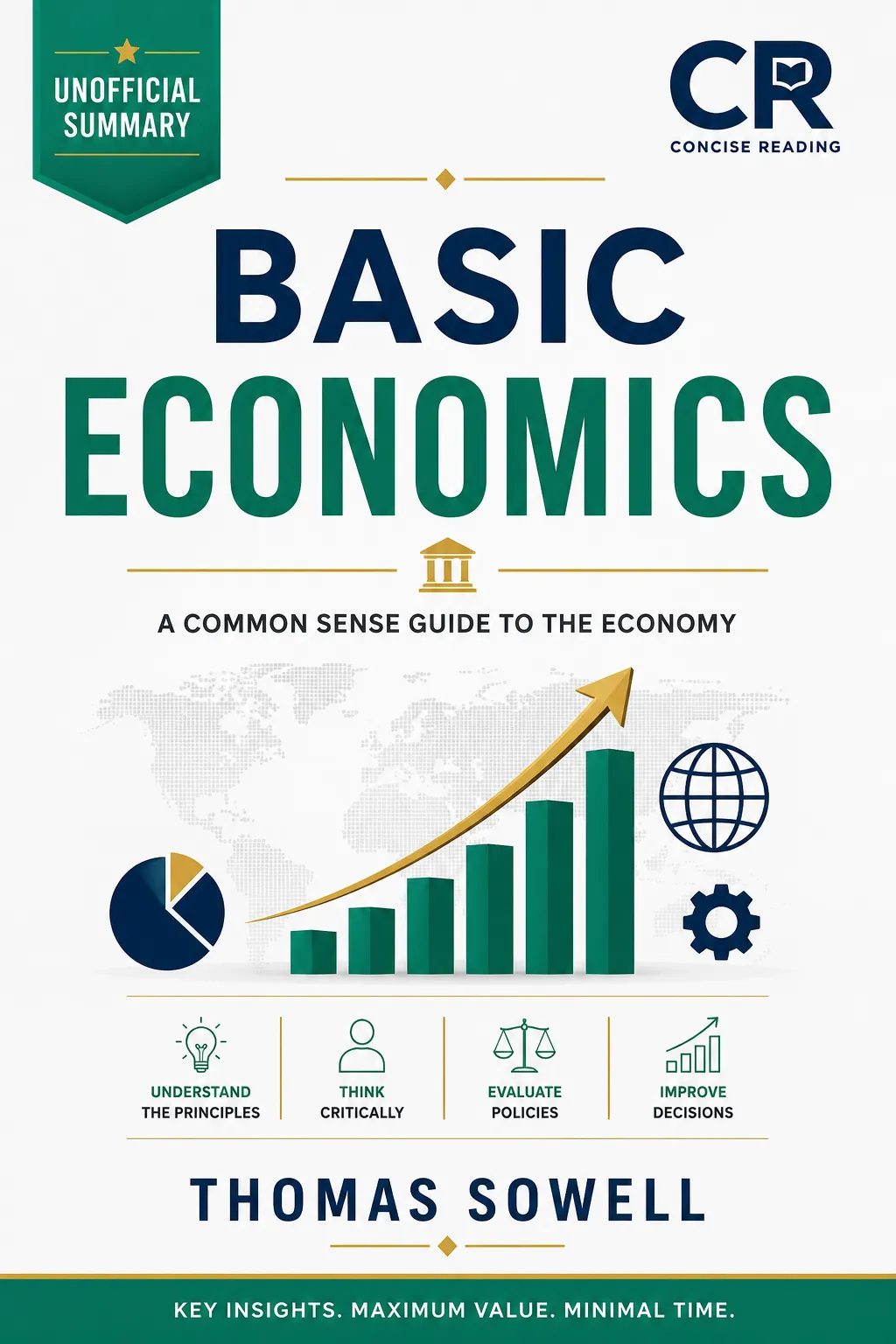
Everything you think you know about prices, wages, and government policy is probably wrong — this summary will fix that in the next 10 minutes, and permanently change how you evaluate every business and financial decision you make.
Read by 10,000+ entrepreneurs, investors, and self-educated professionals who choose to understand the economy — not just react to it. Part of our curated Economics & Economic Thinking collection at Concise Reading.
Book Snapshot
- Author – Thomas Sowell
- Category – Economics / Political Economy / Financial Literacy
- Original Book – ~ 640 pages. Average read time approximately 21 hours.
- Free Summary – 09 pages
- Premium Summary – 44 pages. Estimated read time 45 to 55 minutes.
The Big Idea
Economics is not about money. It is about the consequences of decisions made under scarcity. In Basic Economics, Thomas Sowell makes one argument with relentless consistency: most economic suffering — from housing shortages to unemployment to failed government programs — is caused not by greed or bad luck, but by people evaluating policies by their intentions rather than their results. Every policy produces two sets of effects. The ones you can see, and the ones you cannot. The unseen is where the damage lives. Once you learn to look for it, you cannot stop — and you will make better decisions in business, investing, and life for the rest of your career.
What You’ll Learn — Key Lessons Preview
- — You will understand exactly why prices are not arbitrary — they are a real-time information system, and suppressing them always creates the shortages politicians promise to fix.
- — You will master the Seen vs. Unseen framework — the single most powerful tool for evaluating any government policy, business decision, or investment thesis before it costs you money.
- — You will stop accepting “solutions” at face value and start finding the hidden trade-off in every deal, policy, and strategy before you commit.
- — You will understand how incentives — not intentions — determine what any system actually produces, and how to redesign the systems in your own business accordingly.
- — You will develop a longer economic time horizon, so you can see the damage that today’s convenient decisions are quietly building toward tomorrow.
Free vs Premium Comparison
| Free – $0 | Premium – $4.99 (Recommended) |
| ➡ Book Snapshot ➡ The Big Idea ➡ Key Lessons ➡ Power Quotes ➡ 09 Pages | ✔ Everything in free + ✔ Full Chapter Breakdown ✔ Key frameworks & diagrams ✔ Action steps ✔ Critical analysis ✔ One-page cheat sheet ✔ 44 pages |
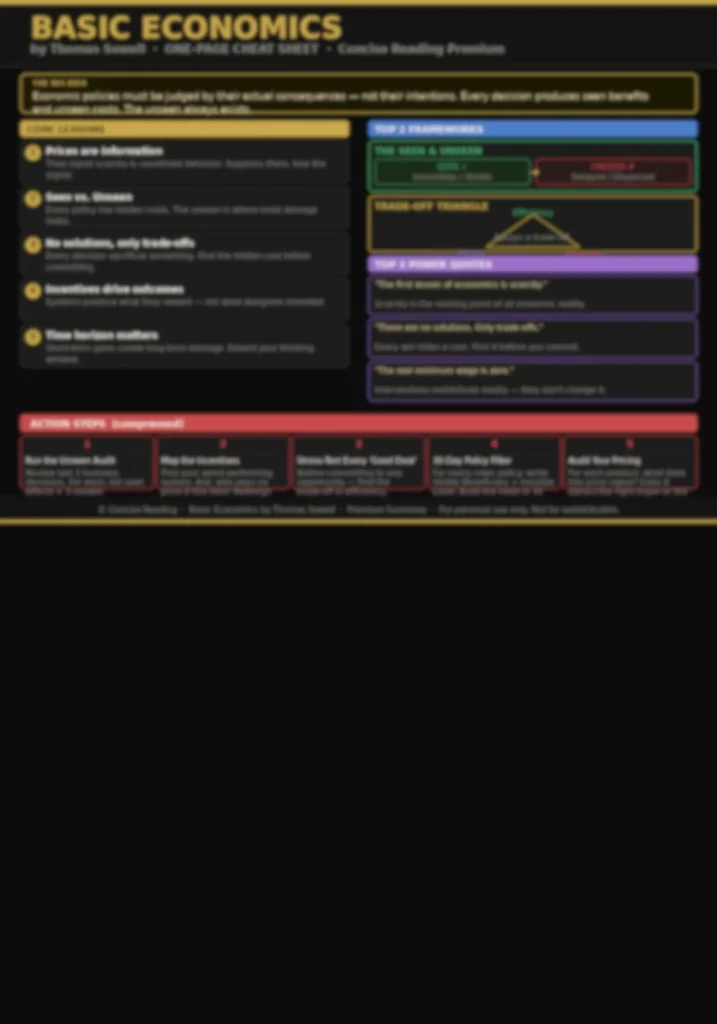
Premium Cheat Sheet Preview
About the Author
Thomas Sowell holds a PhD in Economics from the University of Chicago, where he studied under Nobel laureate Milton Friedman. He spent decades as a Senior Fellow at the Hoover Institution at Stanford University and authored more than 30 books on economics, history, and social policy. He received the National Humanities Medal in 2002. Basic Economics alone has sold over one million copies across five editions — making Sowell one of the most widely read economists writing for a general audience in the last 25 years.
Power Quote From the Book:
“The first lesson of economics is scarcity: there is never enough of anything to fully satisfy all those who want it. The first lesson of politics is to disregard the first lesson of economics.”
— Thomas Sowell, Basic Economics
Who This Summary is For
- This is for you if…
- — You are an entrepreneur or business owner who makes pricing, hiring, and expansion decisions and wants to stop being blindsided by consequences you did not see coming.
- — You are an investor trying to cut through political noise around market interventions, trade policy, or regulatory changes to understand what will actually happen to asset prices and industries.
- — You are a self-educated professional who consumes financial and business news daily but suspects that most of the economic commentary you read is incomplete, politically distorted, or flat-out wrong.
- — You want to understand the real mechanics of markets, prices, wages, and trade without enrolling in a four-year economics degree or reading a 640-page textbook.
- — You are a curious, intellectually honest person who would rather understand how the world works than be comfortable with how you wish it worked.
- Skip this if…
- This summary is not a personal finance guide and it will not tell you how to budget, invest in specific assets, or build a savings plan. If that is what you need right now, our summaries of The Psychology of Money or I Will Teach You to Be Rich are a better starting point.
Social Proof
We do not manufacture reviews — we earn them. If this summary has sharpened how you think about a decision you are currently facing, we want to hear about it. Scroll to the comments below and tell us: which lesson hit hardest, and what you are going to do differently because of it. Your experience is genuinely useful to the next reader deciding whether to invest their time here. The best feedback we have ever received has come from readers who took one framework from a summary, applied it within 48 hours, and came back to tell us what happened. Be that reader.
Basic Economics took Thomas Sowell a lifetime of research and over 640 pages to write. The Concise Reading premium summary distills the complete system — every framework, every chapter, every actionable insight — into 44 pages you can finish in under an hour. If the free summary made you think differently about one decision, the premium version will permanently change the instrument you use to make every decision after it.
Related Summaries
- Economics in One Lesson by Henry Hazlitt — Hazlitt builds on exactly the “seen and unseen” framework Sowell uses, but takes a more focused, lesson-by-lesson approach. If Basic Economics lit a fire in you, this is the next logical read. Shorter, sharper, and ruthlessly direct.
- The Wealth of Nations by Adam Smith — This is where modern market economics began. Sowell’s entire argument about price signals and market coordination traces back to Smith’s invisible hand. Reading this summary alongside Basic Economics gives you both the foundation and the modern interpretation.
- Freakonomics by Steven D. Levitt and Stephen J. Dubner — Where Sowell teaches you the principles of economic thinking, Freakonomics shows you how to apply that thinking to situations nobody expects. Same intellectual discipline — incentives, trade-offs, unintended consequences — applied to crime, education, and human behavior. Highly readable and immediately practical.
[…] deeper economic context, explore “Basic Economics”, “Capitalism and Freedom”, and “Economics in One Lesson” in our Free […]
[…] you’ve explored similar ideas in Das Kapital (Vol 1) or Basic Economics, this book builds on those foundations with modern data and practical […]
[…] you enjoy learning from economic classics like Basic Economics or Capitalism and Freedom available in our Economics and Macroeconomics subgenres, Knowlton’s […]