
Capital in the Twenty-First Century by Thomas Piketty — Summary & Key Lessons
What this book will teach you in the next 10 minutes — and why it matters for your financial future and every money decision you’ll ever make.
Trusted by readers in 40+ countries. Part of the Concise Reading library of business and finance summaries — built for people who take their financial education seriously.
Book Snapshot
- Author – Thomas Piketty
- Category – Economics / Wealth Inequality / Political Economy
- Original Book – ~ 696 pages. Average read time: 23–28 hours.
- Free Summary – 08 pages
- Premium Summary – 23 pages. Estimated read time: 45–55 minutes.
The Big Idea
Thomas Piketty spent a decade building the most comprehensive database of wealth and income ever assembled — two centuries of data across 20+ countries. His conclusion rewrites everything you thought you knew about how money works. When the return on capital (investments, real estate, inherited wealth) consistently grows faster than the overall economy, wealth doesn’t spread. It concentrates — automatically, mathematically, and regardless of how hard anyone works. Piketty calls this r > g. And his data shows it has been the default setting of capitalism for 250 years. The middle-class prosperity of the 20th century wasn’t normal. It was a temporary accident caused by two World Wars that physically destroyed centuries of accumulated capital. That reset is over. Wealth is concentrating again, and if you don’t understand why, you cannot make a rational financial decision in the world we’re actually living in.
What You’ll Learn — Key Lessons Preview
- You will understand exactly why your salary, no matter how high, is structurally losing ground against people who own capital — and what to do about it.
- You will see why the post-WWII middle-class boom was a historical anomaly, not the natural output of capitalism, and why anchoring your financial expectations to it is a strategic error.
- You will learn the single formula (r > g) that predicts wealth concentration across generations — and how to use it as a personal financial compass, not just a macroeconomic theory.
- You will discover why inheritance is becoming more economically decisive than talent, education, or effort — and the specific financial moves that put you on the right side of that shift.
- You will walk away with a framework for shifting from selling labor to owning capital — the only financial strategy that Piketty’s 250 years of data actually validates at every level of wealth.
Free vs Premium Comparison
| Free – $0 | Premium – $4.99 (Recommended) |
| ➡ Book Snapshot ➡ The Big Idea ➡ Key Lessons ➡ Power Quotes ➡ 08 Pages | ✔ Everything in free + ✔ Full Chapter Breakdown ✔ Key frameworks & diagrams ✔ Action steps ✔ Critical analysis ✔ One-page cheat sheet ✔ 23 pages |
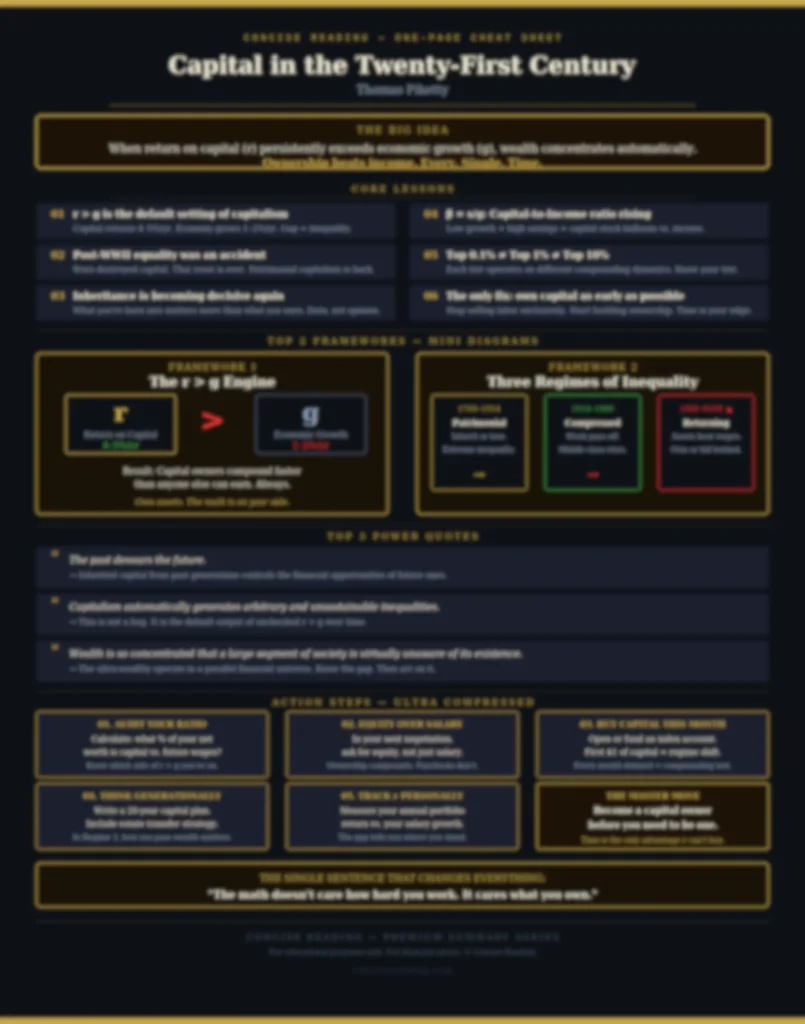
Premium Cheat Sheet Preview
About the Author
Thomas Piketty is a French economist and professor at the Paris School of Economics who completed his PhD at age 22 — jointly from EHESS and the London School of Economics. He spent over a decade building the World Inequality Database, the most comprehensive collection of historical income and wealth data ever assembled, covering 100+ countries. Capital in the Twenty-First Century became one of the best-selling economics books in history, translated into 40+ languages and praised across the ideological spectrum for its empirical rigor.
Power Quote From the Book:
“The past devours the future.”
— Thomas Piketty, Capital in the Twenty-First Century
Who This Summary is For
- This is for you if…
- You are an investor, entrepreneur, or business owner who wants the macro context behind why owning assets matters more than earning income — backed by 250 years of data, not financial opinion.
- You are a finance professional, economist, or policy-engaged reader who wants to understand the empirical foundation of the modern inequality debate without reading 700 pages of academic text.
- You are a high-earning professional who feels financially stuck despite a strong salary and wants to understand the structural reason why — and what the data says you should actually do differently.
- You want to understand the economic system you are operating in — not the sanitized version taught in textbooks, but what the historical record actually shows about how wealth behaves over time.
- You are building long-term financial literacy and want the foundational frameworks that explain everything from wealth taxes and inheritance policy to real estate prices and stock market compounding — in one place.
- Skip this if…
- You are looking for a step-by-step personal budgeting guide or a quick-win money hack. This summary operates at the level of economic systems and long-horizon financial strategy. If you want the personal finance entry point first, start with our summary of The Psychology of Money or Rich Dad Poor Dad and come back here when you’re ready to go deeper.
Social Proof
This summary has been read by investors, finance students, entrepreneurs, and economics enthusiasts who wanted Piketty’s framework without the 700-page commitment. If you’ve read it — free version or premium — we’d genuinely like to know what landed for you. Did the r > g formula change how you think about your own financial decisions? Did anything surprise you? Leave a comment below. Real feedback from real readers is how we know whether a summary actually does its job — and your experience helps the next reader decide whether this is the right book for them right now.
Capital in the Twenty-First Century took Thomas Piketty over a decade to research and write. The premium summary gives you the complete framework — every key concept, five visual frameworks, five action steps calibrated to cause productive discomfort, and a one-page cheat sheet worth pinning to your wall — in under an hour.
Related Summaries
- The Intelligent Investor by Benjamin Graham — Piketty proves capital compounds faster than income. Graham teaches you exactly how to build and protect that capital using disciplined, evidence-based investing principles. The logical next step after understanding why owning assets matters is learning how to own them well.
- The Wealth of Nations by Adam Smith — Piketty is essentially in direct conversation with Smith’s foundational ideas about capitalism, labor, and markets. Reading Smith gives you the original blueprint that Piketty is stress-testing 250 years later. Understanding both gives you the full arc of economic thought.
- The Psychology of Money by Morgan Housel — Piketty gives you the macro picture of how wealth accumulates at a systemic level. Housel gives you the behavioral and psychological framework for why individuals succeed or fail in building wealth personally. Together they cover both the system and the human inside it.
[…] understand financial inequality deeper, you can also explore Capital in the Twenty-First Century on our […]
[…] deepen your understanding, you can also explore related summaries like Capital in the Twenty-First Century and End the Fed, both available in our Free Summaries […]
[…] idea connects deeply with works like Capital in the Twenty-First Century, which you can also explore on our […]