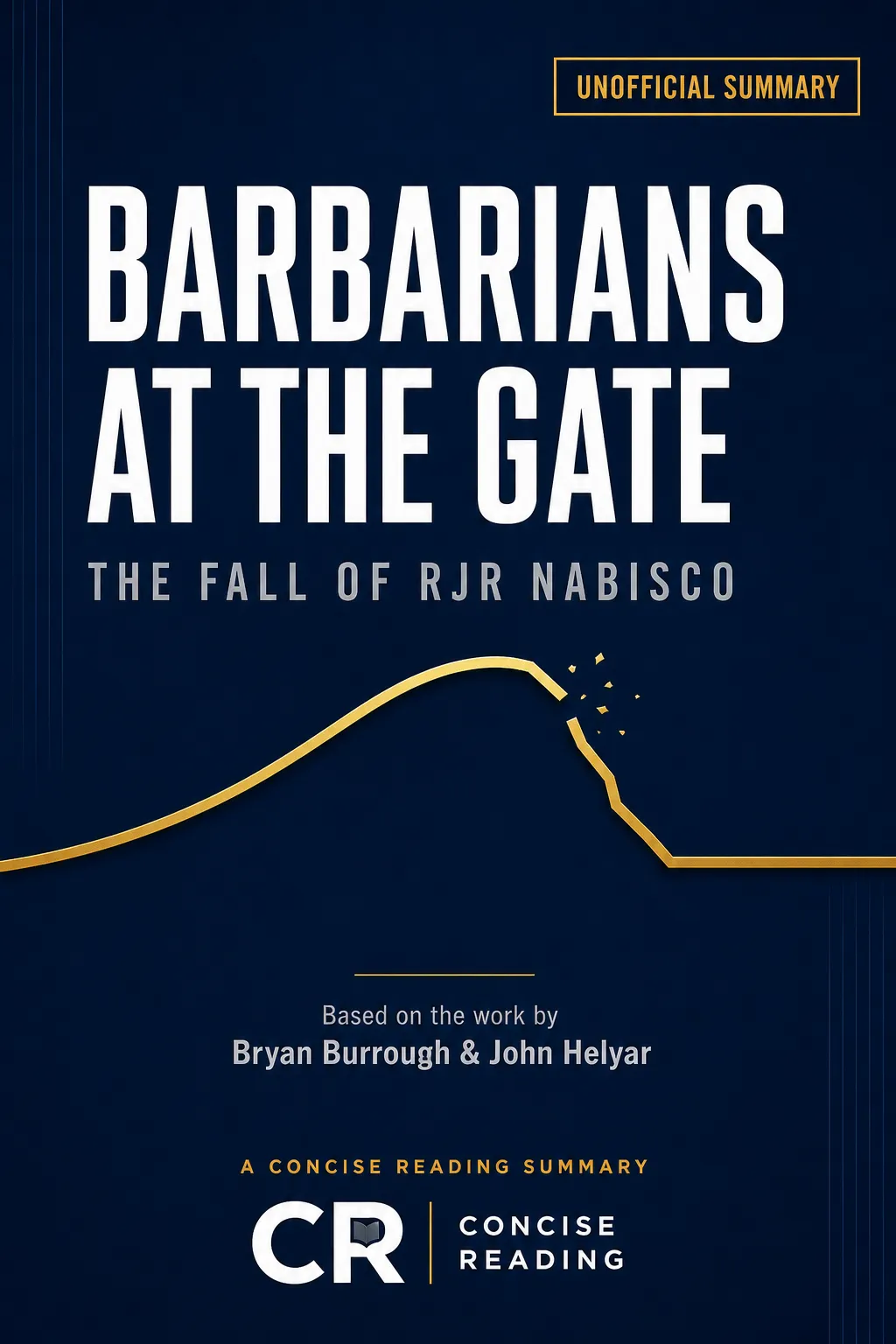
Barbarians at the Gate by Bryan Burrough and John Helyar — Summary & Key Lessons
What this book will teach you in the next 10 minutes — and why it matters for your business decisions, your deals, and the money you put at risk.
Read by investors, founders, and executives across 40+ countries. Distilled from 560 pages into what actually matters — and what you can actually use.
Book Snapshot
- Author – Bryan Burrough and John Helyar
- Category – Financial History / Corporate Drama / Business Strategy
- Original Book – ~ 560 pages, approximately 14-16 hours average read time
- Free Summary – 08 pages
- Premium Summary – 26 pages, estimated read time 45-55 minutes
The Big Idea
In 1988, RJR Nabisco’s CEO tried to buy his own company in secret to pocket billions for himself and a small circle of insiders. What followed was the largest corporate bidding war in history — $25 billion fought over by Wall Street’s most powerful firms, financed almost entirely with debt the company would spend years trying to survive. Barbarians at the Gate is not just a story about money. It is a case study in what happens when incentives misalign at the highest levels of business — when advisors are paid to close deals rather than protect you, when boards stop questioning the person who controls their information, and when winning replaces thinking. The lessons inside this book apply to every business deal, every debt decision, and every negotiation you will ever face — at any scale.
(If you want to go deeper on how financial incentives corrupt decision-making at the institutional level, our summary of Liars Poker covers the same era from the inside of Salomon Brothers.)
What You’ll Learn — Key Lessons Preview
- WHAT YOU’LL LEARN — KEY LESSONS PREVIEW
- How to identify when the advisors and bankers around you are optimizing for their outcome, not yours — and what to do about it before you sign anything
- Why intelligent people consistently overbid, overlever, and overpay — and the one structural safeguard that stops deal momentum from replacing rational analysis
- How corporate boards fail not through corruption but through information control — and the specific audit you can run on any governance structure, including your own
- Why reputation is a strategic financial asset that transfers directly into negotiating leverage — and how to build the kind of credibility that wins deals on terms, not just on price
- How to stress-test your debt or financial commitments against a 40% revenue decline — the exact exercise that would have saved RJR Nabisco’s post-buyout leadership years of crisis management
- (These same negotiation and incentive principles appear in a different context in our Never Split the Difference summary and our Getting to Yes summary — worth reading alongside this one.)
Free vs Premium Comparison
| Free – $0 | Premium – $4.99 (Recommended) |
| ➡ Book Snapshot ➡ The Big Idea ➡ Key Lessons ➡ Power Quotes ➡ 08 Pages | ✔ Everything in free + ✔ Full Chapter Breakdown ✔ Key frameworks & diagrams ✔ Action steps ✔ Critical analysis ✔ One-page cheat sheet ✔ 26 pages |
Premium Cheat Sheet Preview

About the Author
Bryan Burrough and John Helyar were both investigative journalists at The Wall Street Journal during the exact era the book covers — which means they reported on this world in real time before reconstructing it in 560 pages of sourced detail. Burrough later became a contributing editor at Vanity Fair and the author of multiple major works of financial and American history. Helyar went on to write for Fortune and ESPN. Together, they conducted hundreds of interviews with the actual participants in the RJR deal, including participants who had every reason to stay quiet. No subsequent account of this transaction comes close to their level of access or sourcing.
Power Quote From the Book:
“A few hundred million dollars is not something that should get between friends.” — Ross Johnson, CEO of RJR Nabisco
(Said in apparent sincerity. Which tells you everything about what happens when people at the top of organizations lose track of whose money they are managing.)
Who This Summary is For
- This is for you if…
- You are a founder, executive, or investor who wants to understand how elite-level deals actually work — not the sanitized version taught in business schools
- You are building or growing a business and want to understand what happens when the incentives of your advisors, lenders, or partners diverge from yours
- You want a practical framework for negotiation, governance, and financial risk that you can apply immediately — not theory, not case-study abstraction
- You are interested in financial history and want the definitive account of the deal that defined an era of Wall Street excess
- You have already read The Big Short or Den of Thieves and want to complete your understanding of how financial systems fail from the inside
- Skip this if…
- You are looking for a step-by-step financial modeling guide or a how-to manual on structuring leveraged buyouts. This summary delivers frameworks and mental models extracted from a deeply researched narrative — not technical finance instruction. For pure technical grounding, our Corporate Finance summary or our Financial Intelligence summary are better starting points.
- (Not sure where to start with business and finance books? Our Start Here page maps the right reading path based on where you are and what you’re trying to build.)
Social Proof
We have kept this section intentionally open because the most useful review of a summary is one written by someone who just read it. If this summary sharpened how you think about deals, incentives, or corporate governance — or if you spotted something we got wrong or could have explained better — leave a comment below. Every piece of feedback we receive goes directly into improving the next version of this summary and every summary we produce after it. The readers who leave honest comments here are the reason Concise Reading summaries get better over time. We read every one.
Barbarians at the Gate took Bryan Burrough and John Helyar years of interviews, legal scrutiny, and investigative reporting to produce 560 pages that Wall Street still references four decades later — the premium summary gives you the complete system: full chapter-by-chapter breakdown, five actionable frameworks with visual diagrams, five discomfort-level action steps, a critical analysis, and a one-page cheat sheet, in 26 pages you can finish in under an hour.
(Browse our full Wall Street and Financial Markets Pack if you want Barbarians at the Gate alongside our summaries of Liars Poker, The Big Short, Flash Boys, Den of Thieves, and When Genius Failed — bundled and discounted.)
Related Summaries
- The Big Short by Michael Lewis — Where Barbarians at the Gate exposes the ego and greed behind 1980s dealmaking, The Big Short reveals how the same Wall Street incentive failures produced the 2008 financial crisis. Together they form a complete picture of how financial systems collapse from the inside.
- Liars Poker by Michael Lewis — Written by a former Salomon Brothers bond trader, this book is the insider account of the same era that produced the RJR deal. It explains the culture, the characters, and the machinery of 1980s Wall Street from someone who lived it.
- Den of Thieves by James B. Stewart — This is the definitive account of the insider trading scandals that ran parallel to the LBO boom. If Barbarians at the Gate showed you how the deals were structured, Den of Thieves shows you what was happening illegally underneath them.