When Genius Failed by Roger Lowenstein — Summary & Key Lessons

What this book will teach you in the next 10 minutes — and why it matters for your money, your investments, and every high-stakes decision you’ll ever make.
Read by investors, finance professionals, and entrepreneurs who want to understand risk before the market teaches them the hard way.
Book Snapshot
- Author – Roger Lowenstein
- Category – Financial History / Risk Management / Behavioral Finance
- Original Book – ~ 264 pages. Average read time: 5 to 6 hours.
- Free Summary – 08 pages
- Premium Summary – 28 pages. Estimated read time: 45 to 55 minutes.
The Big Idea
In 1998, the most credentialed hedge fund in history — staffed by Nobel Prize-winning economists and Wall Street legends — lost over $4 billion in under four months and nearly brought down the global financial system. Long-Term Capital Management did not fail because of fraud or recklessness. It failed because its founders were so intelligent, so successful, and so certain that they borrowed beyond any possible margin of safety. When reality refused to cooperate with their models, there was nothing left to absorb the shock. This is the story of what happens when genius meets leverage and runs out of humility.
What You’ll Learn — Key Lessons Preview
- You will understand exactly why leverage is not a tool of the bold — it is the mechanism that turns a smart person’s mistake into a permanent one.
- You will see how historical data creates a false sense of security, and why the events your model has never recorded are the only ones that truly matter.
- You will learn how track record and reputation quietly disable the critical thinking that made those track records possible in the first place.
- You will grasp why size alone transforms a private financial failure into a public emergency that everyone else pays for.
- You will walk away with a concrete framework for stress-testing your own decisions, investments, and financial positions before the market does it for you.
Free vs Premium Comparison
| Free – $0 | Premium – $4.99 (Recommended) |
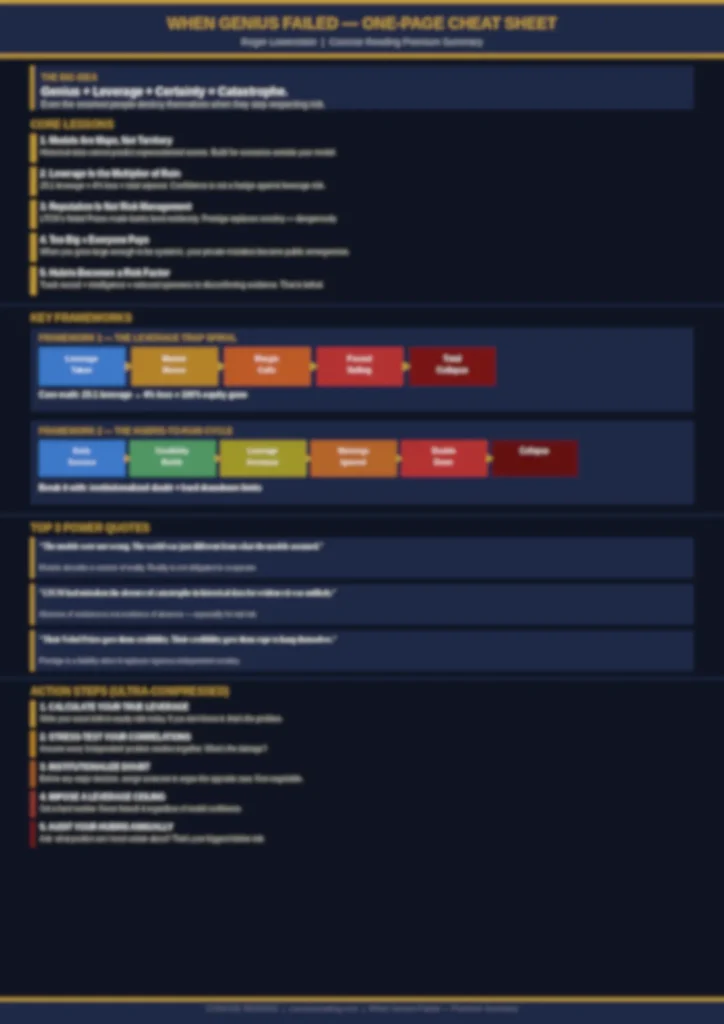
| ➡ Book Snapshot ➡ The Big Idea ➡ Key Lessons ➡ Power Quotes ➡ 08 Pages | ✔ Everything in free + ✔ Full Chapter Breakdown ✔ Key frameworks & diagrams ✔ Action steps ✔ Critical analysis ✔ One-page cheat sheet ✔ 28 pages |
Premium Cheat Sheet Preview
About the Author
Roger Lowenstein spent over a decade as a staff writer at The Wall Street Journal and is one of the most respected financial journalists in the United States. He is also the author of Buffett: The Making of an American Capitalist, widely considered the definitive biography of Warren Buffett. For When Genius Failed, Lowenstein conducted direct interviews with traders, regulators, and LTCM insiders, producing a reconstruction of the collapse that is both technically rigorous and impossible to put down.
Power Quote From the Book:
“The same genius that had produced their outsized returns had also blinded them to the possibility that their models might be wrong.”
Who This Summary is For
- This is for you if…
- You are an investor — active or passive — who uses models, backtesting, or historical data to guide decisions and wants to understand the limits of that approach.
- You are a finance professional, analyst, or fund manager who works with leverage, derivatives, or quantitative frameworks in any form.
- You are an entrepreneur or business owner using debt to grow, and you have never seriously modeled a scenario where multiple things go wrong at the same time.
- You want to understand systemic risk and how private financial decisions can create consequences that extend far beyond the people who made them.
- You are drawn to financial history and want one of the most gripping, detailed, and instructive case studies ever written about a real-world collapse.
- Skip this if…
- You are looking for a personal finance or wealth-building guide — this book operates at the institutional level and its lessons require some translation to everyday financial decisions. If you want to start with the fundamentals of personal investing, our summary of The Intelligent Investor or The Psychology of Money may be a better starting point.
Social Proof
This summary was built for readers who take financial decision-making seriously. If you have read this free summary — or gone deeper with the premium version — we want to hear what shifted for you. Did a specific lesson change how you think about leverage or risk in your own portfolio? Did the frameworks surface a blind spot you had not noticed before? Drop your thoughts in the comments below. Every piece of feedback helps other readers decide whether this is the right summary for them, and it helps us make the next one sharper. There are no incentives for leaving a review here — just the knowledge that your experience might save someone else from a very expensive mistake.
When Genius Failed took Roger Lowenstein years of reporting, dozens of interviews, and access to internal documents that most journalists never obtained — the premium summary distills the complete system, all four frameworks with visual diagrams, five curated power quotes, five uncomfortable action steps, and a one-page cheat sheet into a focused 28-page read you can finish in under an hour.
Related Summaries
- The Big Short by Michael Lewis — LTCM is the prequel. The Big Short is the sequel. This book shows how the same structural failures — hidden risk, misplaced confidence, and regulatory blindness — came back a decade later and nearly destroyed the global economy. Essential companion reading.
- Fooled by Randomness by Nassim Nicholas Taleb — Taleb builds the philosophical framework that explains exactly why LTCM failed. He argues that humans systematically underestimate the role of randomness and rare events in outcomes. Read this to understand the mindset that makes disasters like LTCM almost inevitable.
- Manias, Panics and Crashes by Charles Kindleberger — A classic historical survey of financial crises across centuries. LTCM fits perfectly into the pattern Kindleberger identifies: excessive leverage, euphoria, and the eventual brutal correction. This book shows you that LTCM was not an anomaly — it was history repeating itself.