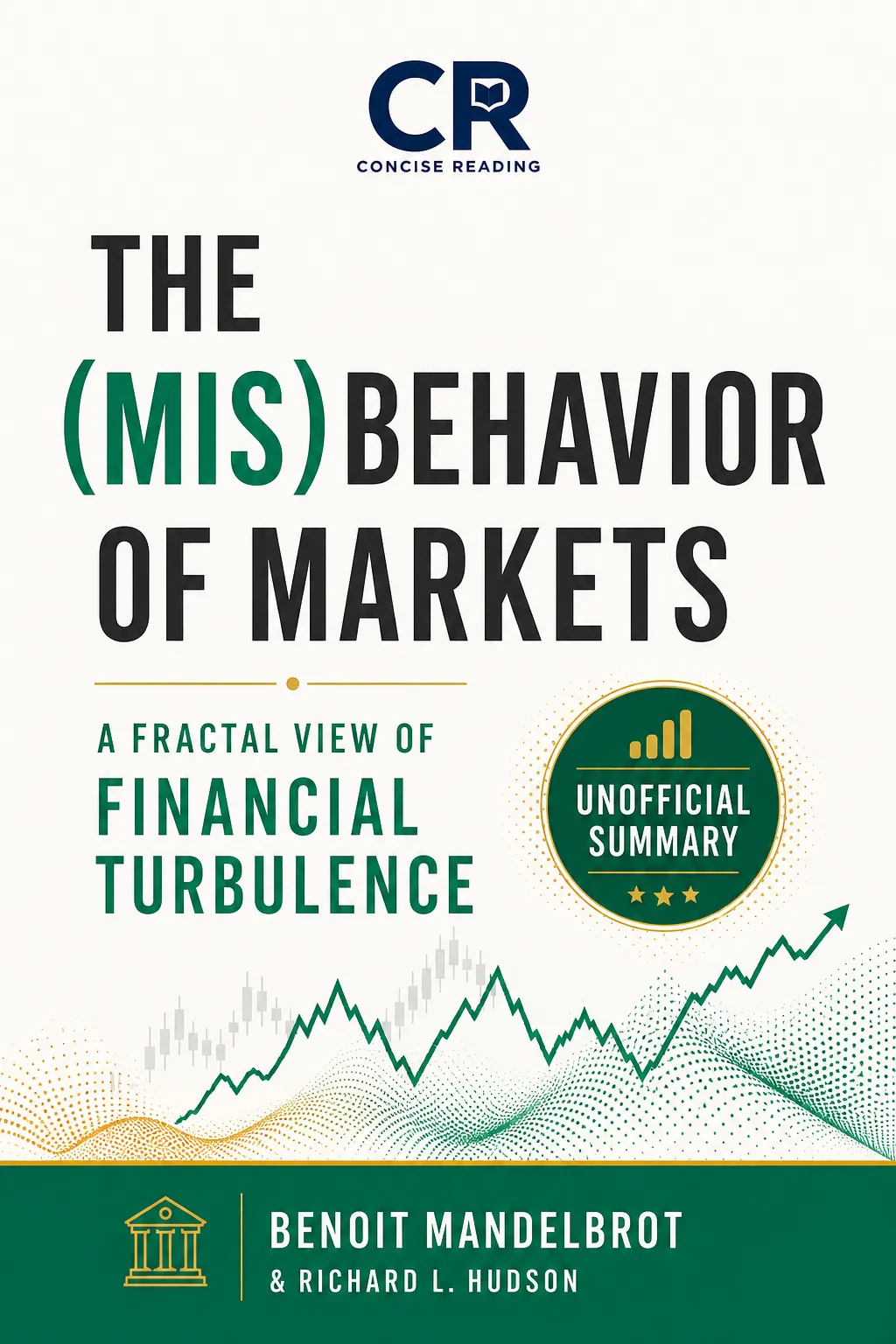
The Misbehavior of Markets by Benoit Mandelbrot — Summary & Key Lessons
One-Line Hook:
What this book will teach you in the next 10 minutes — and why it matters for every investment decision you will ever make.
Read by investors, finance professionals, and independent thinkers who want an honest picture of market risk — not a comfortable one.
Book Snapshot
- Author – Benoit Mandelbrot and Richard L. Hudson
- Category – Investing & Financial Risk / Behavioral Finance
- Original Book – ~ 328 pages. Average read time approximately 7 to 9 hours.
- Free Summary – 08 pages
- Premium Summary – 26 pages. Estimated read time 40 to 55 minutes.
The Big Idea
Every risk model Wall Street trusts — the bell curve, modern portfolio theory, Value at Risk — was built on a single assumption that Benoit Mandelbrot spent fifty years proving false: that market price changes are mild, random, and roughly predictable. They are not. Real markets are wild, with fat tails, long memory, and price jumps that make “once in a century” crashes happen every decade. This book does not give you a better prediction system. It gives you something more valuable: an accurate map of how dangerous markets actually are — and why the models telling you otherwise are the real risk. If you invest, manage risk, or simply want to understand why financial crises keep defying probability, this is the most important book you have not read. Browse our full investing library at concisereading.com/library to see how it fits alongside the essential financial reading canon.
What You’ll Learn — Key Lessons Preview
- You will understand exactly why the standard risk models used by banks, funds, and advisors systematically underestimate the probability of catastrophic losses — and what that means for your portfolio today.
- You will see why market crashes are not statistical anomalies that can be safely ignored, but structural features of wild markets that every investor will eventually face, regardless of how calm recent history appears.
- You will learn why diversification — the most universally recommended risk management strategy — fails at the precise moment you need it most, and what a more honest alternative looks like.
- You will grasp the fractal nature of market behavior and why volatility repeats self-similar patterns at every time scale, which means “just hold long-term” is a horizon choice, not a risk management strategy.
- You will walk away with a permanently recalibrated understanding of financial risk that makes you a harder target for the comfortable false precision that most investment products sell. For more on thinking probabilistically about money and markets, see our summary of Thinking in Bets and our summary of Against the Gods.
Free vs Premium Comparison
| Free – $0 | Premium – $4.99 (Recommended) |
| ➡ Book Snapshot ➡ The Big Idea ➡ Key Lessons ➡ Power Quotes ➡ 08 Pages | ✔ Everything in free + ✔ Full Chapter Breakdown ✔ Key frameworks & diagrams ✔ Action steps ✔ Critical analysis ✔ One-page cheat sheet ✔ 26 pages |
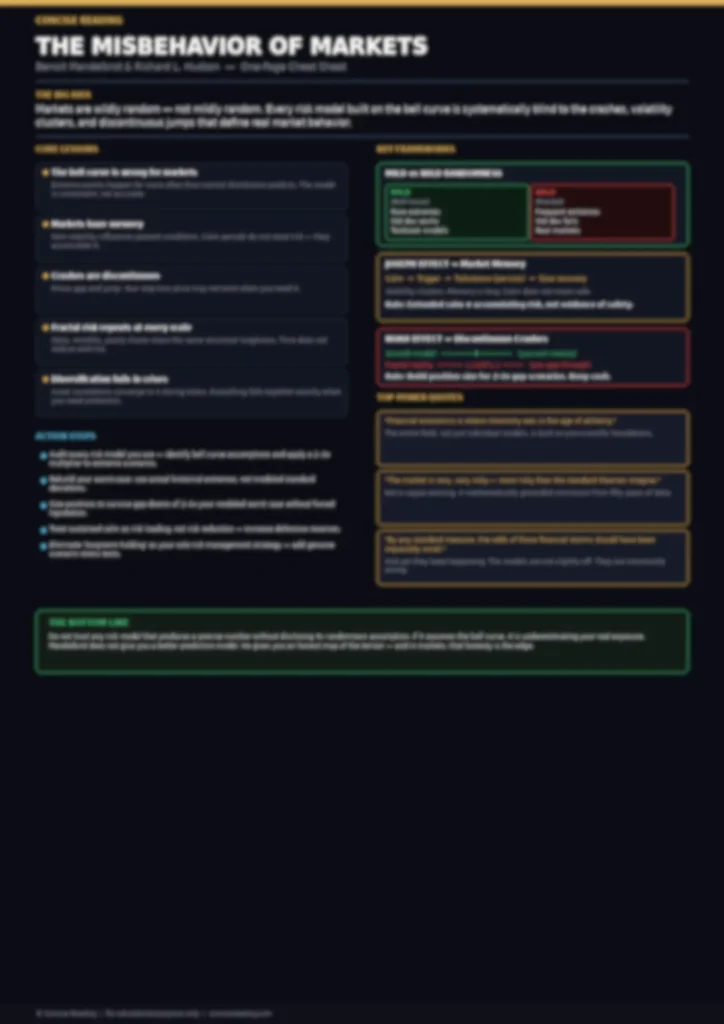
Premium Cheat Sheet Preview
About the Author
Benoit Mandelbrot (1924–2010) was the father of fractal geometry and one of the most original mathematical minds of the twentieth century. A Sterling Professor Emeritus at Yale and longtime IBM Research Fellow, he spent five decades studying price data across cotton, equities, and currencies, accumulating evidence that mainstream finance has systematically misunderstood the nature of market randomness. His work earned him the Wolf Prize, the Japan Prize, and the Légion d’Honneur. Richard L. Hudson, co-author and former managing editor of The Wall Street Journal Europe, translates Mandelbrot’s dense mathematical framework into prose that working investors can actually use.
Power Quote From the Book:
“Financial economics, as a discipline, is where chemistry was in the age of alchemy.”
— Benoit Mandelbrot, The Misbehavior of Markets
Who This Summary is For
- This is for you if…
- You are an investor — retail or professional — who has sensed that something is fundamentally off about how risk is measured and sold to you, but have not had the framework to articulate it.
- You are a finance student or early-career analyst who wants to stress-test the models you are being taught before trusting real capital to them.
- You are someone who lost money in 2008, 2020, or any other “statistically impossible” market event and wants to understand, once and for all, why it keeps happening.
- You want to develop an honest, grounded investment philosophy that does not depend on the false precision of bell-curve risk models.
- You are drawn to the intersection of mathematics, economics, and market history and want one of the most rigorous thinkers of the last century guiding you through it. If you enjoy this kind of foundational thinking, our summaries of The Black Swan by Nassim Taleb and When Genius Failed by Roger Lowenstein cover directly adjacent territory and are essential companions to this one.
- Skip this if…
- You are looking for a trading system, stock-picking method, or a way to time the market. Mandelbrot is explicit: the fractal framework does not predict what will happen. It tells you what is possible, probable, and prudent. If you want actionable short-term strategies, this is the wrong starting point — explore our investing library instead.
Social Proof
This summary was built to be genuinely useful, not just a fast read. If it challenged an assumption you had been holding, introduced a framework that changed how you think about your portfolio, or made you want to read the original book, we want to hear about it. Leave a comment below with your biggest takeaway, a question the summary raised, or how it compares to other investing books you have read. Reader responses are how we refine every summary we publish — and your experience helps the next reader decide if this is the right read for them. If you have already read The Misbehavior of Markets in full, we especially want to know what we got right and what we missed.
Mandelbrot spent fifty years and a lifetime of mathematical research to build the framework in this book. The premium summary gives you the complete system — every chapter, every framework, every action step — in 26 focused pages, including a one-page cheat sheet worth pinning to your wall. If you found the free version worth your time, the premium version will be worth far more than its price. And if you are building a serious financial reading foundation, consider pairing it with The Wall Street and Financial Markets Pack or The Investing Playbook — both available at concisereading.com/premium-packs and concisereading.com/playbooks.
Related Summaries
- The Black Swan by Nassim Nicholas Taleb — Taleb extends and sharpens Mandelbrot’s core argument, focusing specifically on how humans systematically ignore the probability of extreme, high-impact events. If this book disturbed your confidence in financial models, The Black Swan will dismantle whatever is left standing. Essential companion reading.
- Against the Gods: The Remarkable Story of Risk by Peter L. Bernstein — A sweeping history of how humans have tried to measure, manage, and understand risk across centuries. It provides the intellectual lineage that makes Mandelbrot’s critique meaningful, showing exactly which assumptions were adopted, why they were adopted, and what was sacrificed in the process.
- When Genius Failed by Roger Lowenstein — The collapse of Long-Term Capital Management is the most instructive real-world case study of what happens when brilliant people build enormous financial positions on models that assume mild randomness. Everything Mandelbrot warns about in theory, LTCM demonstrated in catastrophic practice.