
Irrational Exuberance by Robert J. Shiller — Summary & Key Lessons
What this book will teach you in the next 10 minutes — and why it matters for your investment decisions, your financial safety, and your ability to think clearly when markets go insane.
Written by a Nobel Prize-winning economist who predicted the dot-com crash and the 2008 housing collapse — before they happened. This is not theory. This is documented history with your money on the line.
Book Snapshot
- Author – Robert J. Shiller
- Category – Behavioral Finance / Economics / Investing Psychology
- Original Book – Approximately 336 pages. Average read time: 8 to 10 hours.
- Free Summary – 08 pages
- Premium Summary – 22 pages. Estimated read time: 45 to 60 minutes.
The Big Idea
Markets do not crash because of bad economic data. They crash because millions of people tell each other the same story for long enough that prices lose all connection to reality. Robert Shiller — using over 130 years of market data — shows that every major financial bubble in history followed the same pattern: prices rise, stories spread, new investors pile in, prices rise further, and the cycle repeats until the inevitable correction arrives. His CAPE ratio, now used by central banks and institutional investors worldwide, has predicted poor long-run returns with remarkable consistency every time markets became dangerously overvalued. If you want to understand why smart people keep losing money in bubbles, this is the book — and this summary gives you the complete framework in under an hour.
What You’ll Learn — Key Lessons Preview
- You will understand exactly how financial bubbles form and self-reinforce — so you can recognize the pattern while it is still happening, not after your portfolio has been cut in half.
- You will learn how to use the CAPE ratio to assess whether the market is cheap, fairly valued, or dangerously overpriced — and adjust your investment strategy accordingly before the correction arrives.
- You will identify the six cognitive biases that make rational investors act irrationally at market peaks — and get a specific antidote for each one you can apply before your next investment decision.
- You will see how financial narratives spread like infectious diseases through populations — and learn to identify which stage a market story is in so you know whether to enter, hold, or exit.
- You will understand why the price you pay for any asset is the single most powerful determinant of your long-run return — and why “I’m a long-term investor so valuations don’t matter” is one of the most expensive ideas in finance.
Free vs Premium Comparison
| Free – $0 | Premium – $4.99 (Recommended) |
| ➡ Book Snapshot ➡ The Big Idea ➡ Key Lessons ➡ Power Quotes ➡ 08 Pages | ✔ Everything in free + ✔ Full Chapter Breakdown ✔ Key frameworks & diagrams ✔ Action steps ✔ Critical analysis ✔ One-page cheat sheet ✔ 22 pages |
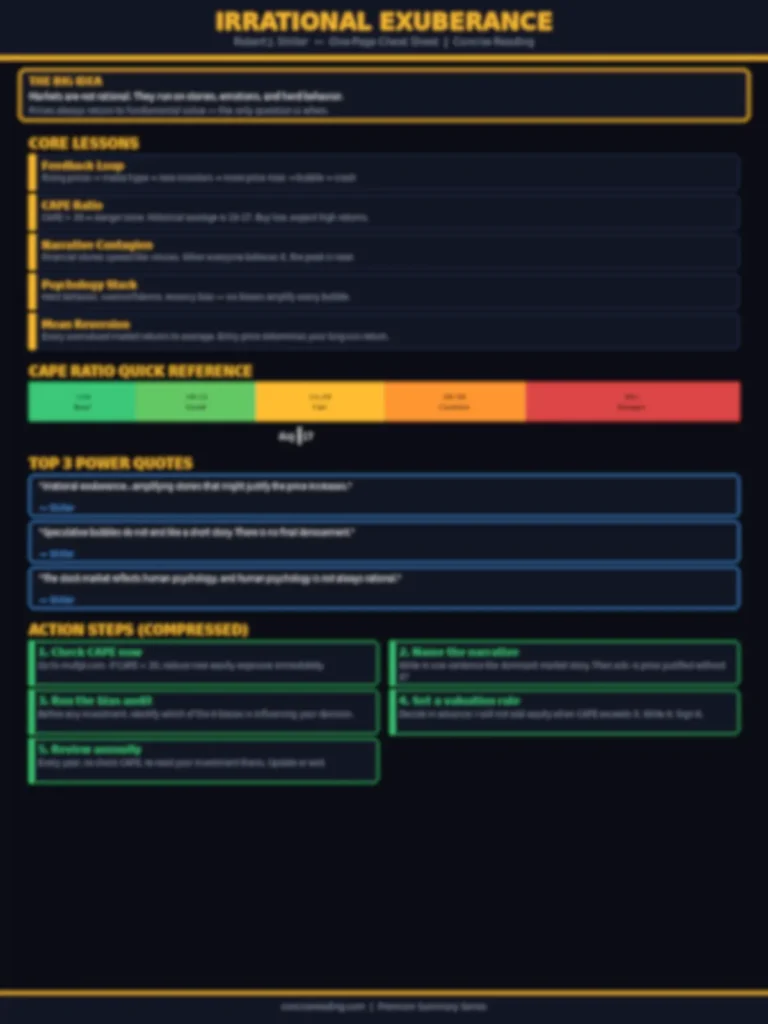
Premium Cheat Sheet Preview
About the Author
Robert J. Shiller is a Sterling Professor of Economics at Yale University and a 2013 Nobel Prize laureate in Economic Sciences. He created the CAPE ratio — the most widely used long-run market valuation tool in professional finance — and co-developed the S&P/Case-Shiller Home Price Index. Irrational Exuberance was published in March 2000, the literal peak of the dot-com bubble, and updated before the 2008 housing collapse. Shiller did not predict these events by luck. He predicted them by measurement.
Power Quote From the Book:
“Irrational exuberance is the psychologically based situation in which news of price increases spurs investor enthusiasm, which spreads by psychological contagion from person to person, in the process amplifying stories that might justify the price increases.”
— Robert J. Shiller, Irrational Exuberance
Who This Summary is For
- This is for you if…
- You are an investor — beginner or experienced — who wants to understand what causes markets to become dangerously overvalued and how to protect yourself when they do.
- You want a rigorous, data-backed framework for evaluating whether the market you are investing in is genuinely attractive or quietly setting you up for a decade of poor returns.
- You are a finance student, analyst, or professional who understands the mechanics of markets but wants a deeper grounding in the behavioral forces that make even sophisticated investors act irrationally at scale.
- You are an entrepreneur or business owner making major capital allocation decisions who needs to understand whether the economic environment you are operating in is genuinely supportive or inflated beyond sustainability.
- You want to think more independently about investing — to stop following market sentiment and start using a 130-year validated framework for making calmer, better-calibrated decisions.
- Skip this if…
- You are a complete beginner looking for a step-by-step guide to opening a brokerage account or picking your first stock. This summary assumes you understand basic market concepts. If you are just starting out, begin with our summary of The Psychology of Money or The Intelligent Investor and come back here when you have your footing.
Social Proof
This summary is read by investors, finance professionals, and serious learners from across the world. If you found this summary useful — whether the free version changed how you think about market valuations, or the premium version gave you a framework you actually used — we would love to hear from you. Leave a comment below with your biggest takeaway, a question that came up while reading, or how you plan to apply Shiller’s ideas to your own investment decisions. Your feedback helps other readers decide which version is right for them, and it helps us make every summary better. Real reactions from real readers are the most valuable thing on this page.
Irrational Exuberance took Robert Shiller over a decade of research and three editions to complete. The premium summary gives you the complete analytical system — five validated frameworks, a full chapter breakdown, five action steps specific enough to cause discomfort, and a one-page cheat sheet you will actually use — in under 45 minutes.
Related Summaries
- The Black Swan by Nassim Nicholas Taleb — Shiller tells you why markets become irrational. Taleb tells you why rare, catastrophic events are far more likely than any model predicts. Together, these two books form the most important risk education available to any investor.
- Thinking, Fast and Slow by Daniel Kahneman — Shiller references behavioral psychology throughout Irrational Exuberance. Kahneman’s book is the definitive source on exactly how human cognitive biases distort judgment — directly explaining why investors behave the way Shiller describes.
- Manias, Panics and Crashes by Charles P. Kindleberger — This is the historical companion to Shiller’s theoretical framework. Kindleberger documents financial crises across centuries with remarkable detail, showing that irrational exuberance is not a modern pathology but a recurring feature of every financial system in history.

[…] about speculative bubbles discussed in Irrational Exuberance or The Black Swan (both available in our Free Summaries). Investors often act irrationally due to […]
[…] you’ve explored insights from books like The Psychology of Money, Irrational Exuberance, or The Big Short in our Free Summaries, you’ll find this story connects the dots beautifully. It […]