Against the Gods Summary — Free & Premium | Concise Reading
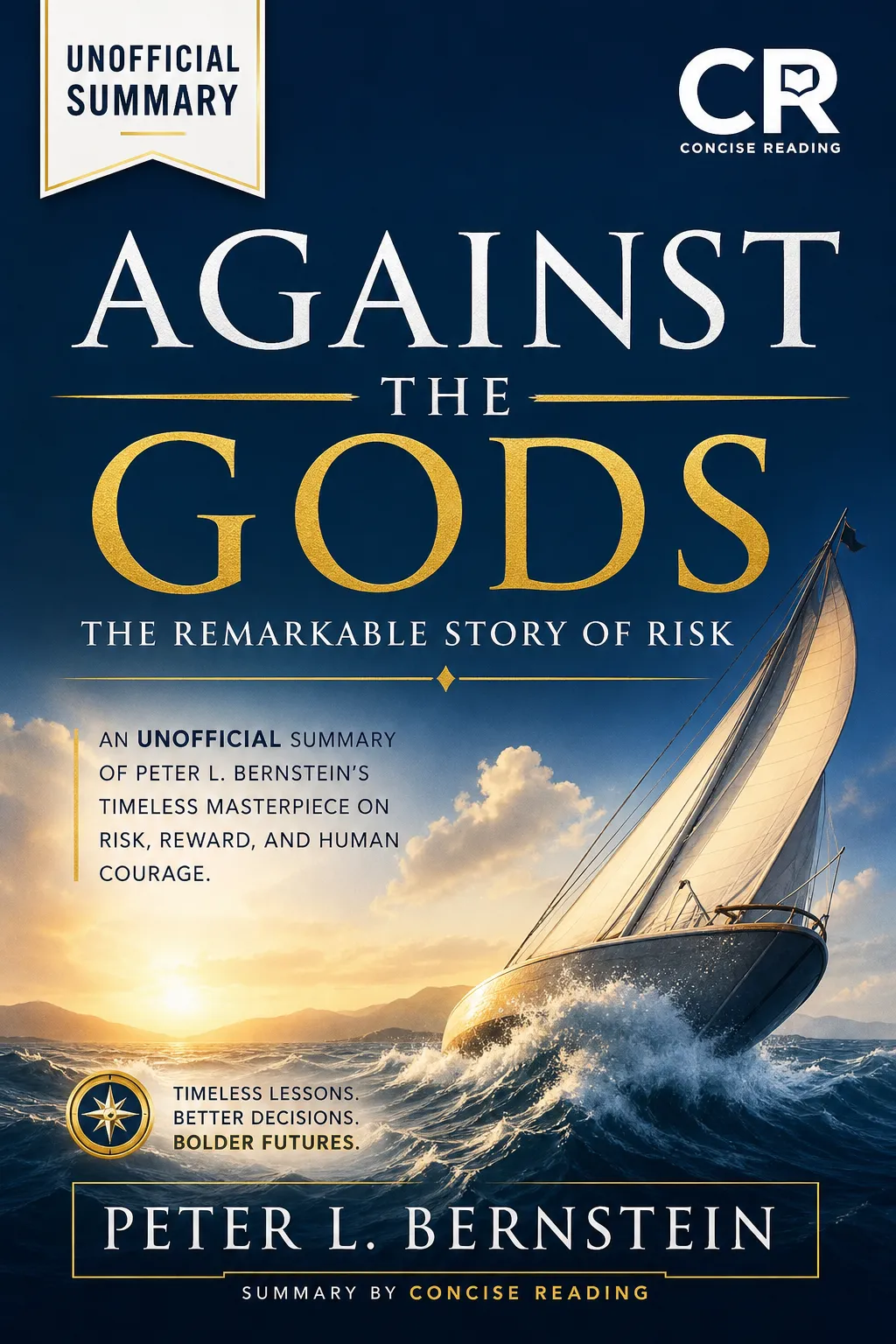
What 3,500 years of human struggle with uncertainty can teach you about making smarter decisions with your money — starting today.
Read by investors, analysts, and financial professionals worldwide. Trusted summaries from Concise Reading — built for people who take ideas seriously.
Book Snapshot
- Author – Peter L. Bernstein
- Category – Risk Management / Financial History / Decision-Making
- Original Book – 352 pages. Average read time: 8-10 hours.
- Free Summary – 09 pages
- Premium Summary – 22 pages. Estimated read time: 60-75 minutes.
The Big Idea
For most of human history, the future belonged to the gods. There was no language for probability, no framework for calculating odds, no tools for spreading risk. Then, across four centuries of mathematical breakthroughs, a handful of thinkers changed everything. Peter Bernstein’s Against the Gods tells that story — and issues a warning that has never been more relevant: the risk management tools we built are powerful, but fragile. They work under normal conditions and fail catastrophically under extreme ones. The gap between your model and reality is the most dangerous place in finance. This summary shows you exactly where that gap lives — and how to stay on the right side of it. If you want to explore more books on this theme, browse our full Wall Street and Financial Markets pack and the Investing Playbook.
What You’ll Learn — Key Lessons Preview
- You will understand why sophisticated investors and entire institutions blow up — not because their math is wrong, but because their assumptions were built on a world that stopped existing. This is the single most important lesson in risk management, and most people who use risk models every day have never been taught it.
- You will learn the Frank Knight distinction between risk and uncertainty — the most consequential idea in decision-making — and how to apply it before any major financial commitment so you stop applying the wrong tools to the wrong problems.
- You will learn why chasing top-performing funds is statistically the worst time to buy into them, how regression to the mean works against almost every investor who ignores it, and how to use this knowledge to identify undervalued positions before the crowd does.
- You will discover the five-question filter derived from Bernstein’s core argument that will tell you — in under 15 minutes — whether any investment or business risk is worth taking, whether you are adequately compensated for it, and whether you have sized it correctly.
- You will walk away with a complete intellectual map of how every major risk tool — from probability theory to modern portfolio theory to options pricing — was invented, what problem it was designed to solve, and precisely where each one breaks down. This knowledge is more durable than any specific strategy.
Free vs Premium Comparison
| Free – $0 | Premium – $4.99 (Recommended) |
| ➡ Book Snapshot ➡ The Big Idea ➡ Key Lessons ➡ Power Quotes ➡ 09 Pages | ✔ Everything in free + ✔ Full Chapter Breakdown ✔ Key frameworks & diagrams ✔ Action steps ✔ Critical analysis ✔ One-page cheat sheet ✔ 22 pages |
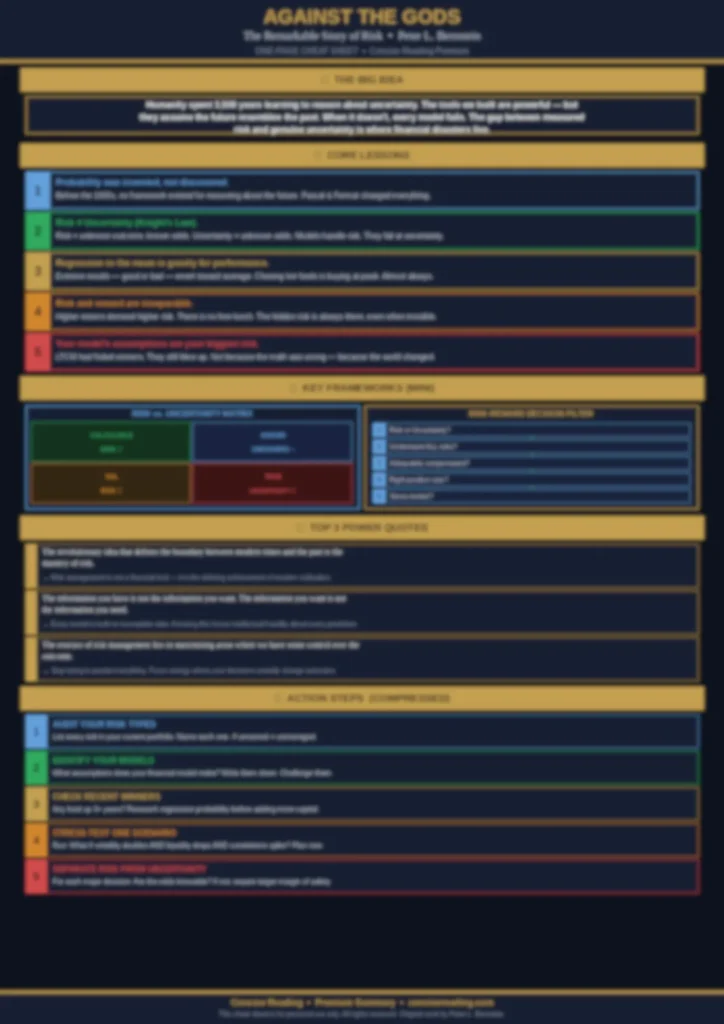
Premium Cheat Sheet Preview
About the Author
Peter L. Bernstein was one of the most respected financial historians of the 20th century. He founded an investment management firm, edited the Journal of Portfolio Management for over three decades, and advised institutional investors and governments on risk and portfolio strategy. He was not an academic writing from a distance — he managed real money under real uncertainty for decades. That combination of intellectual depth and practical skin-in-the-game is exactly what makes Against the Gods uniquely trustworthy as a foundation for understanding risk.
Power Quote From the Book:
“The revolutionary idea that defines the boundary between modern times and the past is the mastery of risk: the notion that the future is more than a whim of the gods and that men and women are not passive before nature.”
— Peter L. Bernstein, Against the Gods
Who This Summary is For
- This is for you if…
- You are an investor — beginner or experienced — who uses financial models and wants to understand what those models actually assume and where they reliably fail.
- You are an entrepreneur or business owner who makes high-stakes decisions with incomplete information and wants a more rigorous framework for thinking about downside scenarios before they happen.
- You are a finance student, analyst, or professional who has been taught how to use risk tools but has never been taught where those tools came from or what their inventors knew about their limits.
- You want to deeply understand books like The Black Swan, Thinking in Bets, or The Psychology of Money — because Against the Gods is the intellectual foundation all of them build on. You can find our summaries of The Black Swan, Thinking, Fast and Slow, and Manias, Panics and Crashes in our library.
- You want to stop making financial decisions based on confidence in your model and start making them based on understanding of your model’s assumptions.
- Skip this if…
- You are looking for a specific investment strategy, a stock-picking system, or a step-by-step guide to a particular asset class. Against the Gods will not tell you what to buy. It will permanently change how you think about buying anything — but if you need tactics before foundations, start with our Investing Fundamentals Pack and come back to this when you are ready.
Social Proof
We don’t have a wall of testimonials here — and we won’t pretend to. What we do have is a growing community of readers who take ideas seriously. If you have read this summary — free or premium — we would genuinely like to know what landed for you. Did a lesson change how you are thinking about a current investment? Did the Risk vs. Uncertainty distinction shift something? Leave a comment below. Your perspective helps other readers decide whether this summary is right for them, and it helps us make every future summary sharper. The best feedback we get is specific — tell us which lesson hit hardest and why.
Against the Gods took Peter Bernstein a lifetime of research and over 350 pages to write — the premium summary gives you the complete system, four visual frameworks, five curated power quotes, five specific action steps, and a one-page cheat sheet in under 75 minutes.
Related Summaries
- The Black Swan by Nassim Nicholas Taleb — Directly extends Bernstein’s argument about the limits of risk models. Taleb argues that the most consequential events in history are the ones no model predicted. Essential reading after Against the Gods.
- Thinking, Fast and Slow by Daniel Kahneman — Bernstein explains how the tools for measuring risk were built. Kahneman explains why humans systematically fail to use them correctly. The two books are a complete education in decision-making under uncertainty.
- Manias, Panics and Crashes by Charles Kindleberger — A historical account of financial crises that shows exactly what happens when the gap between risk models and reality closes violently. Complements Bernstein’s history with brutal real-world case studies.