Animal Spirits by Akerlof & Shiller — Summary & Key Lessons
What this book will teach you in the next 10 minutes — and why it matters for every investment, business decision, and financial move you make in an unpredictable economy.
Written by two Nobel Prize-winning economists. Summarized so you can actually use it.
Book Snapshot
- Author – George Akerlof and Robert J. Shiller
- Category – Behavioral Economics / Economic Theory / Money Psychology
- Original Book – ~ 230 pages, approximately 6-8 hours average read time
- Free Summary – 08 pages
- Premium Summary – 28 pages, approximately 45-55 minutes estimated read time
The Big Idea
Standard economics is built on a lie: that people make rational decisions. Animal Spirits — written by Nobel laureates George Akerlof and Robert Shiller — dismantles that assumption with evidence, history, and clarity. The real drivers of economic behavior are five primal psychological forces they call animal spirits: confidence, fairness, corruption, money illusion, and stories. These forces do not operate at the margins of the economy. They are the economy. Until you understand them, every financial model you trust, every market signal you read, and every economic prediction you believe is built on a foundation that excludes the most important variable — human psychology. This summary gives you the complete framework in under an hour.
(If you want to understand how economies actually behave — not how textbooks say they should — explore our full library of behavioral economics and investing summaries in the Concise Reading Library.)
What You’ll Learn — Key Lessons Preview
- You will understand why financial markets crash even when every fundamental indicator looks healthy — and how to see the warning signs before the crowd does.
- You will learn how confidence works as a self-amplifying economic force — and how to audit the confidence phase of your own market before making major decisions.
- You will discover the Money Illusion Trap: why the gain you think you made may be a loss you haven’t measured yet — and the exact calculation to apply before celebrating any financial outcome.
- You will understand how economic stories spread like viruses, create the realities they describe, and eventually destroy themselves — and how to identify which stage the dominant narrative in your industry is currently in.
- You will learn why fairness is not a soft HR concept but a measurable economic variable — one that determines whether your team, your customers, and your market participants act in your interest or against it.
- (These lessons connect directly to ideas explored in our summaries of Thinking, Fast and Slow by Daniel Kahneman and Irrational Exuberance by Robert Shiller — worth reading alongside this one.)
Free vs Premium Comparison
| Free – $0 | Premium – $4.99 (Recommended) |
| ➡ Book Snapshot ➡ The Big Idea ➡ Key Lessons ➡ Power Quotes ➡ 08 Pages | ✔ Everything in free + ✔ Full Chapter Breakdown ✔ Key frameworks & diagrams ✔ Action steps ✔ Critical analysis ✔ One-page cheat sheet ✔ 28 pages |
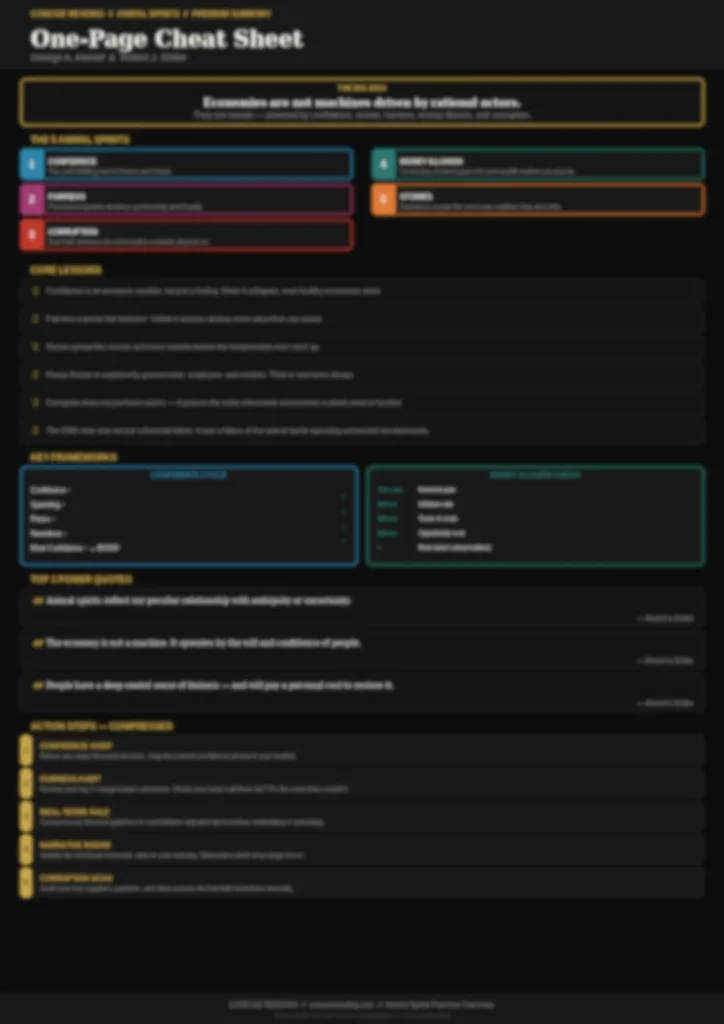
Premium Cheat Sheet Preview
About the Author
George Akerlof and Robert Shiller are both Nobel Memorial Prize-winning economists — Akerlof for his landmark work on information asymmetry, Shiller for his research on behavioral finance and asset pricing. Shiller publicly predicted both the dot-com bubble and the 2008 housing crash before either occurred. Together, they represent the most credentialed author pairing in popular economics, and this book is the direct result of their combined decades of research into why standard economic models keep failing at the moments that matter most.
Power Quote From the Book:
“The economy is not a machine that operates by itself. It operates by the will of people — by their confidence or lack of it.”
— George A. Akerlof and Robert J. Shiller, Animal Spirits
Who This Summary is For
- This is for you if…
- You are an investor who has watched models and forecasts fail at exactly the wrong moments and want a framework that actually accounts for human behavior.
- You are an entrepreneur or business owner who needs to understand market cycles, team psychology, and pricing dynamics at a level that goes beyond surface-level financial advice.
- You want to understand why the 2008 financial crisis happened — not the simplified version, but the actual psychological and structural root causes.
- You are a finance professional, economics student, or policy thinker who is frustrated that standard models keep producing the wrong answers and wants to understand why.
- You want one framework that explains market booms, busts, stubborn unemployment, persistent poverty, and irrational consumer behavior — all in one coherent model.
- (If this describes you, you may also want to look at The Economics & Economic Thinking Premium Pack — which bundles this summary with others from the same intellectual tradition.)
- Skip this if…
- You are looking for a personal finance how-to guide or a step-by-step investment manual. This book operates at the level of economic theory and mental models — it will permanently change how you interpret financial events, but it will not tell you which stocks to buy. For tactical financial guidance, our summaries of The Psychology of Money or The Intelligent Investor may be a better starting point.
Social Proof
We do not pad this page with fake stars or invented testimonials. If you have read this summary — free or premium — we genuinely want to know what you took from it. Did a framework click? Did an action step cause real discomfort in a good way? Scroll to the comments below and share your experience. The readers who follow you here will benefit from it, and so will we. The best reviews we have ever received came from people who told us exactly which idea changed how they made a decision. That is the only metric we care about.
Animal Spirits took two Nobel Prize-winning economists decades of combined research to write. The premium summary gives you the complete system — five frameworks, chapter-by-chapter breakdown, five action steps, critical analysis, and a one-page cheat sheet — in 28 pages.
(For readers who want the full behavioral economics stack, the Wall Street & Financial Markets Premium Pack and The Economics & Economic Thinking Premium Pack include this summary alongside complementary titles — available in Premium Packs.)
Related Summaries
- Thinking, Fast and Slow by Daniel Kahneman — Animal Spirits shows you that irrational forces drive economies. Kahneman shows you exactly how those irrational forces work inside your own brain. These two books together give you the complete psychological picture.
- Irrational Exuberance by Robert J. Shiller — Shiller is a co-author of Animal Spirits and this book is his most focused work on how psychological forces inflate market bubbles. It directly extends the ideas in Animal Spirits with harder data and historical depth.
- The Black Swan by Nassim Nicholas Taleb — Where Animal Spirits explains the psychological drivers of economic unpredictability, The Black Swan explains the structural reasons why extreme, unexpected events are inevitable. Read them together to understand both the human and systemic roots of financial chaos.