The Persuasion & Influence Playbook: How to Read People, Shape Decisions & Win Every High-Stakes Conversation
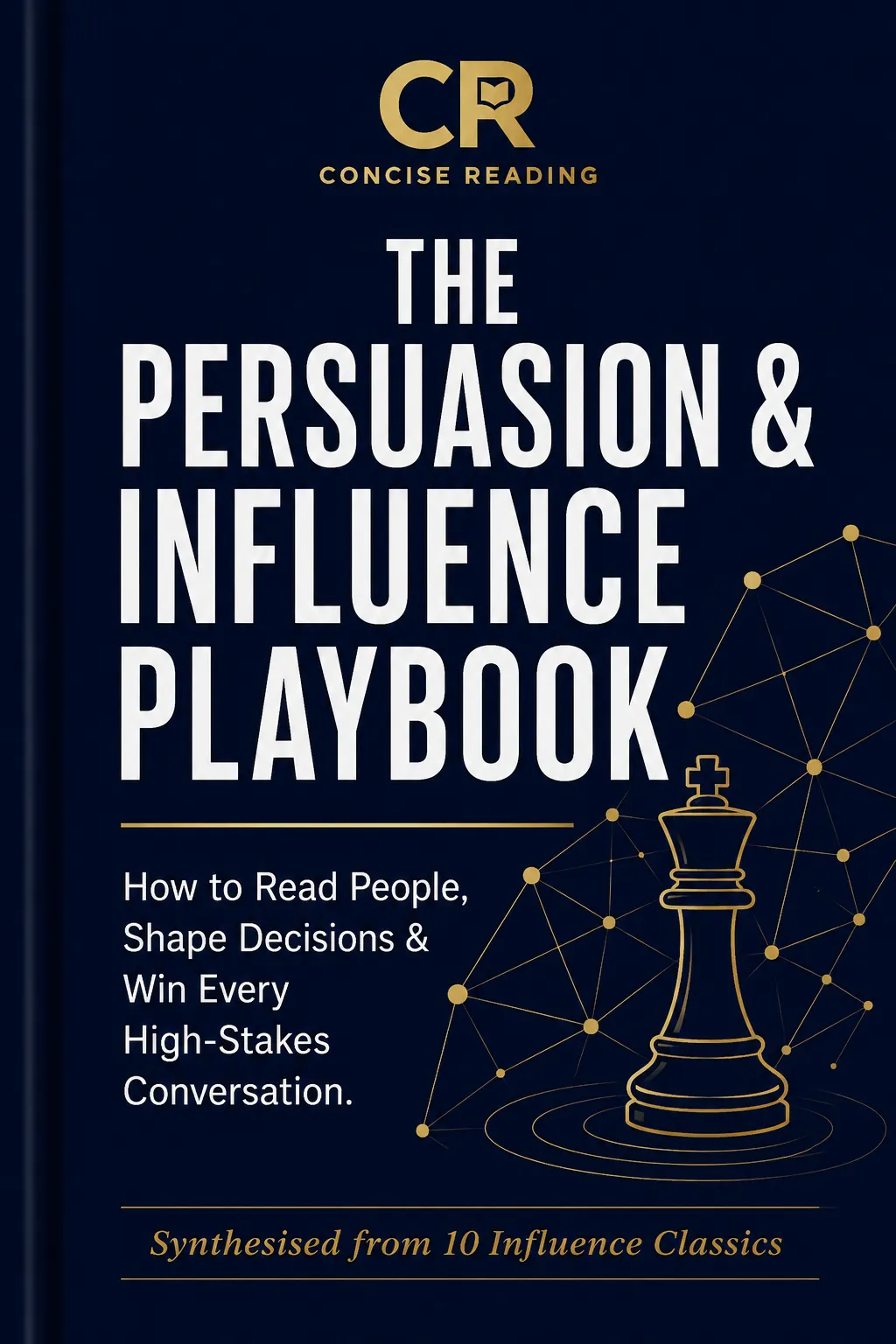
10 of the world’s most powerful influence books — Influence, Never Split the Difference, How to Win Friends and Influence People, Getting to Yes, Crucial Conversations, Made to Stick, Building a StoryBrand, Nudge, Alchemy, and Pre-Suasion — synthesized by Concise Reading into one complete, executable system.
- 10 books synthesized
- 127 pages
- 6 complete frameworks
- 1 master execution plan
- Instant download
- PDF + printable formats
The Problem — Agitate Before You Solve
You already know how to communicate. You have been doing it your entire life. And yet, there is a specific class of situation where everything breaks down. You make a clear, logical case — and the other person nods and does nothing. You go into a salary negotiation with solid numbers and come out with less than you deserved. You send a pitch or proposal you believe in completely and it gets ignored. You have watched someone less prepared, less right, and less qualified than you walk out of a room with exactly the outcome you wanted.
This is not a confidence problem. It is not a preparation problem. Here are the three specific frustrations behind it:
- You have read bits of these books — maybe Cialdini, maybe Carnegie — but you have never had a clear system for actually using what you learned in real conversations with real stakes.
- You know the theory. You do not have a step-by-step process for what to do when the theory meets a resistant counterpart, a hostile room, or a conversation you have been avoiding for months.
- You have been applying one framework at a time, in isolation, and getting inconsistent results — because none of these books was designed to work alone.
The problem is not that good information does not exist. Ten brilliant books cover everything you need to know about persuasion, negotiation, and influence. The problem is that none of them tells you how to use them all together. Cialdini gives you the triggers. Voss gives you the tactics. Carnegie gives you the relationship. But which comes first? And when do you switch? That gap — between having read great books and having a working system — is exactly what this Playbook fills. If you want a starting point before you go deeper, explore our Communication & Influence category page to see how these books fit together.
What is a Playbook ?
A Concise Reading Playbook is not a collection of separate summaries placed side by side. It is one unified guide — written by us, powered by insights from 10 books — that takes you from the core problem to a complete executable system. Every chapter synthesizes multiple books around one specific challenge you face. The result is a single guide that replaces 10 books — not one that summarises them in sequence and leaves the integration work to you.
Most business readers have experienced the frustration of finishing a great book and not knowing what to do with it. A Playbook solves that problem by doing the synthesis before it reaches you. If you are new to the format, our blog post What Is a Book Playbook? (And Why It’s Better Than Reading 10 Books Separately) explains the full logic. Here is how it compares to the alternatives:
Comparison
| Free Summary | Premium Pack | This Playbook | |
|---|---|---|---|
| Book Insights | Single Book(15–25 pp) | Multiple Books | 10 Books |
| Synthesis Across Books | No | Partial | Full |
| Unified System | No | No | Yes |
| Chapter-by-Chapter Application | No | Partial | Yes |
| 6-Week Master Action Plan | No | No | Yes |
| Master Reference Sheet | No | No | Yes |
| Price | Free | $27 – $37 | $37 |
The upgrade from a Premium Pack to a Playbook is not about more content. It is about a fundamentally different output. You are not buying 10 summaries. You are buying one system.
Table of Contents — Full Chapter Breakdown
CHAPTER 1: Why Rational Arguments Fail and What Actually Changes Minds
The foundational mindset shift: human decisions are driven by psychology, not logic — and until you understand this, every persuasion technique you apply will underperform.
Books drawn from: Influence (Cialdini) · Alchemy (Sutherland) · Nudge (Thaler & Sunstein)
Bridge to Chapter 2: Now that you understand people don’t decide rationally, the next question is: what psychological levers actually drive them — and how do you activate them ethically?
CHAPTER 2: How to Activate the Six Triggers That Make People Say Yes
How to apply Cialdini’s six principles of influence — reciprocity, commitment, social proof, authority, liking, scarcity — with precision in professional and personal contexts.
Books drawn from: Influence (Cialdini) · Pre-Suasion (Cialdini) · How to Win Friends and Influence People (Carnegie)
Bridge to Chapter 3: The six triggers tell you what activates compliance — but they only work if the relationship foundation is in place first. Without trust and rapport, scarcity feels like pressure and authority feels like arrogance.
CHAPTER 3: How to Build the Relational Foundation That Makes Every Technique Work
How to establish genuine rapport, make people feel deeply understood, and create the emotional safety that makes persuasion feel like collaboration rather than manipulation.
Books drawn from: How to Win Friends and Influence People (Carnegie) · Never Split the Difference (Voss) · Crucial Conversations (Patterson et al.)
Bridge to Chapter 4: With a solid relational foundation, you are now ready for the hardest test: high-stakes negotiations where the other party starts with an opposing position and real consequences are on the table.
CHAPTER 4: How to Negotiate Any High-Stakes Conversation and Walk Away With More Than You Came In With
How to combine Voss’s tactical empathy with Fisher and Ury’s principled negotiation framework to navigate salary discussions, business deals, conflict resolution, and any situation where two parties want different things.
Books drawn from: Never Split the Difference (Voss) · Getting to Yes (Fisher & Ury)
Bridge to Chapter 5: Negotiation assumes both parties show up willing to engage. But what about the conversations people refuse to have — or where emotion, ego, and fear shut the dialogue down before it starts?
CHAPTER 5: How to Have the Difficult Conversations That Everyone Else Avoids — and Win Them
How to use the Crucial Conversations framework to enter high-stakes, emotionally loaded dialogues without triggering defensiveness — and how to transform conflict into commitment.
Books drawn from: Crucial Conversations (Patterson et al.) · Getting to Yes (Fisher & Ury) · Never Split the Difference (Voss)
Bridge to Chapter 6: You now know how to navigate conversations one-on-one. But influence at scale — pitches, presentations, content, campaigns — requires a different skill: making your ideas stick in the minds of people who aren’t even in the room.
CHAPTER 6: How to Build Messages That Stick, Spread, and Survive in a Distracted World
How to apply the Made to Stick SUCCESs framework and the StoryBrand architecture to craft messages — for pitches, presentations, emails, or content — that are impossible to ignore and easy to repeat.
Books drawn from: Made to Stick (Heath & Heath) · Building a StoryBrand (Miller) · Pre-Suasion (Cialdini)
Bridge to Chapter 7: You can now craft a message that sticks. But the moment before you deliver it — the context, environment, and framing you set up in advance — determines whether that message lands or gets filtered out. This is where Pre-Suasion and Nudge complete the system.
CHAPTER 7: How to Design the Context, Timing, and Environment That Makes Your Message Irresistible Before You Even Speak
The complete influence system: how to use pre-suasion priming, choice architecture, and environmental cues to ensure your message is received in the most receptive psychological state possible — combining Cialdini’s Pre-Suasion with Thaler and Sunstein’s Nudge.
Books drawn from: Pre-Suasion (Cialdini) · Nudge (Thaler & Sunstein) · Alchemy (Sutherland)
Chapter 7 is the synthesis chapter — it draws the entire Playbook together into a unified influence operating system: the psychology (Chapter 1), the triggers (Chapter 2), the relationship (Chapter 3), the negotiation (Chapter 4), the difficult conversation (Chapter 5), the message (Chapter 6), and now the context that makes all of it land.
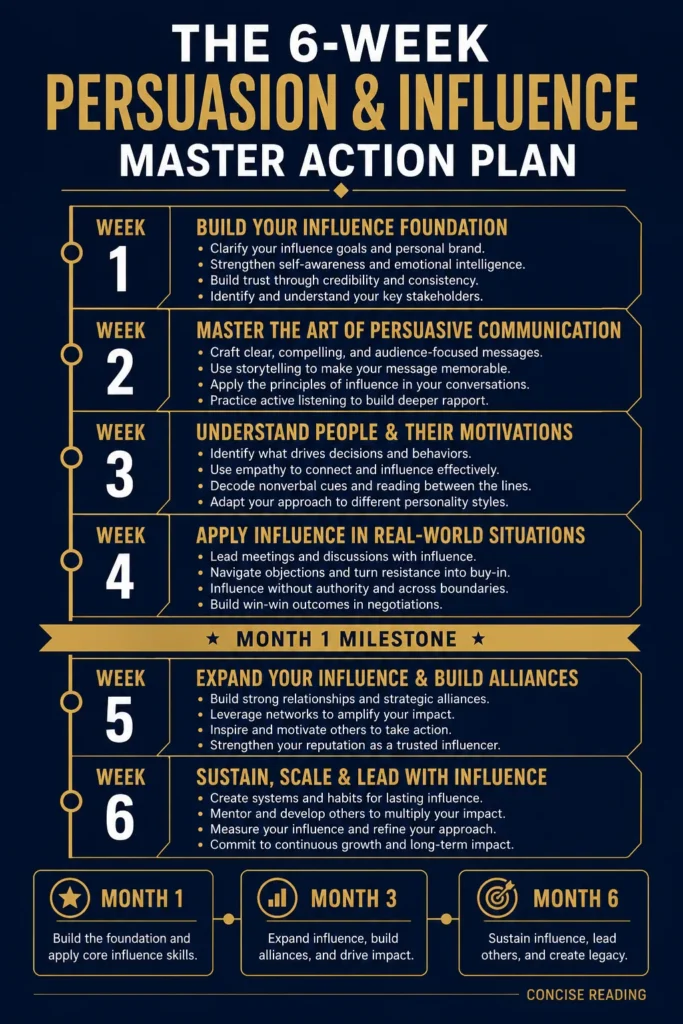
The Master Action Plan
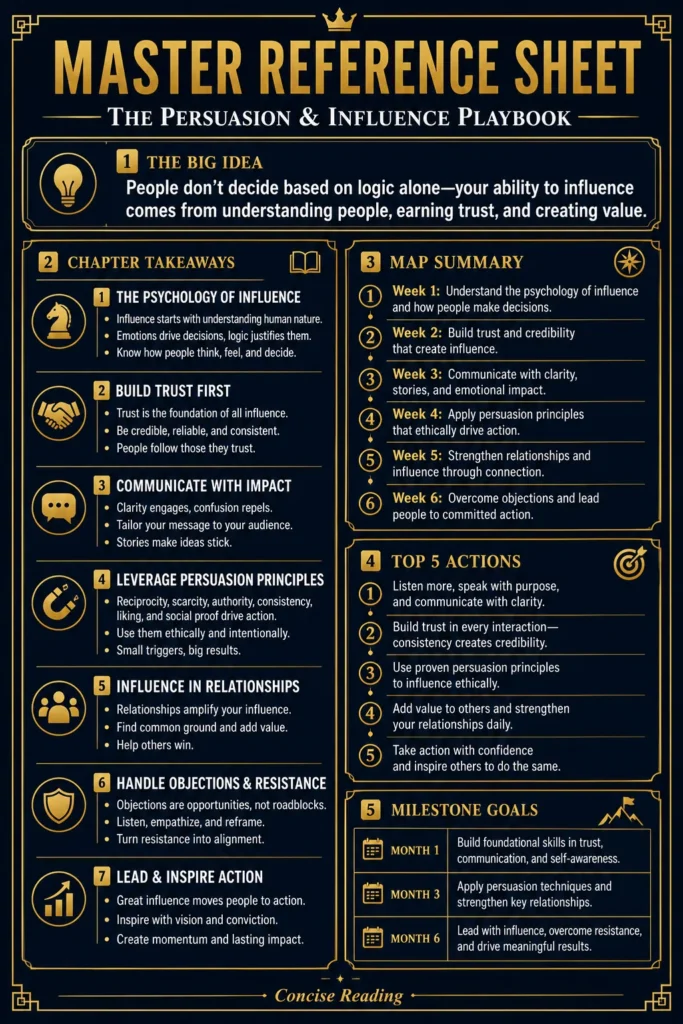
Master Reference Sheet
Books Behind This Playbook
Every book in this Playbook was selected because it contributes something the others cannot. This is not a reading list. It is an engineered stack.
- Influence: The Psychology of Persuasion — Robert B. Cialdini
- The foundational text on why humans comply. Cialdini’s six triggers — reciprocity, commitment, social proof, authority, liking, and scarcity — form the psychological backbone of the entire Playbook. If you want the full standalone treatment, our premium summary of Influence covers all six principles in full chapter-by-chapter detail. Cialdini appears in the Communication & Influence Premium Pack alongside 11 related titles.
- Never Split the Difference — Chris Voss
- Written by the FBI’s former lead hostage negotiator. Voss contributes the tactical execution layer of the system — tactical empathy, calibrated questions, mirroring, and accusation audits. His approach transforms negotiation from a positional game into an emotional intelligence exercise. Read our full premium summary of Never Split the Difference to go deeper, or find it in the Sales & Negotiation Premium Pack.
- How to Win Friends and Influence People — Dale Carnegie
- The oldest book in this stack and still the most foundational. Carnegie’s contribution is the relational operating system — the insight that all influence rests on a foundation of genuine interest, remembered names, and people who feel valued rather than used. The Sales & Negotiation category page has more on how Carnegie connects to modern negotiation frameworks.
- Getting to Yes — Roger Fisher & William Ury
- The definitive text on principled negotiation from Harvard’s Program on Negotiation. Fisher and Ury contribute the BATNA framework, the separation of people from problems, and the discipline of focusing on interests rather than positions. Paired with Voss, it gives you the complete negotiation system: framework plus tactics.
- Crucial Conversations — Kerry Patterson, Joseph Grenny, Ron McMillan & Al Switzler
- The missing book in most negotiation libraries. Crucial Conversations contributes what the other negotiation books skip: what to do when the conversation turns emotionally dangerous — when stakes are high, opinions differ, and feelings run strong. The STATE method and “mutual purpose” framework are among the most directly applicable communication tools in this Playbook.
- Made to Stick — Chip Heath & Dan Heath
- The definitive text on why some ideas survive and others die. The Heath brothers contribute the SUCCESs framework — Simple, Unexpected, Concrete, Credible, Emotional, Story — which applies to every message, pitch, or presentation in the Playbook. Our Marketing Mastery category page covers more on messaging and communication at scale.
- Building a StoryBrand — Donald Miller
- Miller contributes the language architecture — a seven-part narrative framework that clarifies every message you deliver by positioning the other person as the hero and you as the guide. This framework applies equally to a sales pitch, a job interview, a proposal, or a marketing campaign.
- Nudge — Richard Thaler & Cass Sunstein
- The Nobel Prize-winning contribution to this system. Thaler and Sunstein show that the architecture of choice — default options, sequence, and framing — shapes decisions more powerfully than logic or argument. Their work explains why even well-argued cases lose when the choice environment is wrong.
- Alchemy — Rory Sutherland
- The most counterintuitive book in the stack. Sutherland, former Vice Chairman of Ogilvy, dismantles the rationality assumption that underlies most persuasion advice and replaces it with “psycho-logic” — the insight that perception, not objective value, drives human decisions. His contribution reframes the entire system. You can explore more laterally through our blog post on consumer psychology books.
- Pre-Suasion — Robert B. Cialdini
- Cialdini’s second major contribution to this Playbook. Pre-Suasion extends the six triggers with one critical insight: the moment immediately before your message determines how it is received. What you do and say in the 30 seconds before your pitch is as important as the pitch itself. This is the capstone book of the system.
Specific Outcomes — What You’ll Be Able To Do
These are not learning objectives. They are capabilities. Each one describes something you will be able to do in a real professional situation after you complete this Playbook and its 6-week implementation plan.
- You will be able to identify the specific psychological driver operating in any counterpart before you make your case — so you stop building logical arguments for people who are not deciding logically.
- You will be able to deploy Cialdini’s six influence triggers deliberately and ethically in any professional context — a client pitch, a partnership negotiation, a team meeting, or a job interview — without the other person experiencing them as pressure.
- You will be able to build a genuine rapport and relational foundation with resistant, difficult, or skeptical counterparts using Voss’s tactical empathy and Carnegie’s relational principles — so that every subsequent technique works harder.
- You will be able to enter any salary discussion, business deal, contract negotiation, or conflict resolution conversation with a complete pre-built preparation system — BATNA, interests map, anchoring strategy, calibrated questions, and accusation audit — and leave with better outcomes than you currently get.
- You will be able to have the crucial conversations you have been avoiding — the high-stakes, emotionally loaded dialogues with a manager, partner, client, or colleague — using a tested framework that preserves the relationship while resolving the conflict.
- You will be able to craft any pitch, presentation, email, or proposal using the SUCCESs framework and StoryBrand architecture — so your message is not just heard but remembered, repeated, and acted on.
- You will be able to design the context, timing, and environment around your communication using pre-suasion and choice architecture principles — so your message lands in the most receptive psychological state before you say a single word.
- You will be able to identify when the rational, obvious solution to a persuasion problem is the wrong one — and find the counterintuitive reframe that changes the other person’s perception without changing the underlying facts.
- You will be able to use a complete, written, personal Influence Operating System — a maintained document built during the 6-week MAP — that you will use as a reference and update throughout your career.
- You will be able to point to at least one specific high-stakes outcome — a deal, a raise, a resolved conflict, a won pitch — that happened because you applied a framework from this system.
This is what a complete persuasion education looks like in practice. If you want to understand where this Playbook sits in the broader landscape of influence and communication resources, start with our Communication & Influence category page or browse the full Playbooks library.
Pricing
What it would cost otherwise
$ 150 +
- 10 original books at Avg. $15 each
- Plus months of reading time
- Plus no synthesis
- Plus no action plan
This Playbook
$ 37
- One-time. Yours forever.
- All 10 books synthesized
- 6 original frameworks
- Master 6-week action plan
- Instant PDF download
Instant download · PDF & printable · Use on any device · One-time payment
Testimonials
We built this Playbook to be the most complete, actionable synthesis of influence and persuasion thinking available in one place. But the honest measure of that is not what we say — it is what happens when you apply it.
If you have gone through The Persuasion & Influence Playbook, we genuinely want to hear from you. Which chapter changed how you approach a specific situation? Which week of the Master Action Plan was the hardest — and what did it produce? Did the negotiation template work in a real conversation? Leave your experience in the comments below. Your specific, honest feedback helps other readers decide whether this is right for them — and it helps us make the next edition sharper. We read every comment. The most detailed and honest ones always rise to the top.
FAQs
- Q: What makes this different from your premium packs? → A pack is 10-15 individual summaries on the same topic. The playbook is one unified guide that synthesizes all of them into a complete system with a master action plan. Think of the pack as individual songs and the playbook as the album — one coherent journey.
- Q: Do I need to read the original books first? → No. The playbook is completely standalone.
- Q: How is this different from Blinkist? → Blinkist gives you short summaries of individual books. This playbook does not summarize books — it synthesizes them. Every chapter uses 2–4 books to answer one specific question you face. The result is an original system, not a summary service.
- Q: How long will it take to read? → The full playbook is designed to be read in one weekend and implemented over 6 weeks using the Master Action Plan.
- Q: What format? → PDF. Readable on any device. Designed for printing if preferred.
Ten of the world’s best influence books, synthesized into one system you can start using this weekend. Cialdini on the psychology of compliance. Voss on tactical negotiation. Carnegie on the relational foundation. Fisher and Ury on principled deal-making. Patterson on the conversations everyone avoids. The Heath brothers and Miller on messages that stick. Thaler, Sutherland, and Cialdini again on the context that makes all of it land. The Master Action Plan gives you your first 6 weeks of implementation mapped to the day. Everything else is up to you.
If you are not sure whether a Playbook is right for you versus a Premium Pack, read our breakdown of the difference — it will take you three minutes and make the decision obvious. And if you want to explore the full range of what Concise Reading offers before you commit, start at our Library or browse all Playbooks.