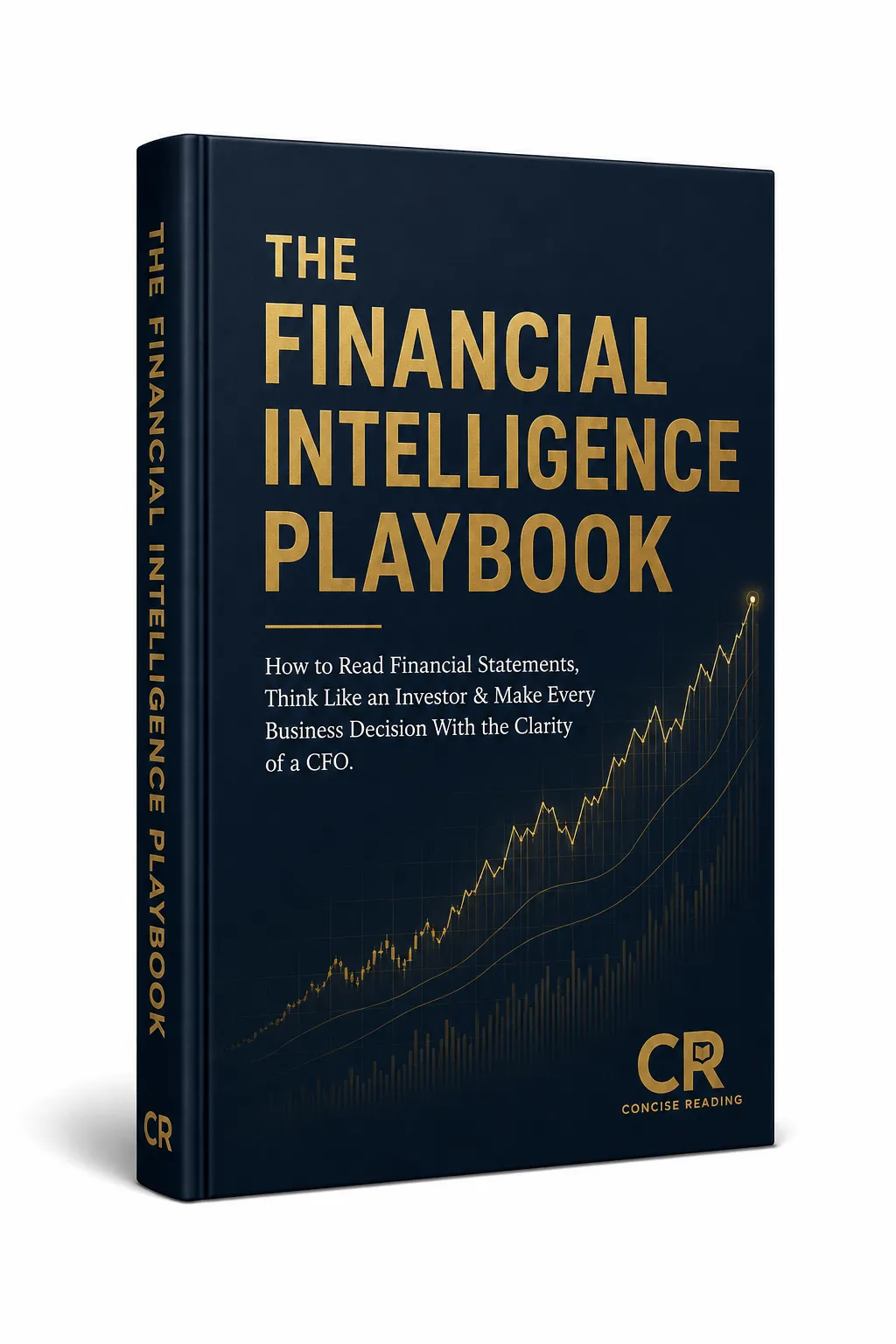
The Financial Intelligence Playbook: How to Read Financial Statements, Think Like an Investor & Make Every Business Decision With the Clarity of a CFO
Synthesised from 10 of the world’s best finance books — Financial Intelligence · Profit First · The Psychology of Money · Financial Shenanigans · Warren Buffett Accounting Book · The Goal · and 4 more — into one complete, executable system.
- 10 books synthesized
- 130 pages
- 6 complete frameworks
- 1 master execution plan
- Instant download
- PDF + printable formats
The Problem — Agitate Before You Solve
You are running a business — or trying to build wealth — and the financial side of it is the part you quietly dread.
You know your bank balance. You can feel whether a month was good or bad. But when your accountant sends you a financial report, or when someone puts a balance sheet in front of you, you nod along and hope the conversation moves on quickly. You have read bits of The Psychology of Money or Profit First but you never had a clear system to use what you learned. You know the theory. You do not have the step-by-step process. And the gap between knowing and doing is costing you — in poor investment decisions, in cash flow surprises that should not have surprised you, in a business that is technically profitable but somehow always short on cash.
Three specific frustrations you are likely carrying right now: You have never been taught to read financial statements with genuine critical judgement — just enough to get by. You are making significant financial decisions using instinct rather than a structured framework. And you suspect some of the financial information you are being given — by partners, by suppliers, by prospective investments — is not as clean as it looks, but you do not know how to verify it.
The problem is not that good information does not exist — 10 brilliant books cover everything you need to know about financial intelligence. The problem is that none of them tells you how to use them all together. Financial Intelligence teaches you to read statements but not to manage cash. Profit First fixes the cash problem but not the investment framework. The Psychology of Money fixes the mindset but not the numbers. Every book solves one problem and opens the next question. This Playbook is where all of those questions get one answer.
What is a Playbook ?
This Is Not a Summary Collection. Here Is What Makes It Different.
A Concise Reading Playbook is not a set of individual book summaries placed side by side. It is one unified guide — researched, synthesised, and written as a single system — powered by insights from 10 of the world’s best books on a single topic. Every chapter synthesises multiple books around one specific challenge you face, in the sequence that makes each challenge build on the last. The result is a complete guide that replaces 10 books — not just abbreviates them.
If you are new to Concise Reading, here is how our products are structured so you can find the right format for where you are right now.
Comparison
| Free Summary | Premium Pack | This Playbook | |
|---|---|---|---|
| Book Insights | Single Book(15–25 pp) | Multiple Books | 10 Books |
| Synthesis Across Books | No | Partial | Full |
| Unified System | No | No | Yes |
| Chapter-by-Chapter Application | No | Partial | Yes |
| 6-Week Master Action Plan | No | No | Yes |
| Master Reference Sheet | No | No | Yes |
| Price | Free | $27 – $37 | $37 |
If you want deep individual summaries of every source book used here, the Financial Intelligence & Analysis Pack and Accounting & Bookkeeping Pack cover each book in 25–35 pages. Many readers get the Playbook first, then use the Packs to go deeper on specific books that resonate.
Table of Contents — Full Chapter Breakdown
Chapter 1 — Read Financial Statements Without Being Fooled
- Every figure on a financial statement is the result of a judgement call — not a fixed fact. Revenue recognition timing, depreciation rates, and inventory valuations are chosen, not discovered.
- The cash flow statement is the hardest to manipulate and therefore the most reliable indicator of true business health. When profit is high but operating cash flow is low, investigate before trusting.
- Your three core ratios to monitor monthly: Current Ratio (liquidity), Gross Profit Margin (efficiency), Operating Cash Flow to Net Income (conversion quality).
Chapter 2 — Detect Financial Manipulation
- The seven manipulation categories (revenue inflation, expense hiding, asset inflation, liability hiding, cash flow manipulation, metric distortion, and acquisition shenanigans) follow predictable patterns that show up in the same places every time.
- Receivables growing faster than revenue is one of the single strongest early warning signs of revenue manipulation. Run this check on any financials you are asked to trust.
- Your forensic checklist is not for paranoia — it is for calibration. Most financials are honest but imprecise. The checklist helps you find the imprecision before it costs you.
Chapter 3 — Find and Eliminate Your Business Constraint
- Every system has exactly one primary constraint at any given time. Improving anything other than the constraint does not improve the system — it only improves that part, while the constraint continues to restrict throughput.
- The five focusing steps (Identify, Exploit, Subordinate, Elevate, Repeat) are the complete operating framework for constraint management. Apply them in sequence, not simultaneously.
- The financial cost of your constraint is the most important number in your business that most business owners have never calculated. Calculate it this week.
Chapter 4 — Profit First Cash Flow System
- The traditional accounting formula (Revenue – Expenses = Profit) guarantees that profit is whatever survives the expenses. The Profit First formula (Revenue – Profit = Expenses) guarantees that profit is non-negotiable.
- The physical separation of money into four accounts (Profit, Owner’s Pay, Tax, Operating Expenses) is the mechanism — not the concept. Without the accounts, it is only a theory.
- Start with the allocation percentages you can actually hit today. Increase them incrementally every quarter. The habit of allocation matters more than the starting percentage.
Chapter 5 — Financial Psychology and Decision-Making
- Your financial decisions are not primarily driven by analysis. They are driven by emotional patterns, inherited beliefs, and cognitive shortcuts. Knowing this is the beginning of financial intelligence — not the end.
- The “enough” number is one of the most protective financial frameworks available to you. Without it, you will take risks you do not need to take, to reach a number you keep moving.
- Written financial decision rules, made in calm before the emotional pressure of a real decision, are significantly more reliable than in-the-moment analysis.
Chapter 6 — Evaluate Investments Like Buffett
- The four filters (understand the business, durable competitive advantage, management quality, margin of safety) are a sequential elimination framework — not a scoring system. One failed filter eliminates the investment.
- Intrinsic value is not a precise number — it is a range. The margin of safety exists because your estimate is always uncertain. If you need the price to be exactly right for the investment to work, the margin of safety is gone.
- The durable competitive advantage (moat) is the single most important filter. A great business at a fair price almost always outperforms a fair business at a great price.
Chapter 7 — Your Complete Financial Operating System
Financial intelligence is not a destination. It is a discipline. The system you have built over these seven chapters is only valuable if it is maintained.
The six systems (financial literacy, forensic filter, constraint identification, cash flow restructuring, psychological framework, investment evaluation) are not independent — they feed each other. Profit First only works well when your financial literacy allows you to read the results accurately.
A financial operating system is not a one-time project — it is a recurring set of practices. Monthly financial statement reviews, quarterly Profit First target adjustments, and annual investment framework reviews keep the system functioning.
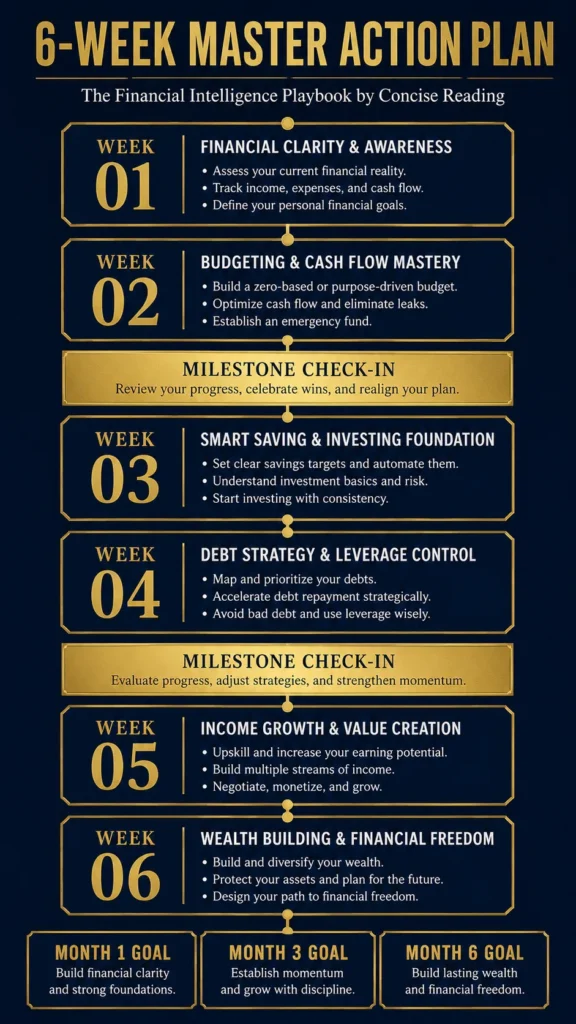
The Master Action Plan
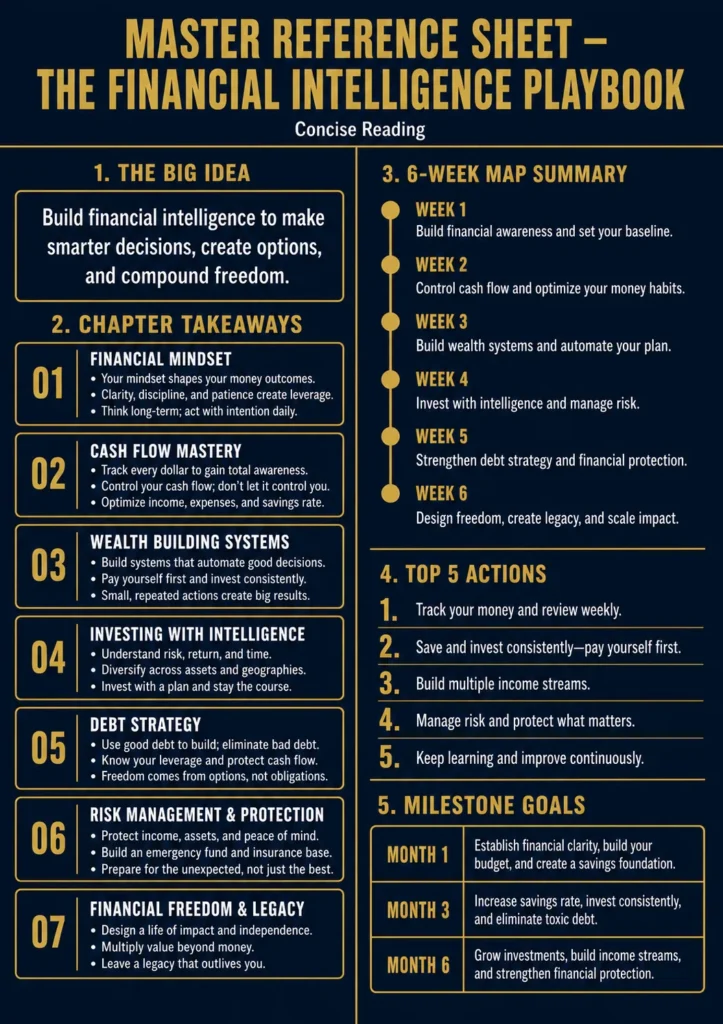
Master Reference Sheet
Books Behind This Playbook
These are not ten randomly selected finance books. Each one was chosen because it contributes something the others do not. Together, they cover every layer of financial intelligence you need — from technical statement reading to behavioural psychology to forensic fraud detection to investment evaluation. Here is what each book specifically contributes to this Playbook:
- Financial Intelligence — Karen Berman & Joe Knight
- The foundation of the entire Playbook. Teaches you to read financial statements as judgements and estimates — not fixed facts — and to ask the questions that turn you from a passive receiver of financial information into an active analyst.
- Financial Statements — Thomas Ittelson
- Provides the clearest visual explanation of how the income statement, balance sheet, and cash flow statement connect. Contributes the three-statement mapping framework in Chapter 1.
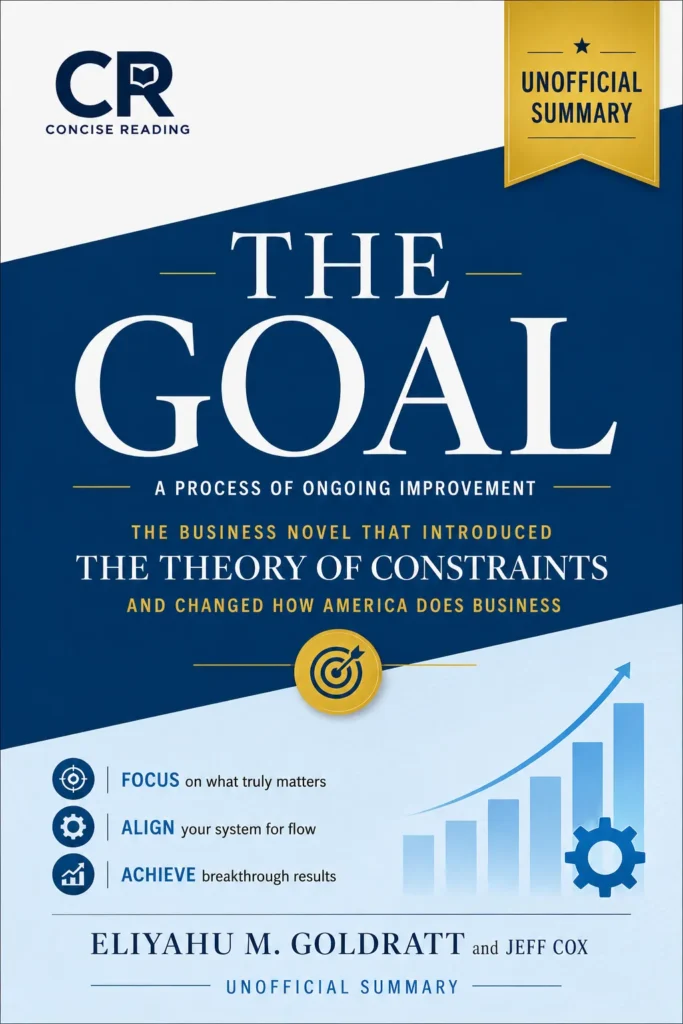
- The Goal — Eliyahu M. Goldratt
- Introduces the Theory of Constraints — the insight that every system has exactly one primary bottleneck limiting throughput, and that optimising anything else does not improve the system. Contributes Chapter 3’s constraint identification framework.
- Profit First — Mike Michalowicz
- Rewires how you allocate cash by reversing the traditional formula. Profit is taken first; expenses are funded from what remains. Contributes the complete cash restructuring system in Chapter 4.
- Warren Buffett Accounting Book — Stig Brodersen & Preston Pysh
- Translates Buffett’s investment methodology into a practical four-filter framework for evaluating whether any business has durable competitive advantages worth investing in. Contributes Chapter 6’s investment evaluation system.
- Accounting Game — Darrell Mullis & Judith Orloff
- Uses a lemonade stand metaphor to make double-entry bookkeeping and balance sheet mechanics genuinely intuitive without jargon. Supports Chapter 1’s technical foundation.
- Rich Dad’s Guide to Investing — Robert Kiyosaki
- Reframes investing as a business-owner’s discipline — understanding cash flow, asset vs. liability thinking, and the cash flow quadrant. Contributes Chapter 5’s mindset framework alongside Housel.
- The Psychology of Money — Morgan Housel
- Explains why financially intelligent people consistently make irrational financial decisions — and how to design your financial behaviour around your psychology rather than pretending it does not exist. Contributes Chapter 5’s bias identification and decision-rule framework.
- Corporate Finance — Pierre Vernimmen et al.
- Provides the institutional framework: how businesses are valued, how capital is structured, and how investment decisions are made at the highest level. Supports Chapters 3 and 6 with the corporate finance lens.
- Financial Shenanigans — Howard Schilit
- Exposes the seven most common techniques companies use to manipulate financial results — and provides a forensic checklist to identify deception before you invest, partner, or trust a set of numbers. Contributes Chapter 2’s forensic filter system.
Interested in individual deep-dives on these books? Browse the Financial Intelligence & Analysis category and the Accounting & Bookkeeping category for 25–35 page premium summaries with full chapter breakdowns.
Specific Outcomes — What You’ll Be Able To Do
This Playbook is not about what you will know. It is about what you will be able to do. After working through the seven chapters and the 6-Week Master Action Plan:
You will be able to look at your monthly financial statements and write a one-paragraph plain-English narrative about the true health of your business — not a number recitation, but a genuine diagnosis.
You will be able to read an income statement, balance sheet, and cash flow statement — and identify the assumptions, estimates, and editorial choices embedded in every line, rather than reading the numbers as fixed facts.
You will be able to apply a forensic checklist to any financial document — spotting the seven most common manipulation techniques used to inflate revenue, hide expenses, and misrepresent a company’s financial position, before you invest or partner.
You will be able to map your business as a system and identify your primary constraint — the single bottleneck that is costing you more throughput and revenue than anything else you are currently optimising for.
You will be able to restructure your business cash flow using the Profit First system — so that profit is allocated before expenses are paid, making profitability structural rather than accidental.
You will be able to identify your dominant financial biases — the specific emotional patterns and cognitive shortcuts that have driven your most costly financial decisions — and apply pre-committed decision rules that prevent them from repeating.
You will be able to define your personal “enough” number — the specific income, net worth, and business revenue targets that protect you from taking risks you do not need to take in pursuit of a goalpost you keep moving.
You will be able to evaluate any business or investment opportunity through Buffett’s four-filter framework — understanding the business, identifying the moat, assessing management quality, and calculating the margin of safety — before committing a dollar.
You will be able to calculate a rough intrinsic value estimate for any business or stock and determine whether the current price offers a genuine margin of safety or an overpriced entry point.
You will be able to run a complete financial operating system — combining statement reading, forensic analysis, constraint management, cash allocation, psychological decision rules, and investment evaluation into one integrated practice you maintain monthly.
Pricing
What it would cost otherwise
$ 150 +
- 10 original books at Avg. $15 each
- Plus months of reading time
- Plus no synthesis
- Plus no action plan
This Playbook
$ 37
- One-time. Yours forever.
- All 10 books synthesized
- 6 original frameworks
- Master 6-week action plan
- Instant PDF download
Instant download · PDF & printable · Use on any device · One-time payment
Testimonials
What Readers Are Saying
This Playbook is built for people who are done with surface-level finance content — and ready to implement a real system. If you have worked through the chapters and the 6-Week Master Action Plan, your experience is worth sharing.
Did the Profit First system change how your business manages cash? Did the forensic checklist from Chapter 2 catch something in a set of financials you were reviewing? Did the four-filter framework stop you from making an investment you now realise was not sound?
Leave your experience in the comments below. Be specific — the more concrete your result, the more useful it is to someone who is deciding whether this Playbook is right for them. Every comment is read. Your experience directly shapes how this Playbook is updated and improved.
Already read other Concise Reading products? You can also share feedback on individual summaries in the Library or browse the Playbooks page to see what other readers have implemented.
FAQs
- Q: What makes this different from your premium packs? → A pack is 10-15 individual summaries on the same topic. The playbook is one unified guide that synthesizes all of them into a complete system with a master action plan. Think of the pack as individual songs and the playbook as the album — one coherent journey.
- Q: Do I need to read the original books first? → No. The playbook is completely standalone.
- Q: How is this different from Blinkist? → Blinkist gives you short summaries of individual books. This playbook does not summarize books — it synthesizes them. Every chapter uses 2–4 books to answer one specific question you face. The result is an original system, not a summary service.
- Q: How long will it take to read? → The full playbook is designed to be read in one weekend and implemented over 6 weeks using the Master Action Plan.
- Q: What format? → PDF. Readable on any device. Designed for printing if preferred.
Ten of the world’s best finance books — covering financial statement literacy, forensic analysis, cash flow management, constraint theory, investment psychology, and Buffett-style investment evaluation — synthesised into one system you can start using this weekend.
The 6-Week Master Action Plan gives you your first six weeks of implementation — day by day, action by action, with specific outputs and done-when criteria for every step. The Master Reference Sheet compresses the entire system onto two printable pages you can pin to your wall.
Most people will read this, feel the gap in their financial education close slightly, and then do nothing. You are not most people — which is presumably why you have read this far. Everything after this is up to you.
Want to understand how this fits with the rest of the Concise Reading library? Browse all Playbooks, explore the Premium Packs, or start here if you are new.