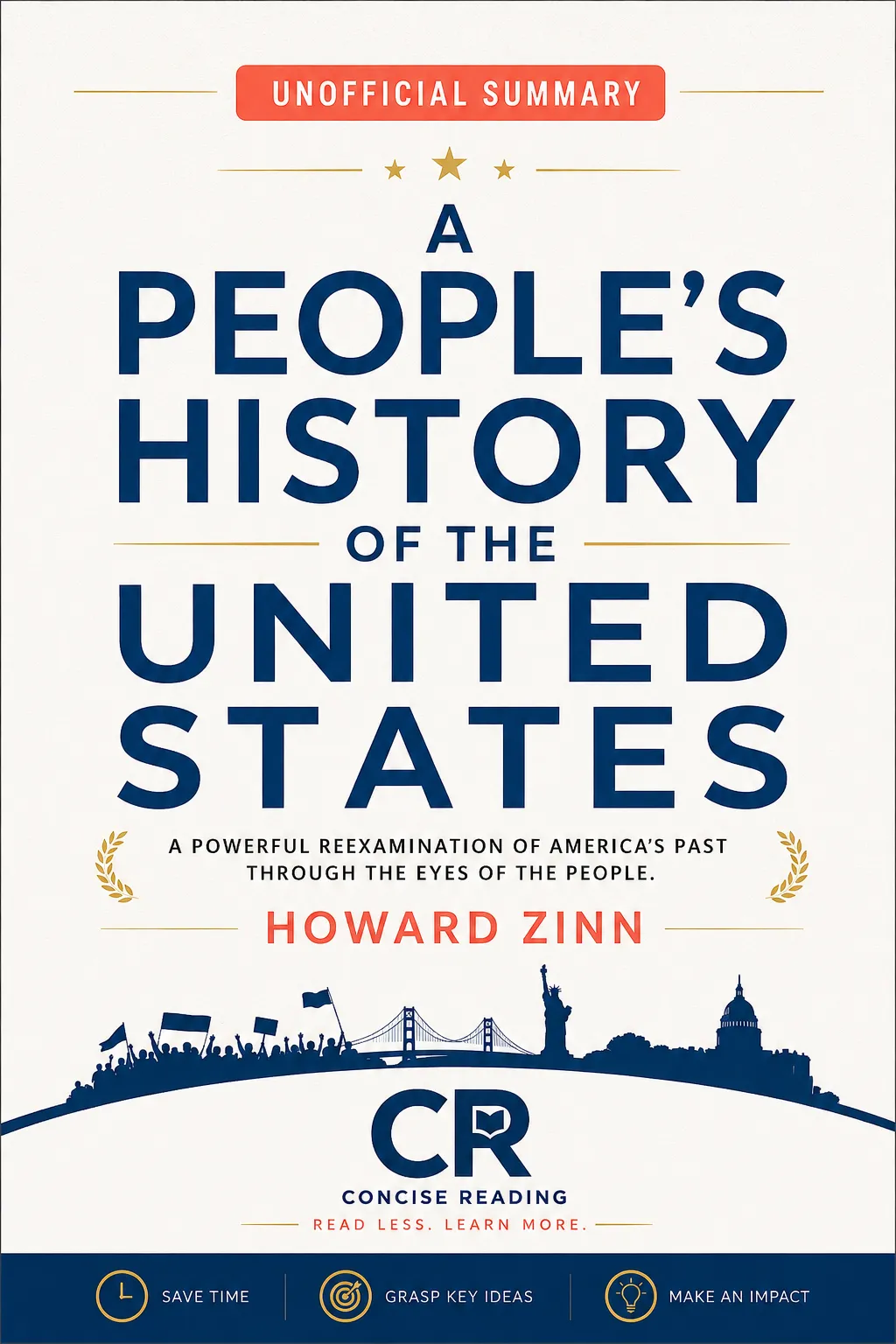
A People’s History of the United States by Howard Zinn — Summary & Key Lessons
What this book will teach you in the next 10 minutes — and why it matters for how you think about money, power, and the economic system you operate in every single day.
Read by analysts, investors, entrepreneurs, and independent thinkers who want to understand how the system was actually built — not just how it presents itself.
Book Snapshot
- Author – Howard Zinn
- Category – History / Politics & Society / Social Justice
- Original Book – ~ 729 pages. Average read time at 250 words per minute: approximately 10 to 12 hours.
- Free Summary – 08 pages
- Premium Summary – 49 pages. Estimated read time: 35 to 45 minutes.
The Big Idea
Every version of history is told from somewhere. For most of recorded American history, that somewhere was the top — by the wealthy, the powerful, and those with the most to lose if the real story got out. Howard Zinn spent his career asking what American history looks like when you tell it from the bottom up: from the perspective of slaves, Indigenous people, factory workers, women, and dissidents. What he found was not a story of inevitable progress. It was a documented record of deliberate design — a system built, enforced, and defended by specific people with specific economic interests. Understanding that is not cynicism. It is clarity. And clarity is the most useful tool any serious thinker can carry.
What You’ll Learn — Key Lessons Preview
- You will understand exactly how the American economic and legal system was constructed — not from textbook idealism, but from the primary source record of who benefited and who paid.
- You will gain a four-step framework for interrogating any narrative — political, economic, or corporate — and identifying whose interests it protects and whose it conceals.
- You will see a documented, repeating five-stage cycle that explains how ruling-class power has been accumulated, codified, and preserved across five centuries — and how to recognize it operating in any industry today.
- You will learn why every major improvement in workers’ rights, civil rights, and economic fairness in American history came from organized pressure from below — never from elite generosity — and what that means for building real change in any organization or system.
- You will walk away with a mental model for decoding the moral and national-interest language used to disguise economic class interests in policy, media, and institutional decisions — one of the most practically valuable analytical tools available to any professional.
Free vs Premium Comparison
| Free – $0 | Premium – $4.99 (Recommended) |
| ➡ Book Snapshot ➡ The Big Idea ➡ Key Lessons ➡ Power Quotes ➡ 08 Pages | ✔ Everything in free + ✔ Full Chapter Breakdown ✔ Key frameworks & diagrams ✔ Action steps ✔ Critical analysis ✔ One-page cheat sheet ✔ 49 pages |
Premium Cheat Sheet Preview

About the Author
Howard Zinn was an American historian, political activist, and former World War II bombardier who taught political science at Boston University for over two decades. He earned his PhD from Columbia University and was a direct participant in the Civil Rights Movement as an advisor to SNCC in the 1960s. A People’s History of the United States, first published in 1980, has sold over three million copies and remains one of the most widely read history books ever written in English.
Power Quote From the Book:
“Nations are not communities and never have been. The history of any country, presented as the history of a family, conceals fierce conflicts of interest between conquerors and conquered, masters and slaves, capitalists and workers, dominators and dominated in race and sex.”
— Howard Zinn, A People’s History of the United States
Who This Summary is For
- This is for you if…
- You are an entrepreneur, investor, or business professional who has succeeded within the system and now wants to understand the actual foundations of the system — not the version that flatters it.
- You are an analyst, strategist, or policy professional who suspects that the economic narratives you receive from institutions and media are incomplete, and you want a more accurate analytical framework.
- You want to understand why labor rights, civil rights, and economic regulation exist — where they actually came from and what was paid to get them — because that context changes how you lead, manage, and operate.
- You are a serious reader who values intellectual honesty and is not satisfied with history that erases inconvenient evidence to produce a cleaner story.
- You want a mental model for cutting through political and corporate language to identify who benefits from any given policy, narrative, or decision — and you want it built on five hundred years of documented historical evidence.
- Skip this if…
- You are looking for a balanced, neutral textbook treatment of American history that presents all sides with equal weight — Zinn is explicitly not that, and does not pretend to be. Also skip this if you want operational business tactics. This summary operates at the level of worldview and structural understanding. The payoff is analytical clarity, not a to-do list.
Social Proof
This summary was built to hold up under scrutiny — not just to be readable, but to be genuinely useful to professionals who think critically about the world they operate in. If you have read the free or premium version, we would genuinely like to know what landed for you, what challenged you, and what you would add. Leave your experience in the comments below. Every serious reader who shares their perspective makes this resource sharper for the next one. There are no fake five-star reviews here — just honest responses from people who took the time to read carefully. Yours matters.
A People’s History of the United States took Howard Zinn decades of primary source research, direct movement participation, and a lifetime of intellectual confrontation with the official record to produce — the premium summary gives you the complete analytical system, four ready-to-use frameworks, five curated power quotes with practical context, five specific action steps, a full critical analysis, and a one-page cheat sheet in under 45 minutes.
Related Summaries
- Capital in the Twenty-First Century by Thomas Piketty — If Zinn shows you the human story of inequality, Piketty gives you the mathematical proof. His landmark analysis of wealth concentration across centuries directly extends the economic arguments Zinn makes about class and power.
- The Wealth of Nations by Adam Smith — Reading Zinn without reading Smith creates a blind spot. Smith’s foundational arguments about markets, labor, and capital are what Zinn is often responding to. Understanding both gives you the full ideological battlefield.
- Freakonomics by Steven Levitt and Stephen Dubner — A very different tone, but a deeply compatible lesson: incentives drive behavior, and official explanations are frequently wrong. Freakonomics trains the same skeptical muscle that Zinn demands you use — just in a lighter, data-driven package.