
Accounting Principles by Weygandt, Kimmel & Kieso — Summary & Key Lessons
What this book will teach you in the next 10 minutes — and why it matters for your business, your money, and every financial decision you’ll ever make.
Part of the Accounting & Bookkeeping category — one of book summaries in the Concise Reading Library. Read by business owners, students, and professionals who want financial clarity without a four-year degree.
Book Snapshot
- Author – Jerry J. Weygandt, Paul D. Kimmel, Donald E. Kieso
- Category – Finance & Accounting / Business Fundamentals
- Original Book – ~ 1,280 pages | Average read time: 42–50 hours
- Free Summary – 08 pages
- Premium Summary – 44 pages | Estimated read time: 45–60 minutes
The Big Idea
Most people hand their finances to an accountant and call it done. That’s not financial management — that’s financial avoidance. Accounting Principles by Weygandt, Kimmel & Kieso argues that every business decision has an accounting consequence, and the person who can read the numbers controls the outcome. Built on one foundational equation — Assets = Liabilities + Equity — the book teaches you how money enters a business, moves through it, and leaves it, and how to tell the difference between a business that is genuinely healthy and one that only looks that way on paper.
What You’ll Learn — Key Lessons Preview
- You’ll understand exactly what a balance sheet, income statement, and cash flow statement tell you — and why reading just one of them is like diagnosing a patient from a single symptom
- You’ll learn why profitable businesses fail, and how the gap between net income and actual cash flow is the silent killer behind most of those failures
- You’ll be able to spot the accounting red flags that reveal financial manipulation — in other companies’ statements and your own books
- You’ll know how to build internal controls that close the most common fraud and error vulnerabilities in any business with more than one person handling money
- You’ll walk away with a working command of the complete accounting cycle — from recording the first transaction to producing a clean set of financial statements at period end
Free vs Premium Comparison
| Free – $0 | Premium – $4.99 (Recommended) |
| ➡ Book Snapshot ➡ The Big Idea ➡ Key Lessons ➡ Power Quotes ➡ 08 Pages | ✔ Everything in free + ✔ Full Chapter Breakdown ✔ Key frameworks & diagrams ✔ Action steps ✔ Critical analysis ✔ One-page cheat sheet ✔ 44 pages |
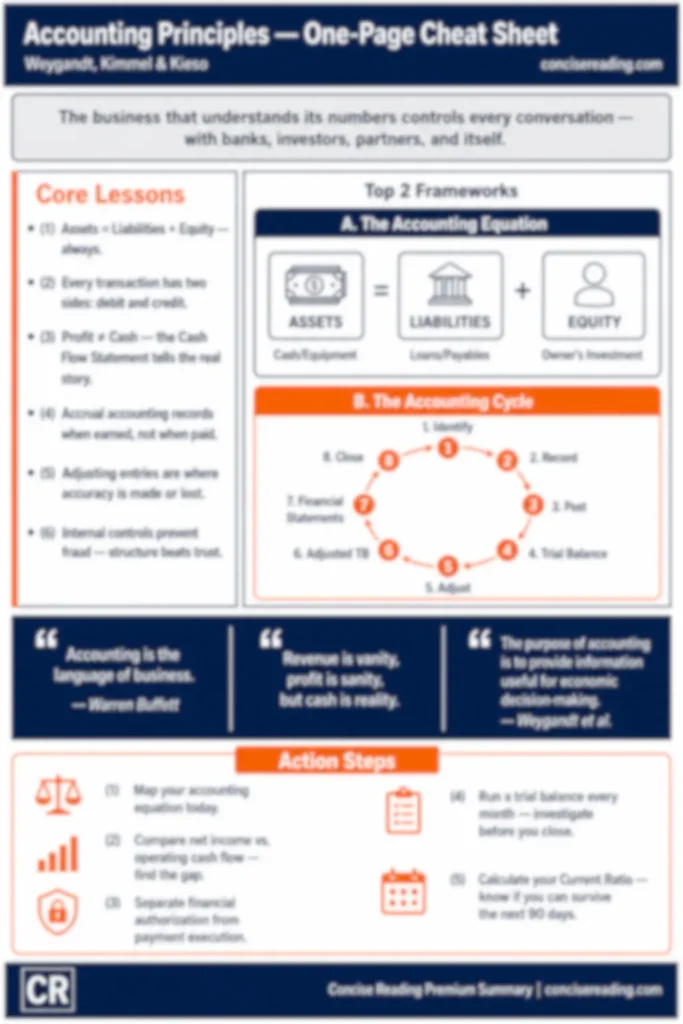
Premium Cheat Sheet Preview
About the Author
Jerry J. Weygandt, Paul D. Kimmel, and Donald E. Kieso are three of the most decorated accounting educators in the United States, collectively holding Emeritus professorships at the University of Wisconsin and Northern Illinois University. Kieso’s Intermediate Accounting has been the standard CPA exam preparation text in North America for over four decades. Together, their textbooks have educated millions of accounting students worldwide — and Accounting Principles is their most accessible entry point for non-specialists.
Power Quote From the Book:
“The purpose of accounting is to provide information that is useful for economic decision-making.”
— Weygandt, Kimmel & Kieso, Accounting Principles
Who This Summary is For
- This is for you if…
- You are a small business owner or solopreneur who delegates all financial tasks and knows, privately, that you shouldn’t
- You are a professional being pushed into budget ownership and need to stop nodding along in finance meetings
- You are an early-stage investor who wants to evaluate companies beyond revenue figures and pitch decks
- You are a student who wants real understanding of accounting — not just exam prep
- You want the financial literacy to read any company’s numbers and know immediately whether the story adds up
- Skip this if…
- You are a practicing CPA or accounting professional looking for advanced technical depth — this summary is built for people building financial literacy from the ground up, not for specialists expanding it. If that’s you, the Financial Statement Analysis summary or Corporate Finance summary will serve you better.
Testimonials
This summary is part of Concise Reading’s Accounting & Bookkeeping library. We’re building something readers can trust — and the most useful signal we have is honest feedback from people who’ve actually used these summaries in their work and studies. If you read this summary and it changed how you think about your finances, clarified something that had been confusing, or helped you make a better decision — share it in the comments below. Your experience helps other readers know exactly what they’re getting before they commit. We read every comment.
Accounting Principles took three of the most respected accounting educators in the world decades of classroom refinement to produce. The premium summary gives you the complete system — every major framework, five curated power quotes, five immediately actionable steps, a full critical analysis, and a one-page cheat sheet designed to be saved permanently — in 44 focused pages.
If you found the free summary useful, the premium version is where it becomes a working tool. And at $4.99, it costs less than the coffee you’ll drink while reading it.
Not sure which format is right for you? The Free vs Premium guide explains exactly what’s in each. Or if you’re building broader financial literacy, the Accounting & Bookkeeping Premium Pack bundles 12 summaries — including this one — at a significant discount.
Related Summaries
- Financial Intelligence — Karen Berman & Joe Knight – A more narrative, less textbook approach to financial literacy. Where Accounting Principles teaches you the mechanics, Financial Intelligence teaches you how executives actually use financial data to make decisions. A natural next step.
- Profit First — Mike Michalowicz – Takes the cash flow lesson from this summary and builds an entire operating system around it. If the gap between profit and cash resonated with you, this book solves that problem practically for small business owners.
- Financial Statement Analysis — Martin Fridson & Fernando Alvarez – The logical upgrade once you understand basic principles. This book teaches you how to read between the lines of financial statements — spotting manipulation, assessing quality of earnings, and evaluating businesses the way analysts and serious investors do.
[…] Accounting Principles (available in our Free Summaries) […]
[…] you’re interested in expanding your financial knowledge further, explore related summaries like Accounting Principles and Accounting for Dummies available in our […]
[…] Accounting Principles […]