Den of Thieves by James B. Stewart — Summary & Key Lessons
What this book will teach you in the next 10 minutes — and why it matters for your career, your investments, and every organization you will ever trust with your money.
Used by finance professionals, MBA students, and serious investors. Part of the Concise Reading library of business and money book summaries — built for people who read to act, not just to finish.
Book Snapshot
- Author – James B. Stewart
- Category – Financial Crime / Wall Street History / Business Ethics
- Original Book – 560 pages, approximately 11-14 hours average read time.
- Free Summary – 08 pages
- Premium Summary – 34 pages, approximately 35-45 minutes read time.
The Big Idea
In the 1980s, a small network of Wall Street insiders — including Ivan Boesky, Michael Milken, Dennis Levine, and Martin Siegel — built the most sophisticated insider trading operation in American financial history. They were not desperate men. They were already rich, celebrated, and powerful. What drove them was something more disturbing than need: a culture that rewarded winning at any cost and never asked how results were achieved. Den of Thieves is not a crime story. It is a systems failure story — and the system it describes is still running.
What You’ll Learn — Key Lessons Preview
- You will understand exactly how insider trading networks form, operate, and survive for years inside legitimate institutions — so you can recognize the warning signs in any organization.
- You will see how a culture that celebrates results without scrutinizing methods is not just ethically weak — it is a ticking structural failure, whether you are inside a bank, a startup, or a sales team.
- You will learn why the most dangerous professional compromises are never the dramatic ones — they are the small ones that accumulate quietly until exit becomes impossible.
- You will walk away with a practical framework for auditing your own organization’s ethical culture — using the same dynamics that kept this network invisible for years.
- You will understand the Cascade Collapse Model: why corrupt systems appear stable for a long time, then fail completely and suddenly when a single thread is pulled.
Free vs Premium Comparison
| Free – $0 | Premium – $4.99 (Recommended) |
| ➡ Book Snapshot ➡ The Big Idea ➡ Key Lessons ➡ Power Quotes ➡ 08 Pages | ✔ Everything in free + ✔ Full Chapter Breakdown ✔ Key frameworks & diagrams ✔ Action steps ✔ Critical analysis ✔ One-page cheat sheet ✔ 34 pages |
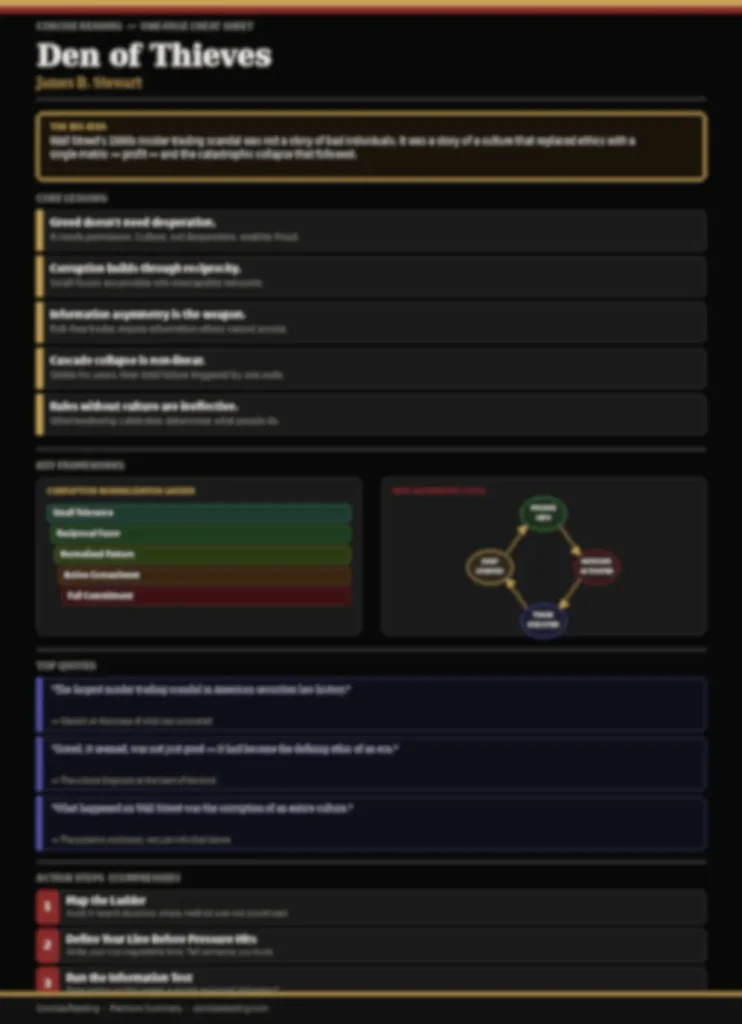
Premium Cheat Sheet Preview
About the Author
James B. Stewart is a Pulitzer Prize-winning journalist, Yale Law graduate, and former front-page editor of The Wall Street Journal. He won the Pulitzer Prize specifically for his coverage of the insider trading scandals documented in this book, making Den of Thieves the definitive account by the journalist who broke the story. He later became a professor at Columbia University’s Graduate School of Journalism and a columnist at The New York Times.
Power Quote From the Book:
“What had happened on Wall Street wasn’t just a series of individual crimes, but the corruption of an entire culture.”
— James B. Stewart, Den of Thieves
Who This Summary is For
- This is for you if…
- You are a finance professional, investor, or MBA student who wants to understand the real history behind modern securities law and market regulation.
- You are a business leader or founder who wants a vivid, documented case study of exactly what happens when organizational culture stops asking how results are achieved.
- You want to understand how information asymmetry works in practice — not in theory — and what separates legitimate advantage from illegal exploitation.
- You are building or evaluating an organization and want a practical lens for diagnosing whether its culture is creating ethical risk you cannot yet see.
- You read The Big Short, Liar’s Poker, or Bad Blood and want more — this is the book those books orbit around.
- Skip this if…
- You are looking for a tactical investing guide or a step-by-step wealth-building system. This is investigative narrative and cultural history — it will change how you think, not what you trade. For that, start with our summary of The Intelligent Investor or A Random Walk Down Wall Street.
Social Proof
We do not manufacture credibility with fake reviews. Instead, we ask you to be part of building something real. If you have read this summary — free or premium — scroll down and leave a comment. Tell us which lesson hit hardest, which framework you are taking into your work this week, or what question it left you with. Every honest response helps the next reader decide whether this is right for them. Your experience is the most useful thing on this page.
Den of Thieves took James B. Stewart years of access, investigation, and legal expertise to produce 560 pages of the most important financial history written in the last four decades. The premium summary gives you the complete system — four actionable frameworks, five power quotes with context, chapter-by-chapter breakdown, and a one-page cheat sheet — in under 45 minutes.
Related Summaries
- Liar’s Poker by Michael Lewis — A first-person account of Wall Street’s ruthless bond trading culture in the same era. Pairs directly with Den of Thieves as a cultural portrait of 1980s finance.
- The Big Short by Michael Lewis — Shows how a different generation of Wall Street insiders exploited information asymmetry and systemic failures, this time in the mortgage market. Same disease, different decade.
- Bad Blood by John Carreyrou — The most compelling modern story of how fraud, unchecked ambition, and a culture of silence nearly destroyed a company and harmed thousands of people. Essential reading for anyone interested in how institutional deception actually operates.