Dynamic Hedging by Nassim Nicholas Taleb — Summary & Key Lessons
What this book will teach you in the next 10 minutes — and why it matters for how you manage risk, protect your portfolio, and survive what the market throws at you next.
Read by options traders, risk managers, and serious investors who want the real framework behind derivatives — not the textbook version.
Book Snapshot
- Author – Nassim Nicholas Taleb
- Category – Finance & Investing / Derivatives & Risk Management
- Original Book – Approximately 506 pages. Average read time at standard pace: 16 to 20 hours.
- Free Summary – 08 pages
- Premium Summary – 28 pages. Estimated read time: 45 to 60 minutes.
The Big Idea
Most people think options trading is about predicting where prices go. Nassim Taleb spent his career proving that idea wrong. Dynamic Hedging argues that the real work happens after you own an option — the continuous, expensive, and absolutely critical process of managing risk that never stays still. Your exposure changes with every price tick, every passing day, every volatility shift. The traders who survive are not the best forecasters. They are the ones who understand how risk actually behaves — and who never mistake their model for the truth. If you want to understand how professional derivatives traders actually think, this book is where that education begins. You can also explore our summary of Antifragile and The Black Swan to see how Taleb’s ideas connect into a single coherent worldview.
What You’ll Learn — Key Lessons Preview
- You will learn how to use the Greeks — delta, gamma, theta, and vega — as a real-time risk dashboard instead of textbook definitions, so you never get caught offside by a position you thought was safe.
- You will understand why volatility, not price direction, is the actual product that options traders are buying and selling — and how to use that insight to identify when options are overpriced or underpriced.
- You will see exactly why standard risk models fail during extreme market events, why fat tails are not rare anomalies but predictable features of financial markets, and how to build a portfolio that accounts for them.
- You will learn the real cost of dynamic hedging — why continuous re-hedging is never free, how to calculate whether you are paying a fair price for risk transfer, and how to calibrate your hedging frequency to your specific position.
- You will walk away with Taleb’s framework for optionality — the principle that guides every sound portfolio decision — and understand why seeking asymmetric positions is not a strategy but a survival requirement.
- If this kind of thinking interests you, our Wall Street and Financial Markets Premium Pack covers twelve books in this space with the same depth, and The Investing Playbook applies these ideas directly to long-term wealth building.
Free vs Premium Comparison
| Free – $0 | Premium – $4.99 (Recommended) |
| ➡ Book Snapshot ➡ The Big Idea ➡ Key Lessons ➡ Power Quotes ➡ 08 Pages | ✔ Everything in free + ✔ Full Chapter Breakdown ✔ Key frameworks & diagrams ✔ Action steps ✔ Critical analysis ✔ One-page cheat sheet ✔ 28 pages |
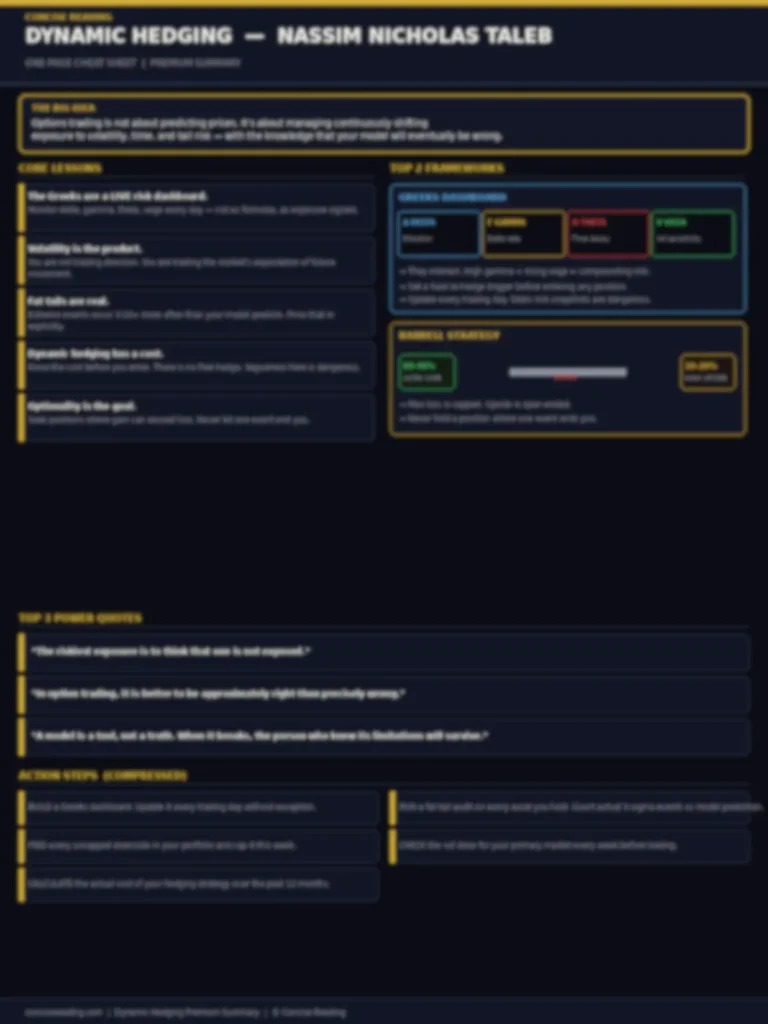
Premium Cheat Sheet Preview
About the Author
Nassim Nicholas Taleb is a former derivatives trader, mathematical statistician, and Distinguished Professor of Risk Engineering at NYU Tandon School of Engineering. He spent years managing options books at major financial institutions — including through the crash of 1987 — before becoming one of the most influential and controversial thinkers in modern finance. He is the author of the Incerto series, which includes The Black Swan and Antifragile, and his warnings about systemic financial fragility were vindicated by the 2008 global financial crisis.
Power Quote From the Book:
“The riskiest exposure is to think that one is not exposed.”
— Nassim Nicholas Taleb, Dynamic Hedging
Who This Summary is For
- This is for you if…
- You are an options trader or derivatives professional who has learned the mechanics but wants the deeper, practitioner-level mental models that no certification teaches you.
- You are a risk manager, financial analyst, or portfolio manager who wants to understand how options risk actually behaves in live market conditions — not just on a spreadsheet.
- You are a serious investor who wants to understand tail risk, volatility pricing, and portfolio protection strategies well enough to make genuinely informed decisions.
- You want to understand why Taleb thinks the way he does before diving into The Black Swan or Antifragile, because this is where his philosophy was forged.
- You are working through our Investing Fundamentals Premium Pack or building your financial library from our full summary Library and want the best risk management book in the collection.
- Skip this if…
- You are new to financial markets and have not yet built foundational knowledge of how options work. Start with our Options as a Strategic Investment summary first, then return here. Dynamic Hedging rewards preparation.
Social Proof
This summary was built for people who take their financial education seriously. If you have read it — free or premium — we want to know what shifted for you. Did it change how you think about hedging? Did a specific framework click in a way that years of reading hadn’t managed? Leave your experience in the comments below. Real feedback from real readers is the most useful thing on this page, and it helps others in this community decide whether this is the right summary for where they are right now. Every comment, question, or honest reaction is welcome here.
Dynamic Hedging took Nassim Taleb a career on live trading desks — and 506 pages — to write. The premium summary gives you the complete system, every framework, and the one-page cheat sheet in under an hour. If you found the free version useful, the premium version will permanently change how you think about risk.
Related Summaries
- The Black Swan by Nassim Nicholas Taleb — Dynamic Hedging shows you how to manage unknown risk at the trading desk. The Black Swan explains the deeper philosophical framework behind why extreme, unpredictable events are the rule rather than the exception in complex systems. They are companion works.
- When Genius Failed by Roger Lowenstein — The collapse of Long-Term Capital Management is the single most instructive real-world case study in what happens when brilliant people ignore fat tails and over-leverage their positions. Every lesson in Dynamic Hedging is illustrated in brutal detail by this story.
- Options as a Strategic Investment by Lawrence McMillan — Where Taleb provides the philosophy and risk mindset, McMillan provides the comprehensive tactical reference for options strategies. Together, they cover the mental game and the mechanical execution.