
End the Fed by Ron Paul — Summary & Key Lessons
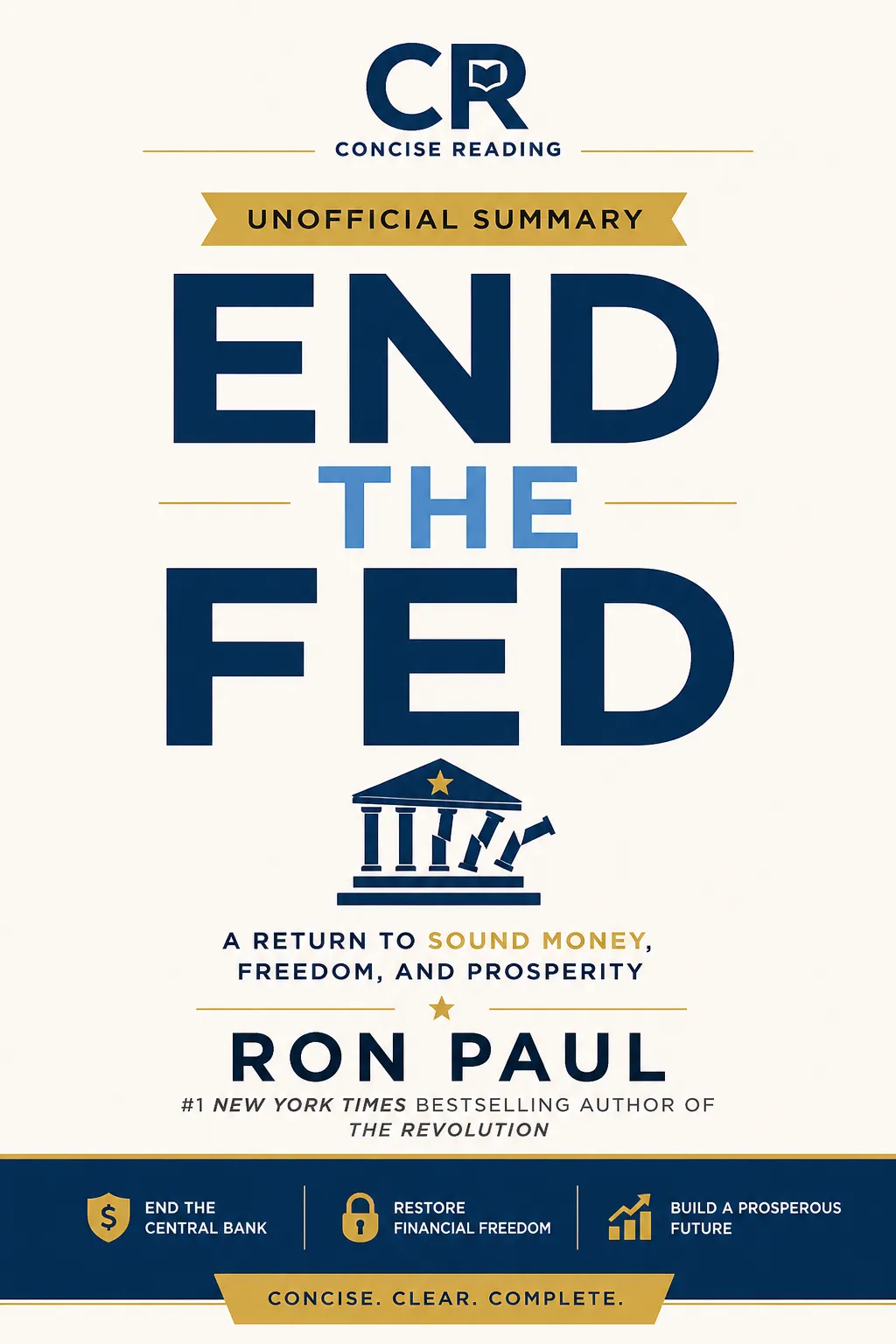
What this book will teach you in the next 10 minutes — and why it matters for your savings, your financial freedom, and every economic crisis you will live through.
Read by 40,000+ learners. Summaries written for people who take money seriously — not for people who want shortcuts.
Book Snapshot
- Author – Ron Paul
- Category – Economics / Monetary Policy / Political Economy
- Original Book – ~ 212 pages. Average read time for a focused adult reader: 4 to 5 hours.
- Free Summary – 08 pages
- Premium Summary – 35 pages. Estimated read time: 55 to 70 minutes.
The Big Idea
The Federal Reserve was created in 1913 to stabilize the American economy. More than a century later, the dollar has lost over 96% of its purchasing power, financial crises arrive with increasing severity, and the gap between those who own assets and those who earn wages keeps widening. Ron Paul’s argument in End the Fed is both simple and radical: this is not a failure of the system — it is the system working exactly as designed. A private institution with the power to create money without limit will always serve the governments and banks that depend on it, at the expense of the citizens who have no choice but to use its currency. This summary gives you Paul’s complete case — the history, the economics, and the solution — in under an hour. If you have ever wondered why your money buys less every year despite working harder, this book is the closest thing to an answer you will find.
What You’ll Learn — Key Lessons Preview
- Why every financial crisis since 1913 traces back to the same root cause — and why the Federal Reserve’s “solutions” plant the seeds of the next one How the Cantillon Effect transfers wealth from your savings account to banks and governments invisibly, every time new money is created Why inflation is not an accident or a supply chain problem — it is a structural feature of a system that benefits from your purchasing power shrinking How the gold standard constrained government power and why its removal made unlimited war and unlimited debt politically possible What sound money actually looks like, and the specific steps Paul proposes for a transition away from central bank control
Free vs Premium Comparison
| Free – $0 | Premium – $4.99 (Recommended) |
| ➡ Book Snapshot ➡ The Big Idea ➡ Key Lessons ➡ Power Quotes ➡ 08 Pages | ✔ Everything in free + ✔ Full Chapter Breakdown ✔ Key frameworks & diagrams ✔ Action steps ✔ Critical analysis ✔ One-page cheat sheet ✔ 35 pages |
Premium Cheat Sheet Preview
About the Author
Ron Paul served twelve terms in the United States Congress and sat on the House Financial Services Committee, where he directly questioned Federal Reserve chairmen Alan Greenspan and Ben Bernanke — on the record. A practicing physician by training, Paul has spent five decades applying the same rigorous skepticism toward centralized authority that Austrian economists like Mises and Hayek built their intellectual careers on. He predicted the 2008 housing crisis years before it happened, on the House floor, using the exact framework you will find in this book.
Power Quote From the Book:
“It is no coincidence that the century of total war coincided with the century of central banking.”
— Ron Paul, End the Fed
Who This Summary is For
- This is for you if…
- You are a saver or investor who has watched inflation quietly destroy the purchasing power of money you worked hard to earn, and you want to understand the mechanism behind it rather than accepting the official explanation.
- You are a student of economics, investing, or political philosophy who has only been taught one side of the monetary debate and wants to understand what the Austrian School actually argues — at its strongest.
- You are someone who lived through 2008, or 2020, or the 2022 inflation surge, and noticed that the same institutions responsible for creating the crisis were handed more power to solve it — and that has never stopped bothering you.
- You want a framework for reading central bank policy, inflation data, and financial news that goes deeper than what mainstream financial media provides.
- You are building an investment portfolio and want to understand why monetary policy belongs in every serious investment decision.
- Skip this if…
- You are looking for a neutral, academic account that presents all sides equally — this book is an argument, and this summary treats it as one. If you want balance, pair this with our summary of A Monetary History of the United States by Friedman and Schwartz, which reaches some of the same conclusions from a very different starting point.
Social Proof
Every summary at Concise Reading is built to be read, used, and argued with — not just saved and forgotten. If you have read this summary — the free version or the premium — we want to know what landed for you, what you disagreed with, and how it changed the way you think about money. Drop your thoughts in the comments below. Whether you are a first-time reader discovering Ron Paul’s argument or someone who has followed sound money debates for years, your perspective adds something the summary alone cannot. Real readers disagreeing in the comments is more useful than five stars from someone who skimmed it.
End the Fed took Ron Paul five decades of congressional testimony, direct confrontation with Federal Reserve chairmen, and a lifetime of studying monetary history to write. The premium summary gives you the complete system — every chapter, every framework, every action step, and a one-page cheat sheet you can use immediately — in under an hour, for less than a cup of coffee.
Related Summaries
- A Monetary History of the United States by Milton Friedman and Anna Schwartz — The definitive academic case for how money supply decisions drive economic history, including the Great Depression. Pairs directly with Paul’s monetary argument.
- The Road to Serfdom by Friedrich Hayek — Paul’s intellectual framework is deeply Hayekian. This book explains why centralized economic control — including control of money — systematically erodes political freedom. Essential companion reading.
- Antifragile by Nassim Taleb — Taleb argues that artificially suppressing volatility through intervention creates fragile systems that eventually collapse catastrophically. His framework explains exactly why Paul believes Fed-managed “stability” is a dangerous illusion.
[…] understanding, you can also explore related summaries like Capital in the Twenty-First Century and End the Fed, both available in our Free Summaries […]