Financial Statement Analysis by Subramanyam & Wild — Summary & Key Lessons
What this book will teach you in the next 10 minutes — and why it matters for every financial decision you will ever make about a company, investment, or business.
Part of the Financial Intelligence & Analysis collection — one of professional-grade summaries in the Concise Reading Library.
Book Snapshot
- Author – K.R. Subramanyam & John J. Wild
- Category – Finance & Investing / Business Analysis
- Original Book – ~ 736 pages | Average read time: 24–30 hours
- Free Summary – 08 pages
- Premium Summary – 33 pages | Estimated read time: 90–120 minutes
The Big Idea
Most people read financial statements as if they are objective facts. They are not. They are constructed documents — built on hundreds of accounting choices that management selects, controls, and sometimes exploits. A company can report growing profits while bleeding cash. It can appear financially stable while sitting on a structure that one bad quarter will collapse. What Subramanyam and Wild teach — across 736 pages of the most rigorous financial analysis textbook available — is how to get past the presentation and find the economic reality underneath. This is the framework that institutional investors, credit analysts, and due diligence professionals use. Now it is distilled into a form you can apply today. If you want to explore this topic further alongside related books, browse the Financial Intelligence & Analysis and Accounting & Bookkeeping category pages.
What You’ll Learn — Key Lessons Preview
- How to assess whether a company’s reported earnings are real — or the product of aggressive accounting choices that make today’s numbers look better by quietly stealing from tomorrow’s
- Why operating cash flow is the single most reliable number on any financial statement, and how to use the gap between cash flow and net income as an early warning system for financial distress
- The four-ratio-category system that professional analysts use to get a complete picture of financial health — and why using any one category alone produces dangerously incomplete conclusions
- How to decompose Return on Equity into its three drivers so you can tell the difference between a company genuinely earning superior returns and one manufacturing the appearance of them through leverage
- The exact cash flow pattern that precedes most major corporate collapses — and how to identify it in five minutes before you invest a single dollar
Free vs Premium Comparison
| Free – $0 | Premium – $4.99 (Recommended) |
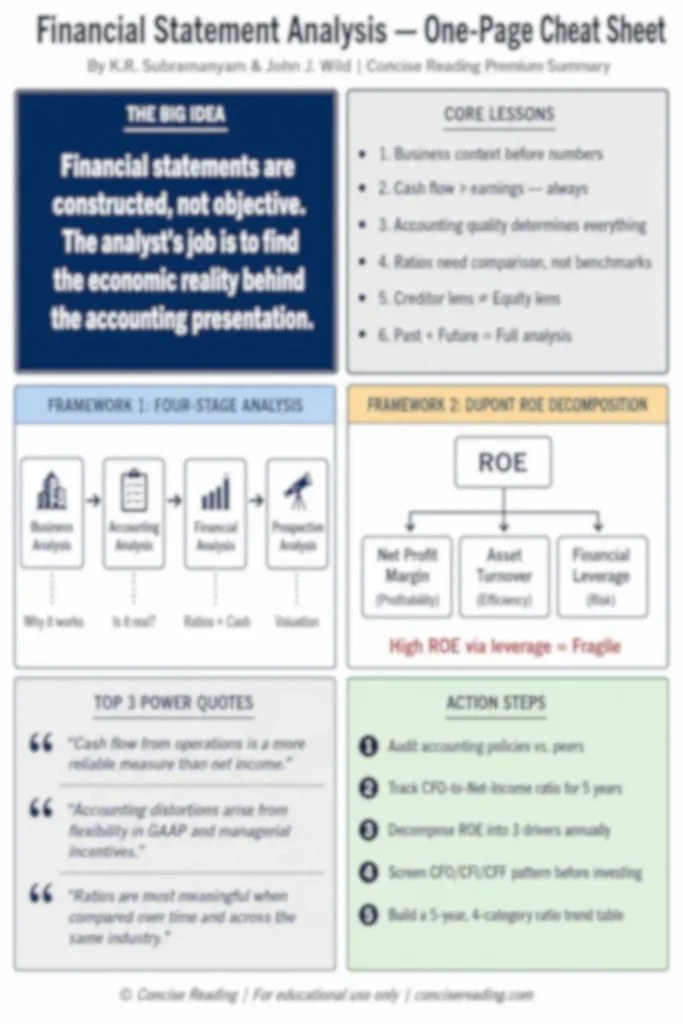
| ➡ Book Snapshot ➡ The Big Idea ➡ Key Lessons ➡ Power Quotes ➡ 08 Pages | ✔ Everything in free + ✔ Full Chapter Breakdown ✔ Key frameworks & diagrams ✔ Action steps ✔ Critical analysis ✔ One-page cheat sheet ✔ 33 pages |
Premium Cheat Sheet Preview
About the Author
K.R. Subramanyam is a professor at USC’s Marshall School of Business whose academic research focuses on earnings quality and the relationship between accounting information and investment returns — the exact discipline this book teaches. John J. Wild was one of the most widely read accounting educators in the United States, with textbook sales in the millions across multiple editions. Together, they produced the definitive graduate-level textbook on financial statement analysis, used in MBA programs, CFA preparation, and by practitioners globally. If you want to understand more about why rigorous financial thinking matters, the About page explains the philosophy behind every summary we publish.
Power Quote From the Book:
“Accounting distortions arise from the flexibility inherent in GAAP and the incentives managers face to report favorable results.”
— K.R. Subramanyam & John J. Wild, Financial Statement Analysis
Who This Summary is For
- This is for you if…
- You are an investor — retail or professional — who makes decisions based on financial statements and wants to stop taking them at face value
- You are a finance student or early-career analyst who wants practitioner-level analytical depth, not just exam-passing knowledge
- You are a business owner, CFO, or operator who wants to understand exactly how an outsider will scrutinize your company’s numbers
- You want to evaluate a company, supplier, or acquisition target before committing money or entering a major financial relationship
- You are working through the Investing Fundamentals or Wall Street & Financial Markets collections and want a rigorous analytical foundation to underpin everything else you read
- Skip this if…
- You are brand new to accounting and have never read an income statement before — start with our Accounting Made Simple summary or Financial Intelligence summary first, then come back. This framework rewards prior foundation. Without it, you will get less than it deserves.
Testimonials
This summary is part of the Financial Intelligence & Analysis Pack — a collection of the most important books on financial analysis available in one place.
If you have read this summary — free or premium — we want to hear what you actually thought. Did a specific framework change how you look at a company’s numbers? Did the cash flow triangulation model catch something you had been missing? Drop your experience in the comments below. Real feedback from real readers is the most useful thing on this page for someone deciding whether to download, and your two sentences could be exactly what helps the next person make a smarter decision. We read every comment and respond to the substantive ones.
(No manufactured testimonials. No fake stars. Just a community of people building real financial literacy — one summary at a time.)
Financial Statement Analysis took Subramanyam and Wild decades of combined academic research and teaching to write — the premium summary gives you the complete analytical system, five professional frameworks, a full chapter breakdown, and a printable one-page cheat sheet in under two hours.
For readers who want to go even further, the Financial Intelligence & Analysis Pack bundles this summary with 11 of the most important books in the discipline — including Financial Shenanigans, The Intelligent Investor, and Security Analysis — at a fraction of the individual price. Or if you want the broadest possible foundation across finance, investing, and money, the Financial Intelligence Playbook synthesizes insights from 10 finance classics into one unified system. New to Concise Reading? The Start Here page will show you exactly how to get the most out of every summary in the library.
Related Summaries
- Financial Shenanigans — Goes deeper into the specific tactics companies use to manipulate earnings and cash flow. The natural companion to this book for anyone serious about detecting accounting fraud.
- The Intelligent Investor — Warren Buffett’s foundational text on value investing. Directly applies the analytical lens this book builds to real stock selection and margin of safety thinking.
- Financial Intelligence — A more accessible entry point that builds the accounting literacy assumed by Subramanyam. Read this first if the concepts above felt dense; read it after to reinforce them.