
Financial Statements by Thomas Ittelson — Summary & Key Lessons
What this book will teach you in the next 10 minutes — and why it matters for your business finances and investment decisions.
Part of the Accounting & Bookkeeping and Financial Intelligence & Analysis collections at Concise Reading — where business and finance books are distilled into summaries that actually teach you something.
Book Snapshot
- Author – Thomas Ittelson
- Category – Finance & Accounting / Business Fundamentals
- Original Book – ~ 272 pages — Average read time: 5–6 hours
- Free Summary – 08 pages
- Premium Summary – 44 pages — Estimated read time: 35–45 minutes
The Big Idea
Most business owners and investors look at financial statements and see numbers. What they’re actually looking at is a story — and they’re reading it wrong. Every business runs on three documents: the Income Statement (are we profitable?), the Balance Sheet (what do we own and owe?), and the Cash Flow Statement (do we have cash to survive?). Thomas Ittelson’s core argument is that these three are not separate reports — they are one mathematically connected system. The moment you understand how they link, you stop confusing profit with health, and you start seeing what the numbers are actually saying.
Explore more books like this in our Financial Intelligence & Analysis and Accounting & Bookkeeping categories.
What You’ll Learn — Key Lessons Preview
- Why profitable businesses go bankrupt — and the one statement that would have warned you before it happened
- How to read all three financial statements as a single connected system — not three separate documents your accountant handles
- The Accrual Gap: why the profit on your income statement and the cash in your bank account are almost never the same number — and why that gap can kill you
- How to use five key financial ratios to diagnose any business in under fifteen minutes — whether it’s yours, a competitor’s, or a stock you’re evaluating
- What rising accounts receivable really signals — and why strong revenue growth with ballooning receivables is a warning, not a win
Free vs Premium Comparison
| Free – $0 | Premium – $4.99 (Recommended) |
| ➡ Book Snapshot ➡ The Big Idea ➡ Key Lessons ➡ Power Quotes ➡ 08 Pages | ✔ Everything in free + ✔ Full Chapter Breakdown ✔ Key frameworks & diagrams ✔ Action steps ✔ Critical analysis ✔ One-page cheat sheet ✔ 44 pages |
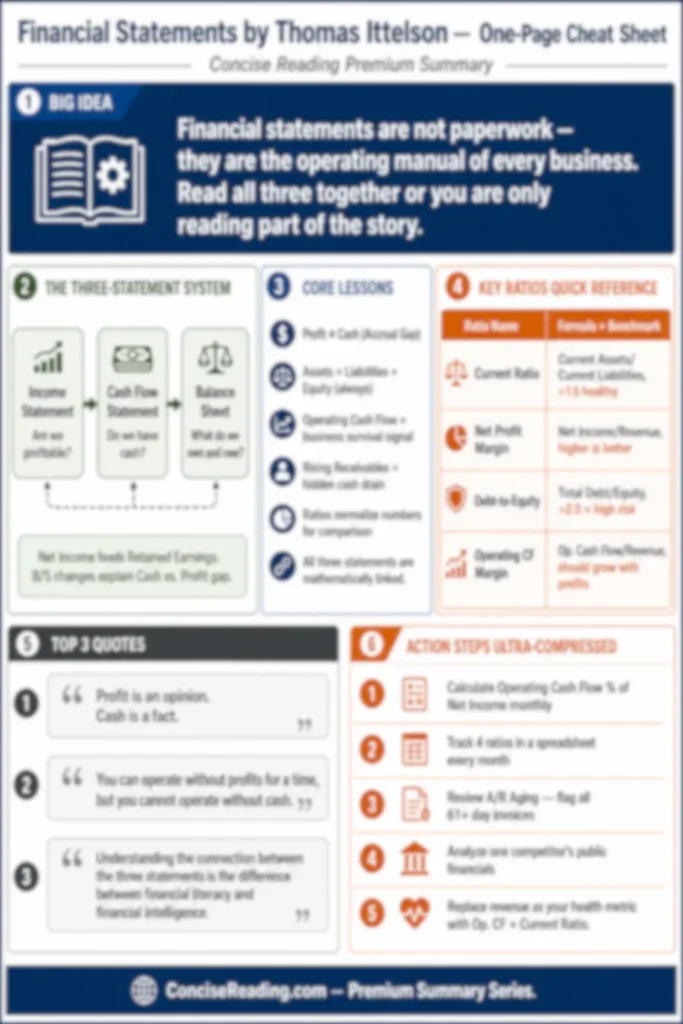
Premium Cheat Sheet Preview
About the Author
Thomas Ittelson is a business consultant and entrepreneur who has founded and operated companies across the technology and life sciences sectors. His credibility isn’t academic — it comes from managing real businesses with real balance sheets. Financial Statements has been adopted in business school curricula and corporate training programs across the United States, and has introduced hundreds of thousands of non-finance professionals to the language of business finance. See more books in our Accounting & Bookkeeping collection.
Power Quote From the Book:
“Profit is an opinion. Cash is a fact.”
— Thomas Ittelson, Financial Statements
Who This Summary is For
- This is for you if…
- You are a founder or small business owner who reviews monthly reports from your accountant but privately doesn’t fully understand what you’re looking at
- You are a manager being considered for a senior leadership role and need to speak the language of financial performance with confidence
- You want to evaluate investment opportunities — stocks, businesses, or real estate — using actual financial data instead of headlines and gut feeling
- You are self-teaching business and finance and need a foundational understanding of how companies work financially before moving to advanced material
- You have read books like Rich Dad Poor Dad, The Psychology of Money, or The Intelligent Investor and want the next layer — the practical mechanics behind the concepts
- Skip this if…
- You are a trained accountant or CPA — this book covers ground you already know, and you will find it too introductory. For a more advanced treatment, explore our Financial Statement Analysis or Corporate Finance summaries instead.
Testimonials
This summary was built to give you a genuine foundation in financial literacy — not a surface skim. If it changed how you read a balance sheet, helped you catch something in your own business finances, or finally made the income statement click, we want to hear about it. Drop your experience in the comments below. Real feedback from real readers is the only thing that improves this work — and it helps other readers decide if this is the right summary for them. No ratings system, no incentives. Just honest responses from people who actually read it.
Already found value here? Explore the full Accounting & Bookkeeping Pack — 12 summaries covering everything from bookkeeping basics to managerial accounting, available as a bundle.
Thomas Ittelson spent years building, financing, and operating real businesses before writing this book — and then spent more time translating everything he learned into a system any non-finance professional could use. The Premium Summary gives you the complete system in 44 pages: every framework, every ratio, five curated power quotes with context, five uncomfortable action steps designed to actually change behavior, a full critical analysis, and a one-page cheat sheet worth pinning to your desk. If you run a business or invest in anything, $4.99 is the cheapest financial education you will ever buy.
Not ready for premium yet? Start with our free summary library or browse the Financial Intelligence Playbook — 10 finance books synthesized into one unified guide.
Related Summaries
- Financial Intelligence — Karen Berman & Joe Knight – Ittelson teaches you the structure of financial statements. Financial Intelligence takes the next step — it explains how managers can use financial data to make better business decisions, and exposes the judgment calls embedded in every set of numbers. A natural companion read.
- The Intelligent Investor — Benjamin Graham – Once you can read financial statements, this is the book that teaches you how to use them to evaluate investments. Graham’s framework for value investing is built entirely on disciplined financial statement analysis. Ittelson gives you the language; Graham teaches you how to use it to find undervalued companies.
- Profit First — Mike Michalowicz – This book approaches business finances from the opposite direction — not analysis, but cash management behavior. Where Ittelson teaches you to understand where your money went, Profit First gives you a system to control where it goes. Especially relevant for entrepreneurs and small business owners who want their business to generate reliable cash, not just reported profit.
[…] concepts with other summaries like Financial Statements and Financial Intelligence (available in our Free […]
[…] summary is also a perfect companion to related content like Financial Statements, Financial Intelligence, and Accounting Made Simple, all available in our Free Summaries […]