Poor Economics by Abhijit Banerjee & Esther Duflo — Summary & Key Lessons
What this book will teach you in the next 10 minutes — and why it matters for every decision you make about money, aid, behavior, and human potential.
Written by two Nobel Prize-winning economists. Verified by 15 years of field research across 50 countries. Summarized by Concise Reading so you get the insight without the 320-page investment.
Book Snapshot
- Author – Abhijit Banerjee & Esther Duflo
- Category – Economics / Development Economics / Social Policy
- Original Book – ~ 320 pages. Average read time: 7-9 hours.
- Free Summary – 08 pages
- Premium Summary – 32 pages. Estimated read time: 35-45 minutes.
The Big Idea
Everything you think you know about poverty is probably wrong — and that includes whatever your favorite political ideology told you. Abhijit Banerjee and Esther Duflo spent fifteen years running real-world experiments in Africa, Asia, and Latin America to find out what actually lifts people out of poverty. Their conclusion dismantles both the “just give aid” camp and the “just free the markets” camp. The poor are not irrational or unmotivated. They are rational people making intelligent decisions under brutal constraints. Fix the constraints, and behavior changes. This book shows you exactly which constraints matter — and how to fix them.
(For more on how rigorous research is changing our understanding of economics, see our summary of Freakonomics and Thinking, Fast and Slow, which explore similar evidence-based approaches to human behavior.)
What You’ll Learn — Key Lessons Preview
- You will understand exactly why the poor sometimes make choices that look self-defeating — and why the real cause is never laziness, always structure
- You will learn the S-Curve Poverty Trap model, which reveals why small interventions fail and what size of push actually produces lasting change
- You will discover why free clinics sit empty, why free schools stay half-attended, and what a bag of lentils taught researchers about behavior change at scale
- You will see why microfinance was oversold — and what the randomized trial evidence actually shows about credit, savings, and entrepreneurship among the poor
- You will walk away with a mental framework for separating what “should work” from what “does work” — a skill that applies far beyond poverty economics into business, investing, and leadership
- (Interested in how behavioral economics shapes decisions at every income level? Our summaries of Nudge and The Psychology of Money are natural companions to this one.)
Free vs Premium Comparison
| Free – $0 | Premium – $4.99 (Recommended) |
| ➡ Book Snapshot ➡ The Big Idea ➡ Key Lessons ➡ Power Quotes ➡ 08 Pages | ✔ Everything in free + ✔ Full Chapter Breakdown ✔ Key frameworks & diagrams ✔ Action steps ✔ Critical analysis ✔ One-page cheat sheet ✔ 32 pages |
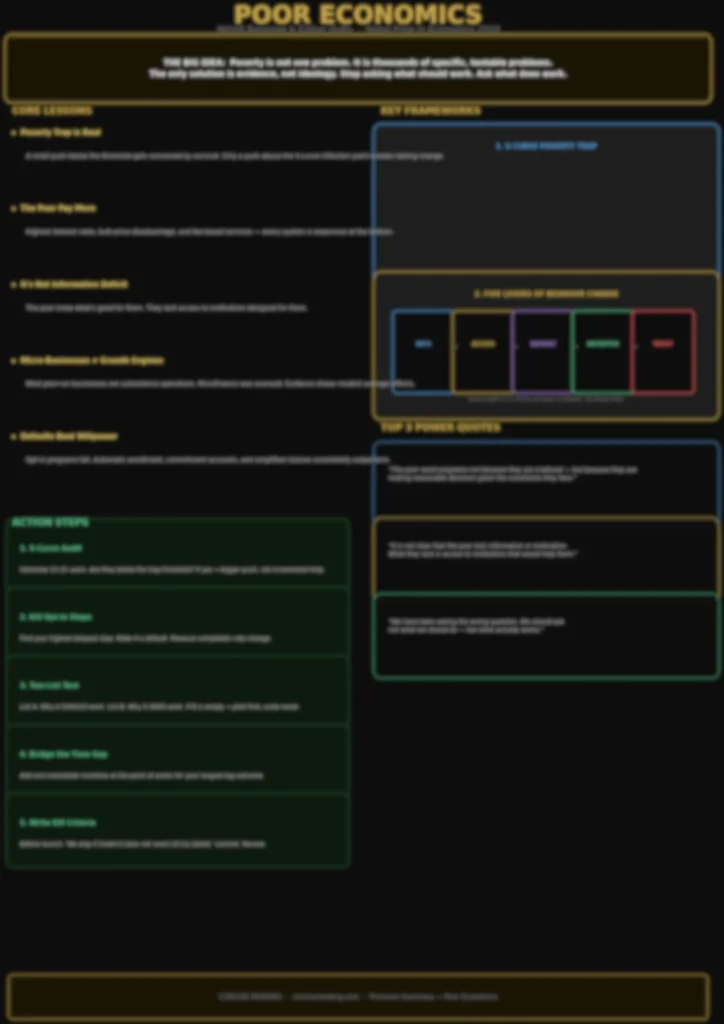
Premium Cheat Sheet Preview
About the Author
Abhijit Banerjee and Esther Duflo are professors of economics at MIT and co-founders of J-PAL, the Abdul Latif Jameel Poverty Action Lab, which has conducted over 1,100 randomized trials across 83 countries. In 2019, they were awarded the Nobel Prize in Economic Sciences — Duflo being only the second woman in history to receive it. They did not write this book from a desk. They wrote it from the field, after fifteen years of testing real interventions on real people. Their credibility is not theoretical. It is empirical.
Power Quote From the Book:
“The poor often resist the very programs that are designed to help them — not because they are irrational or shortsighted, but because they are making reasonable decisions given the constraints they face.”
— Abhijit Banerjee & Esther Duflo, Poor Economics
Who This Summary is For
- This is for you if…
- You are a policy professional, development worker, or NGO strategist who wants to evaluate interventions with evidence rather than ideology
- You are an impact investor or entrepreneur building products or services for emerging market consumers and you want to understand how decisions are actually made under scarcity
- You are a manager, executive, or business owner who wants to apply behavioral economics thinking — specifically how defaults, incentives, and friction shape outcomes — to your own organization
- You are an intellectually serious reader who suspects the mainstream narrative on poverty is too simple and you want the real data
- You want to think more rigorously about human behavior, and you understand that the same cognitive forces that trap the poor in poverty also drive decisions in every market and every boardroom
- (If you are new to this kind of thinking, we recommend starting with our Start Here page to find the right reading path for your goals.)
- Skip this if…
- You are looking for personal finance advice, a business strategy playbook, or a motivational read. Poor Economics is rigorous social science, not self-help. If that is what you need right now, our Personal Finance & Wealth Building Pack or the Wealth Playbook will serve you better.
Social Proof
This summary is new, which means you have the chance to be among the first readers to share what you thought. If you read the free summary or went through the premium version, your experience matters — both to us and to the next reader deciding whether this is worth their time. Scroll to the comments below and leave a quick note: What was your biggest takeaway? Did it change how you think about poverty, behavior, or decision-making? Honest reactions, even critical ones, are welcome. The best communities around books are built by readers who actually engage — and if this summary delivered value, saying so takes thirty seconds and helps someone else make a smarter choice.
(Want to explore more summaries in this category? Visit our Economics & Economic Thinking Pack or browse the full Library to find your next read.)
Poor Economics took Banerjee and Duflo fifteen years of field research across fifty countries to write. The premium summary gives you the complete system — every chapter, five frameworks with visual diagrams, five action steps specific enough to cause discomfort, and a one-page cheat sheet worth printing — in under 40 minutes.
(Have questions about what is included or how our summaries work? Visit our FAQs page or read What is a Premium Book Summary? to see exactly what you are getting before you decide.)
Related Summaries
- Freakonomics by Steven Levitt & Stephen Dubner — Like Poor Economics, it uses data and unexpected analysis to challenge conventional wisdom about human behavior and social problems. If you enjoyed the “let the evidence destroy your assumptions” approach, this is the natural next read.
- Nudge by Richard Thaler & Cass Sunstein — Poor Economics repeatedly demonstrates how defaults and choice architecture determine outcomes for the poor. Nudge is the foundational book on exactly this mechanism. The two books together form a complete picture of behavioral economics applied to real-world policy.
- Thinking, Fast and Slow by Daniel Kahneman — Much of what makes poverty so persistent is rooted in cognitive limitations and biases that hit harder under scarcity. Kahneman’s framework for understanding System 1 and System 2 thinking provides the psychological infrastructure behind almost everything Banerjee and Duflo observe in the field.