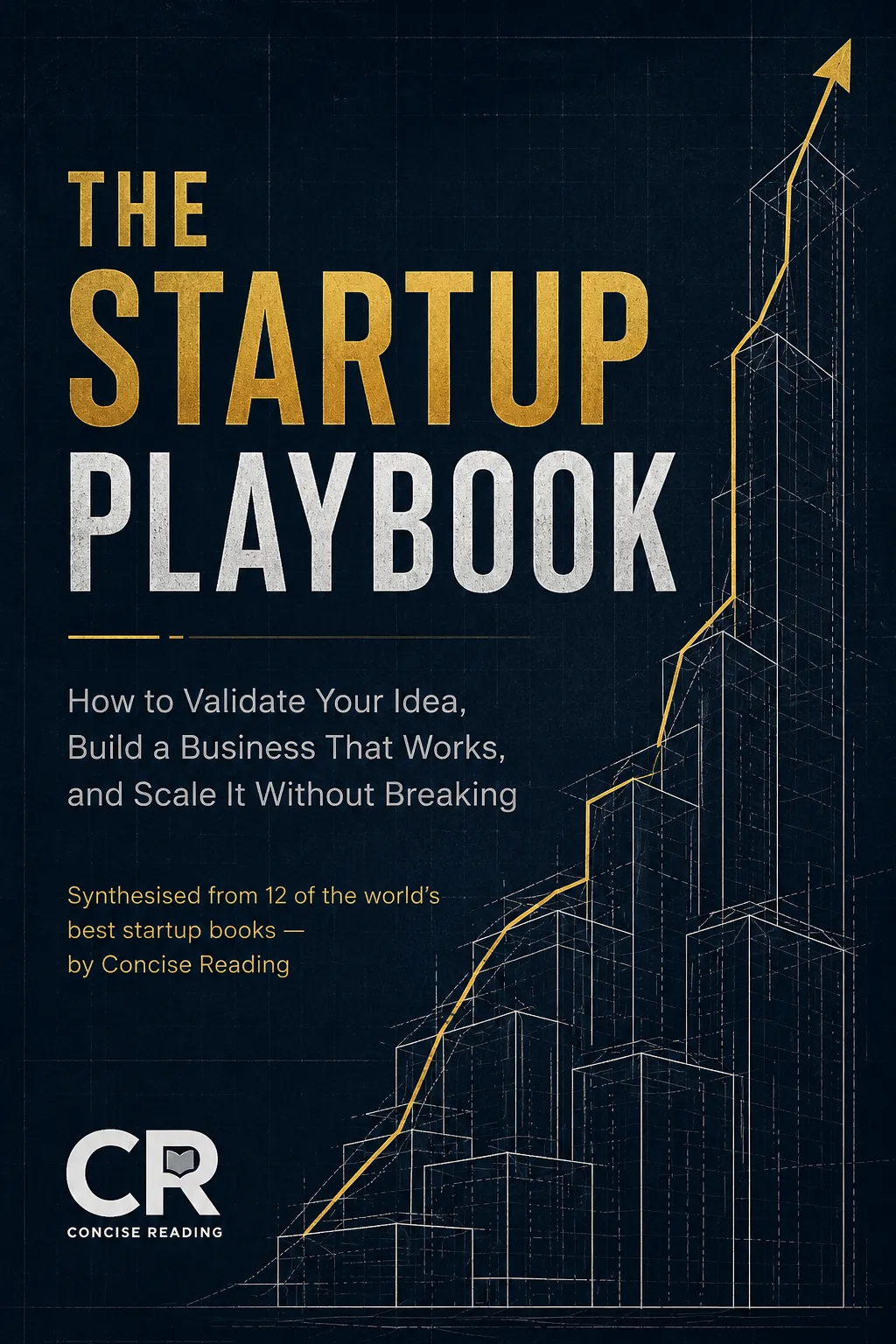
The Startup Playbook: How to Validate Your Idea, Build a Business That Works, and Scale It Without Breaking
Synthesised from Zero to One · The Lean Startup · The Hard Thing About Hard Things · Traction · Built to Sell · The E-Myth Revisited · Business Model Generation · The Innovator’s Dilemma · Rework · The $100 Startup · Company of One · Your Next Five Moves — into one complete, executable system.
- 12 books synthesized
- 151 pages
- 6 complete frameworks
- 1 master execution plan
- Instant download
- PDF + printable formats
The Problem — Agitate Before You Solve
You have read the books. Or at least parts of them. You know Eric Ries talks about validated learning. You know Peter Thiel says stop competing and start creating. You have heard Ben Horowitz on the hard things nobody warns you about. You nodded along. You highlighted things. And then you closed the book and went back to figuring it out yourself — because knowing something and having a system to execute it are two completely different things.
Here is what nobody tells you about the startup space: the information is not the problem. There are twelve genuinely brilliant books that, between them, cover everything you need to build a real business from scratch. The problem is that none of them connects to the others. Ries does not tell you how to find your customers after you have validated. Weinberg does not tell you what breaks when you start to scale. Thiel gives you the philosophy and skips the Monday morning. You end up with a shelf of great ideas and no sequential system for using them — which means you keep starting, stalling, and circling back to the same problems.
The gap is not knowledge. The gap is the absence of a system that takes all twelve books and tells you what to do first, what to do next, and what to completely ignore until you have done the first two things correctly. That is what this Playbook is.
What is a Playbook ?
This is not a summary collection. It is a system.
A Concise Reading Playbook is not a set of individual book summaries placed side by side. It is one unified guide — researched, written, and structured by us — that synthesizes insights from 12 carefully selected books into a single, sequential system for solving one specific problem. Every chapter draws from multiple books to answer one concrete question you face as a founder. The result is a guide that replaces 12 books — not just summarizes them — and gives you something none of those books give you on their own: a clear sequence.
If you have used our free summaries or Premium Packs, you already know how we work. A Playbook goes further. It is the product we build when the topic is too important, too multi-layered, and too sequential to fit into any single summary or pack.
How does a Playbook compare to what you may already have?
Comparison
| Free Summary | Premium Pack | This Playbook | |
|---|---|---|---|
| Book Insights | Single Book(15–25 pp) | Multiple Books | 12 Books |
| Synthesis Across Books | No | Partial | Full |
| Unified System | No | No | Yes |
| Chapter-by-Chapter Application | No | Partial | Yes |
| 6-Week Master Action Plan | No | No | Yes |
| Master Reference Sheet | No | No | Yes |
| Price | Free | $27 – $37 | $42 |
The price of this Playbook reflects what it replaces — not just 12 books at full price, but the time it would take to read them, connect them, and build a usable system from them yourself. That process took us weeks. You get the result in one weekend.
Table of Contents — Full Chapter Breakdown
CHAPTER 1: Why Most Startups Die Before They Deserve To — And the One Mental Shift That Changes Everything
What you will be able to DO after this chapter: Identify whether you are building a business or just creating a demanding job for yourself — and make the foundational decision that determines everything that follows.
Books drawn from: Zero to One (Peter Thiel) · The E-Myth Revisited (Michael E. Gerber) · Company of One (Paul Jarvis) · Rework (Jason Fried & DHH)
CHAPTER 2: How to Validate Your Idea So You Know It Works Before You Build It
What you will be able to DO after this chapter: Design and run a minimum viable experiment that tells you whether real people will pay for your idea — before you invest serious time, money, or credibility into building it.
Books drawn from: The Lean Startup (Eric Ries) · The $100 Startup (Chris Guillebeau) · Rework (Jason Fried & DHH)
CHAPTER 3: How to Design a Business Model That Makes Money by Design, Not by Accident
What you will be able to DO after this chapter: Map every component of your business model — customers, value proposition, revenue streams, cost structure, and key resources — and identify which assumptions are most likely to kill it before it grows.
Books drawn from: Business Model Generation (Osterwalder & Pigneur) · The Lean Startup (Eric Ries) · The $100 Startup (Chris Guillebeau) · Zero to One (Peter Thiel)
CHAPTER 4: How to Find the One Distribution Channel That Will Drive 80% of Your Growth
What you will be able to DO after this chapter: Systematically test multiple customer acquisition channels using the Bullseye Method and identify your primary traction channel — the one that, when you focus on it exclusively, breaks your business open.
Books drawn from: Traction (Gabriel Weinberg & Justin Mares) · The Lean Startup (Eric Ries) · The Innovator’s Dilemma (Clayton Christensen)
CHAPTER 5: How to Lead, Decide, and Stay Functional When Everything Is on Fire
What you will be able to DO after this chapter: Apply a practical decision-making framework for high-stakes, low-information situations — and build the personal operating system that lets you lead effectively when the business is in crisis.
Books drawn from: The Hard Thing About Hard Things (Ben Horowitz) · Your Next Five Moves (Patrick Bet-David) · Zero to One (Peter Thiel)
CHAPTER 6: How to Build the Systems and Structure That Let Your Business Grow Without You Running Every Part of It
What you will be able to DO after this chapter: Document, systematise, and delegate the core operations of your business so that it functions independently of your daily presence — creating the infrastructure that makes scale possible and the business sellable.
Books drawn from: The E-Myth Revisited (Michael E. Gerber) · Built to Sell (John Warrillow) · Company of One (Paul Jarvis) · Your Next Five Moves (Patrick Bet-David)
CHAPTER 7: How to Scale Deliberately — Growing the Right Way at the Right Time Without Breaking What Works
What you will be able to DO after this chapter: Evaluate your business’s readiness to scale, identify the exact constraints that will break first under growth pressure, and build a 90-day scaling plan that protects your margins, your team, and your model as you expand.
Books drawn from: Built to Sell (John Warrillow) · The Innovator’s Dilemma (Clayton Christensen) · Traction (Weinberg & Mares) · Your Next Five Moves (Patrick Bet-David) · Rework (Fried & DHH)
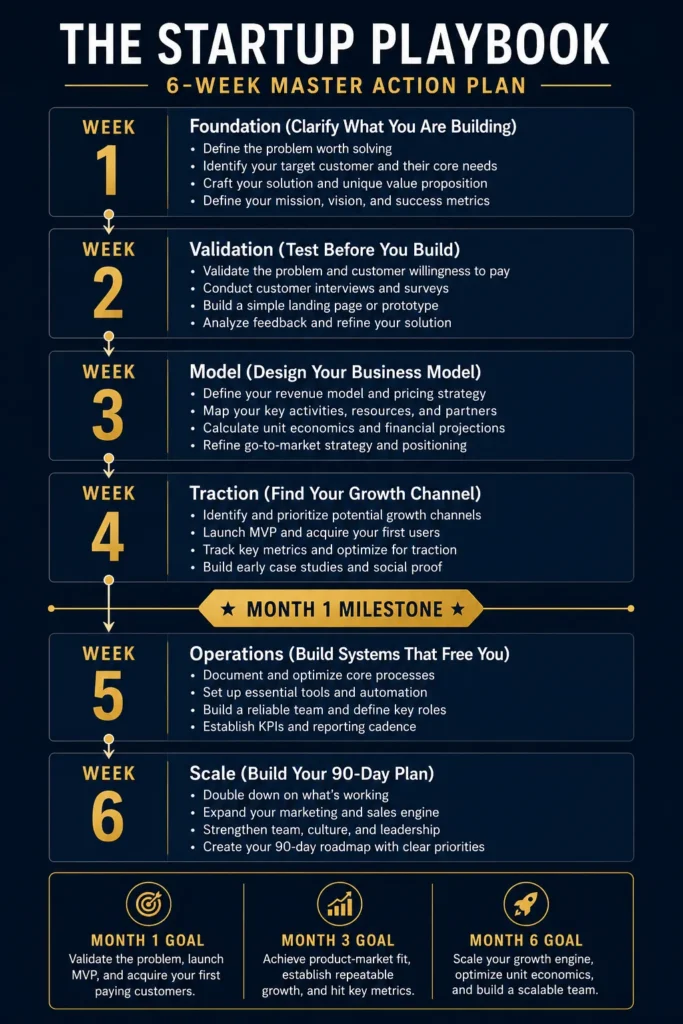
The Master Action Plan
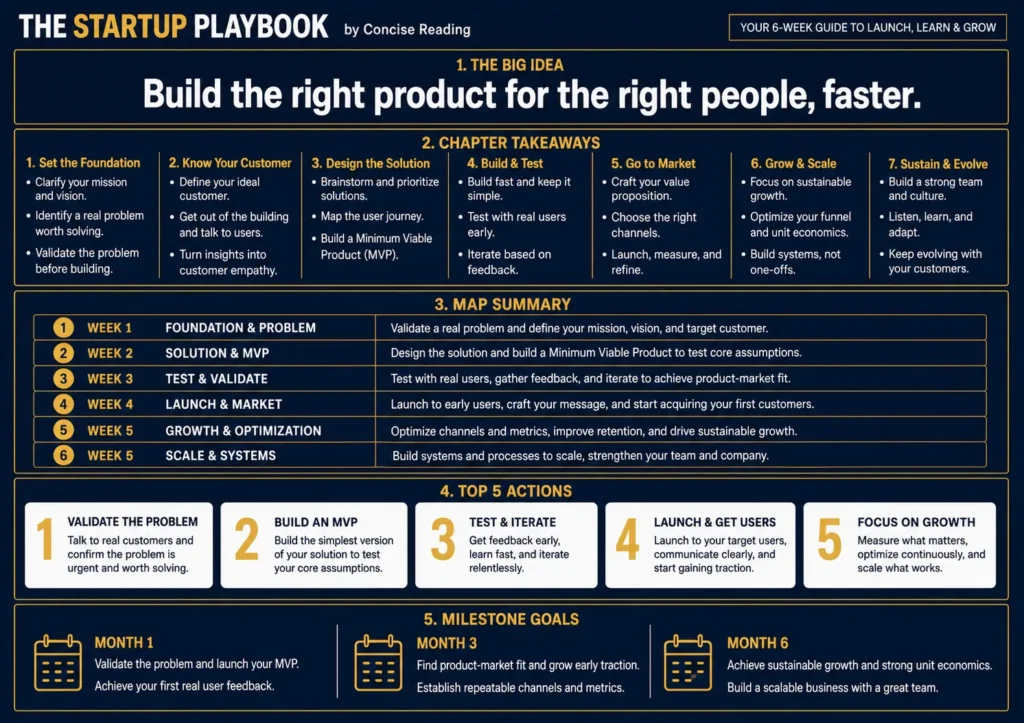
Master Reference Sheet
Books Behind This Playbook
Every book below was selected because it fills a gap the others leave open. Not because it is famous — because it is necessary.
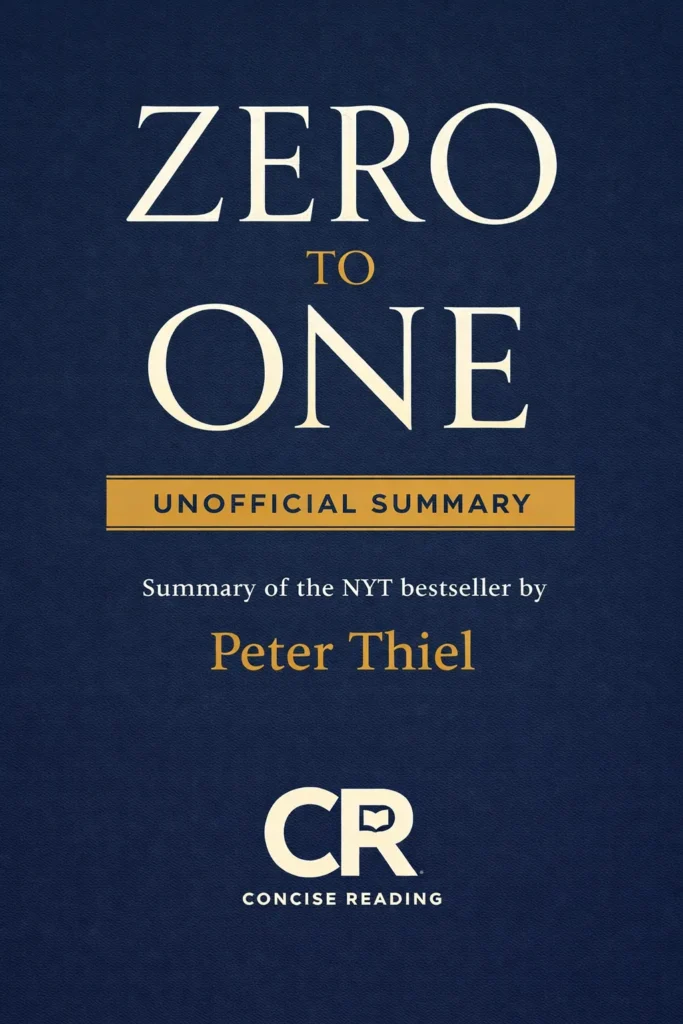
- Zero to One — Peter Thiel
- Provides the foundational philosophy of building something genuinely new rather than competing in an existing market. The “last mover advantage” concept in Chapter 1 draws directly from this.
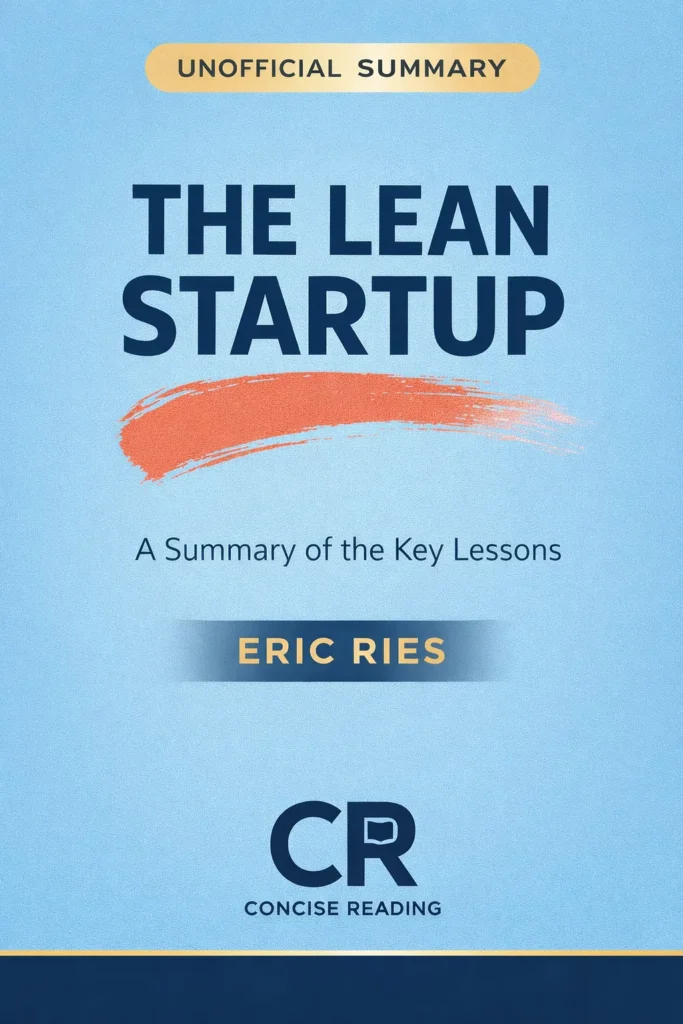
- The Lean Startup — Eric Ries
- Supplies the operational engine of the entire validation and iteration framework — the Build-Measure-Learn loop that governs Chapters 2 and 3.
- Rework — Jason Fried & David Heinemeier Hansson
- Challenges the conventional playbook on funding, planning, and growth — the source of the constraints-as-advantages thinking throughout Chapters 1 and 7.
- The Hard Thing About Hard Things — Ben Horowitz
- Delivers the unfiltered truth about leadership under pressure — the decisions, the people problems, and the psychological reality of building a company. Chapter 5 draws primarily from this.
- The E-Myth Revisited — Michael E. Gerber
- Identifies the most dangerous trap for founders — the Technician/Manager/Entrepreneur split — and provides the systemisation framework that anchors Chapter 6.
- Business Model Generation — Alexander Osterwalder & Yves Pigneur
- Provides the Business Model Canvas used in Chapter 3 to map and pressure-test every component of your business model before committing.
- The Innovator’s Dilemma — Clayton M. Christensen
- Explains why incumbents are often your structural advantage — the disruption theory lens used in Chapters 4 and 7 to identify distribution opportunities.
- Traction — Gabriel Weinberg & Justin Mares
- Contributes the 19-channel Bullseye Method — the most systematic distribution framework available and the backbone of Chapter 4.
- Built to Sell — John Warrillow
- Reframes how you build your business from Day 1 — the systems, standardisation, and founder independence that make a business scalable. Chapter 6 and Chapter 7 draw heavily from this.
- The $100 Startup — Chris Guillebeau
- Demonstrates that profitable businesses can be launched with minimal capital by focusing on existing skills and underserved customers. The validation approach in Chapter 2 is grounded here.
- Company of One — Paul Jarvis
- Challenges the default assumption that growth is always the goal — the source of the right-size vision framework in Chapter 1 and the sustainability lens in Chapter 7.
- Your Next Five Moves — Patrick Bet-David
- Supplies the strategic thinking framework — how to think several moves ahead and make decisions with long-term leverage. The five-moves action in Chapter 5 comes directly from this.
Want all 12 books summarized individually at full depth? The Startup & Entrepreneurship Premium Pack gives you 15 deep-dive summaries with frameworks, action steps, and cheat sheets — for $37.
Specific Outcomes — What You’ll Be Able To Do
These are not features. These are capabilities you will have — in writing, tested against real data — by the time you complete this Playbook and its 6-Week Master Action Plan.
You will be able to answer the question most founders cannot answer honestly: what kind of business am I actually building — and are the decisions I am making every day consistent with that answer?
You will be able to write a one-sentence differentiation statement that tells any potential customer, investor, or partner exactly what your business does that no direct competitor does in the same way — without flinching.
You will be able to design and run a Minimum Viable Experiment that gives you real-world evidence of whether your idea has a market before you invest significant time, money, or credibility into building it.
You will be able to complete a full Business Model Canvas for your business — with every block filled, every unverified assumption labelled, and your three riskiest model components identified and addressed.
You will be able to apply the Bullseye Method to all 19 possible traction channels, rank your top three by realistic fit, and run a live channel test with a defined success metric — so you know which distribution approach actually works for your specific business.
You will be able to make the hard decisions — the ones you have been avoiding because they require you to say or do something uncomfortable — using a structured decision framework that forces a conclusion rather than a list of considerations.
You will be able to document your core business processes as Standard Operating Procedures, identify your first delegation opportunity, and begin the transition from a business that depends on you to a business that runs on systems.
You will be able to build a 90-day scaling plan with specific actions, done-when criteria, and a defined scale constraint — so that when you push for growth, you are pushing on the right lever.
You will be able to complete a full system audit of everything you have built, identify what to maintain going forward, and define the five non-negotiable weekly actions that will sustain your momentum beyond the 6-week plan.
You will be able to identify exactly where your largest competitors are structurally unable or unwilling to compete — and use that gap as the basis for both your positioning and your distribution strategy.
Pricing
What it would cost otherwise
$ 180 +
- 12 original books at Avg. $15 each
- Plus months of reading time
- Plus no synthesis
- Plus no action plan
This Playbook
$ 42
- One-time. Yours forever.
- All 12 books synthesized
- 6 original frameworks
- Master 6-week action plan
- Instant PDF download
Instant download · PDF & printable · Use on any device · One-time payment
Testimonials
Have you read The Startup Playbook?
If this Playbook delivered something useful — a framework that clicked, a week of the MAP you actually executed, a decision you finally made — we want to hear about it. Leave a comment below with what changed for you after reading it. Your experience helps other founders decide whether this is right for them, and it helps us understand what is working and what to improve. We read every comment. The most detailed, honest feedback gets featured. If you have built something real using this system, tell us what happened.
FAQs
- Q: What makes this different from your premium packs? → A pack is 10-15 individual summaries on the same topic. The playbook is one unified guide that synthesizes all of them into a complete system with a master action plan. Think of the pack as individual songs and the playbook as the album — one coherent journey.
- Q: Do I need to read the original books first? → No. The playbook is completely standalone.
- Q: How is this different from Blinkist? → Blinkist gives you short summaries of individual books. This playbook does not summarize books — it synthesizes them. Every chapter uses 2–4 books to answer one specific question you face. The result is an original system, not a summary service.
- Q: How long will it take to read? → The full playbook is designed to be read in one weekend and implemented over 6 weeks using the Master Action Plan.
- Q: What format? → PDF. Readable on any device. Designed for printing if preferred.
12 of the world’s best startup books, synthesised into one system you can start using this weekend. The 6-Week Master Action Plan gives you a specific action for every day of your first six weeks of implementation. The Master Reference Sheet gives you everything compressed onto two printable pages. The Chapter Action Plans give you the foundation the MAP is built on.
None of this works if you just read it. But if you read it and do the work — the experiments, the canvas, the Bullseye Method, the SOPs, the 90-day plan — you will have built more of a real business in six weeks than most people build in a year of reading about starting one.
Everything else is up to you.
Also available: the Startup & Entrepreneurship Premium Pack (15 individual deep-dive summaries, $37) · Browse all Playbooks · Not sure where to start? Start Here