Das Kapital by Karl Marx (Vol 2 & 3) – Book Summary
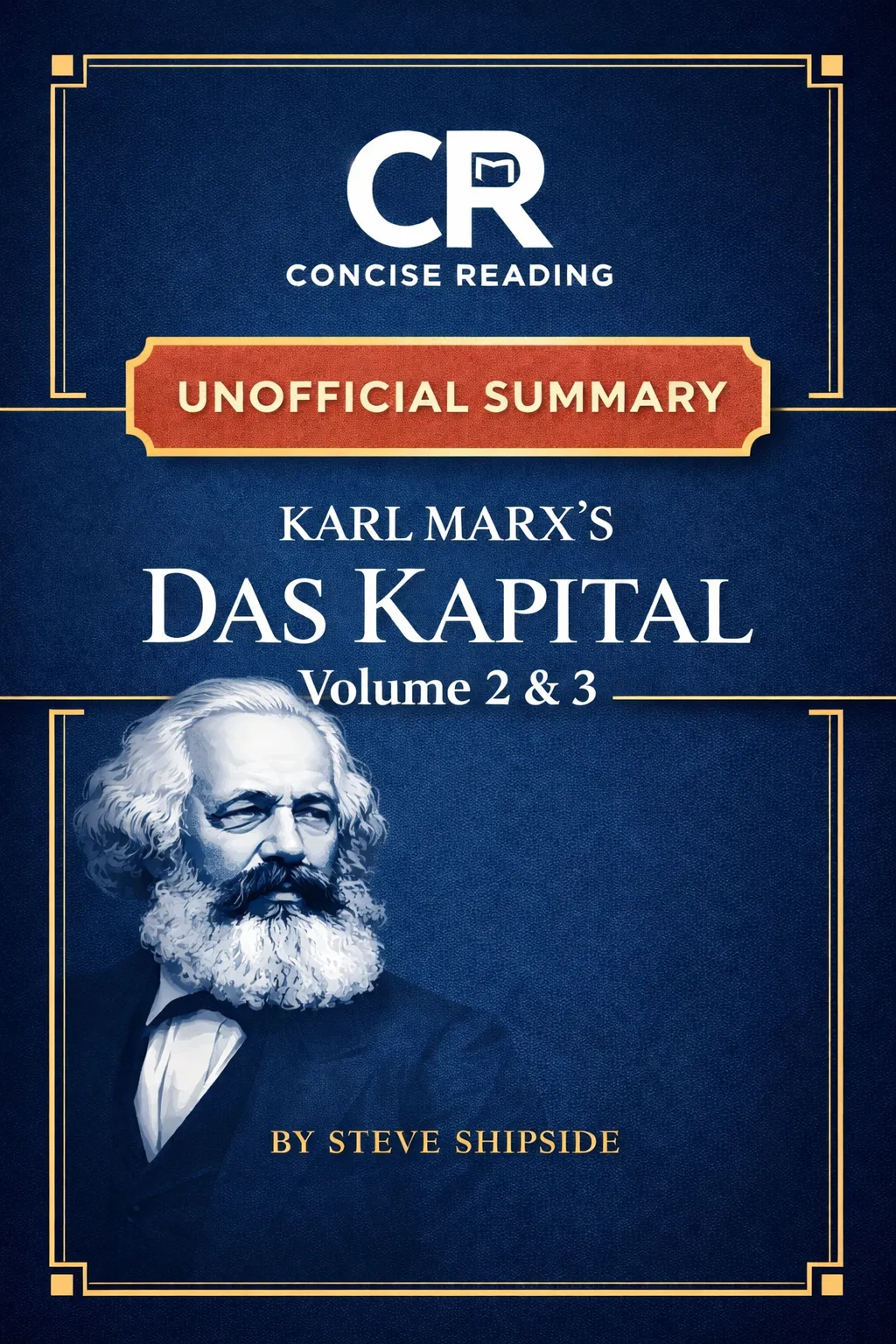
Most people have heard of Das Kapital, but very few truly understand the deeper economic ideas hidden in Volumes 2 and 3.
These volumes explain how capitalism actually works — how money circulates, how profits form, and why economic crises occur repeatedly.
This free PDF summary by Concise Reading simplifies these complex ideas so you can understand them quickly.
You can also explore our full collection of summaries in the Library or browse all Free Summaries available on Concise Reading.
Introduction
Das Kapital (Volumes 2 & 3) by Karl Marx is one of the most influential works ever written on capitalism, economics, and financial systems.
While Volume 1 focuses on labor and exploitation (see our summary of Das Kapital Vol 1), the later volumes analyze something even deeper: how capitalism functions as a complete economic system.
These volumes explore:
- Capital circulation
- Profit formation
- Competition between businesses
- Financial systems
- Economic crises
Understanding these ideas is essential for anyone interested in economics, finance, markets, and global business systems.
If you explore the Economics or Macroeconomics sections of our site, you will see that many modern economic debates still revolve around these ideas.
However, the original Das Kapital text is extremely complex. The book spans thousands of pages and contains dense theoretical arguments that are difficult for modern readers.
That’s why Concise Reading created this simplified summary.
Instead of struggling through dense economic theory, this free PDF gives you:
- Clear explanations
- Organized ideas
- Key arguments simplified
- Practical insights
If you enjoy learning through summaries, you may also like popular summaries such as:
- The Psychology of Money
- Freakonomics
- The Intelligent Investor
- Capitalism and Freedom
- Basic Economics
These books also explore how money, markets, and economic systems function.
About the Author
Karl Marx (1818–1883) was a German philosopher, economist, historian, and social theorist.
He spent his life analyzing how economic systems shape society, particularly focusing on capitalism and industrial production.
Marx believed that understanding economics was essential to understanding politics, social structures, and inequality.
His most famous work is Das Kapital, which provides a deep analysis of how capitalism operates.
Although Marx published the first volume himself, the later volumes were edited and published after his death by his collaborator Friedrich Engels.
Other important works by Marx include:
- The Communist Manifesto
- The German Ideology
- Critique of the Gotha Programme
Many modern discussions about capitalism also appear in books like:
- Capital in the Twenty-First Century
- Economics in One Lesson
- Free to Choose
You can explore these summaries inside the Economics section of our Library.
Key Takeaways
Here are the most important ideas from Das Kapital (Volumes 2 & 3):
- Capitalism functions through the continuous circulation of capital.
- Profits originate from surplus value created by labor.
- Competition between businesses drives economic growth.
- Capital tends to concentrate in fewer hands over time.
- Financial systems often hide the real source of economic value.
- Economic crises are not random—they are built into capitalism.
- Global expansion of capital drives international trade and markets.
These ideas form the foundation of modern debates in macroeconomics, finance, and monetary policy.
Key Ideas
Volumes 2 and 3 explore how capitalism functions beyond individual companies, focusing on the broader economic system.
1. The Circulation of Capital
One of the most important ideas in Volume 2 is the circulation of capital.
Capital moves through a continuous cycle:
Money → Commodities → Production → More Money
Businesses invest money to purchase labor, materials, and machines. These inputs produce goods that are later sold for profit.
This constant movement keeps the economic system running.
You will also see similar ideas discussed in books like:
These works explain how capital flows through modern financial markets.
2. The Formation of Profit
Volume 3 explores how profits appear within capitalist systems.
According to Marx, profits ultimately come from surplus value produced by labor, but competition between industries redistributes those profits.
As a result, profit appears to come from capital itself rather than labor.
Understanding this process helps explain how businesses think about:
- efficiency
- productivity
- automation
- scaling operations
3. Competition Between Capitals
Capitalism is built on competition between firms.
Companies compete to:
- reduce costs
- increase productivity
- introduce new technologies
- dominate markets
This competitive pressure drives innovation but also causes instability.
Modern examples can be seen in industries discussed in summaries such as:
4. The Tendency of Profit Rates to Fall
Marx proposed a controversial theory: as businesses invest more in machinery and technology, the rate of profit may gradually decline.
This is because machines do not create value in the same way labor does.
While economists still debate this theory, it has influenced many discussions in corporate finance and macroeconomic analysis.
5. Economic Crises
One of Marx’s most famous arguments is that capitalism naturally produces economic crises.
When too many goods are produced but consumers cannot afford them, the system enters a crisis.
These crises result in:
- business failures
- unemployment
- financial crashes
Books like The Big Short, Flash Boys, and Irrational Exuberance explore similar financial dynamics in modern markets.
Detailed Lessons
Capital Must Keep Circulating
Capital cannot remain idle.
Businesses must constantly reinvest profits into:
- new equipment
- expansion
- innovation
If capital stops circulating, economic growth slows.
This is why modern economies encourage continuous investment, expansion, and entrepreneurship.
Financial Systems Obscure Value Creation
Modern financial systems can make it difficult to see where value actually comes from.
Stock markets, investment funds, and derivatives often appear detached from production.
However, real economic value still originates from production and labor.
Books such as Against the Gods, Fooled by Randomness, and Margin of Safety explore how financial systems behave under uncertainty.
Capital Concentration
Over time, wealth tends to concentrate among large corporations and investors.
Large firms benefit from:
- economies of scale
- access to capital
- technological advantages
This phenomenon is visible today in global corporations and tech giants.
Cycles of Boom and Bust
Capitalist economies often move through cycles:
- Expansion
- Overproduction
- Crisis
- Recovery
These patterns have been observed repeatedly throughout financial history.
Books like Animal Spirits and A Monetary History of the United States also analyze these economic cycles.
The Global Expansion of Capital
Capitalism constantly searches for new markets.
Businesses expand internationally to access:
- cheaper labor
- new consumers
- natural resources
This expansion has shaped globalization and international trade.
Key Quotes
Here are several memorable insights from Das Kapital:
“Capital is dead labor, that, vampire-like, only lives by sucking living labor.”
“Accumulation of wealth at one pole is accumulation of misery at another.”
“The real barrier of capitalist production is capital itself.”
“The production of too many useful things results in too many useless people.”
These ideas continue to influence debates in economics and politics today.
Practical Takeaways
Even though Das Kapital is theoretical, it offers useful lessons.
Understand economic systems
Studying capitalism helps explain how markets function.
Recognize economic cycles
Booms and recessions follow recognizable patterns.
Observe industry evolution
Large firms tend to dominate industries over time.
Think critically about finance
Financial systems often hide underlying economic realities.
Study long-term economic trends
Understanding capital flows helps explain global markets.
Who This Summary Is For
This summary is ideal for:
- Readers interested in economics and capitalism
- Entrepreneurs who want to understand market systems
- Investors studying financial cycles
- Students learning economic theory
- Readers exploring classic books on business and economics
You can also explore more summaries inside our Economics, Finance, and Money & Monetary Policy sections.
What’s Included in the PDF
When you download this free PDF summary, you’ll receive:
- A simplified breakdown of Das Kapital Vol 2 & 3
- Key economic concepts explained clearly
- Structured lessons for fast learning
- Important quotes and interpretations
- Concise insights you can read in under 30 minutes
You can also explore our Premium Packs if you want curated bundles of the best business and money books.
Content Preview
Inside the PDF summary you will learn:
- How capital circulates through the economy
- Why profits exist in capitalist systems
- The causes of economic crises
- The role of financial markets
- Marx’s key arguments about capitalism
Final Thoughts
Das Kapital (Volumes 2 & 3) remains one of the most influential economic analyses ever written.
Whether you agree with Marx’s ideas or not, understanding them helps you better understand:
- global markets
- economic crises
- financial systems
- wealth distribution
However, the original book is extremely complex.
This Concise Reading summary makes these ideas clear, simple, and accessible.
You can explore more classic business and economics summaries inside the Library or browse all Free Summaries available on the site.
Download the Free Summary
Understanding capitalism is easier when the ideas are simplified.
Download this free PDF summary of Das Kapital (Vol 2 & 3) and learn the most important economic insights in minutes.
Disclaimer: This summary is an independent educational resource and is not affiliated with the author or publisher.