Heading
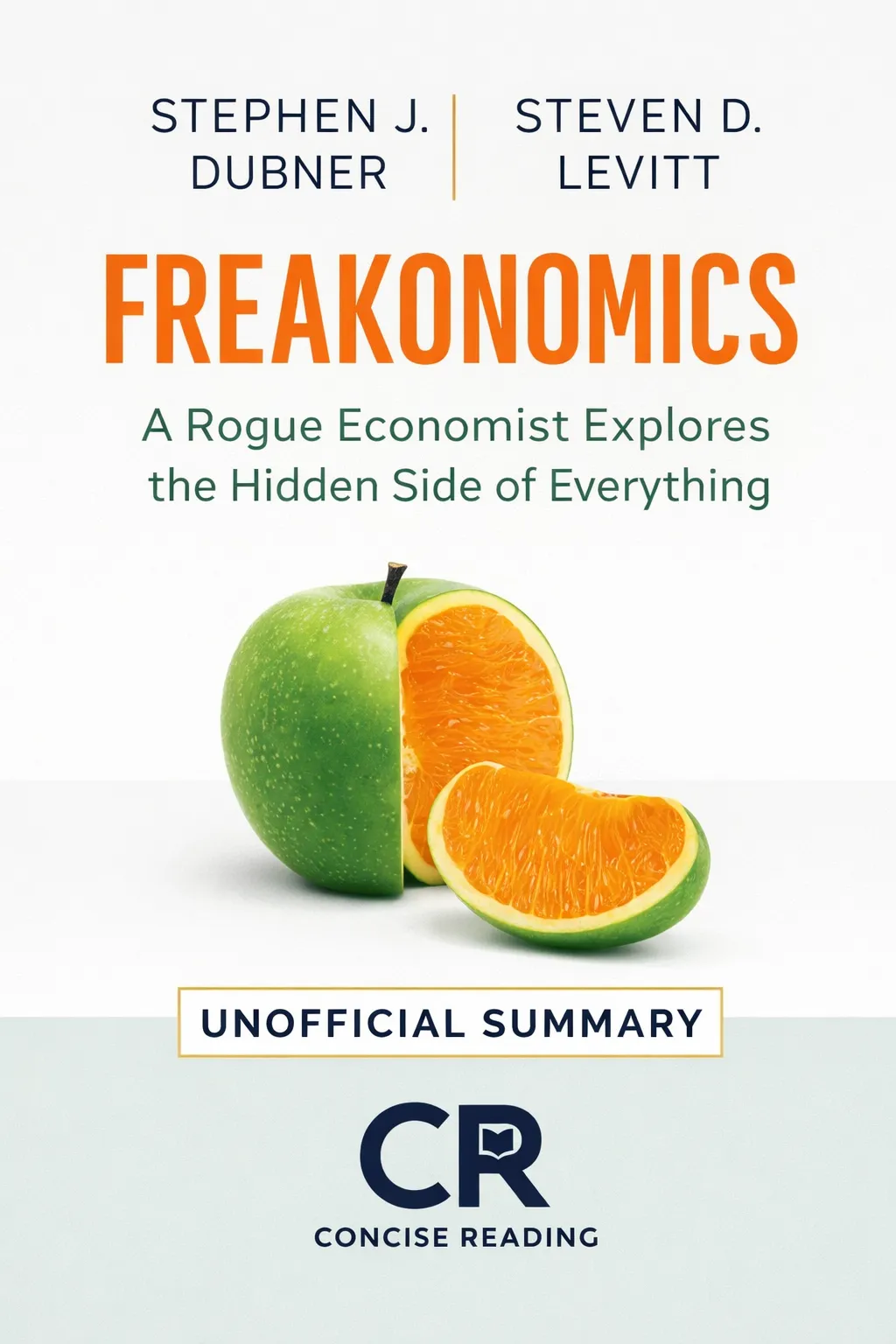
What this book will teach you in the next 10 minutes — and why it matters for every business decision you’ll make this week.
Read by 6,000+ curious thinkers · Part of the Concise Reading Library · Trusted summaries since day one.
Book Snapshot
- Author – Stephen J. Dubner & Steven D. Levitt.
- Category – Behavioral Economics, Critical Thinking, Decision Science
- Original Book – ~ 336 pages | ~ 6–7 hours average read time
- Free Summary – 08 pages
- Premium Summary – 23 pages + ~ 45–55 minutes read time
The Big Idea
Most of what you believe about why things happen — in business, in markets, in human behavior — is the story someone told you, not the truth the data reveals. Freakonomics by Steven Levitt and Stephen Dubner hands you a single, devastatingly useful tool: the ability to follow incentives to their real conclusion, strip conventional wisdom down to its actual evidence, and separate what actually caused an outcome from what merely happened at the same time. Once you see through that lens, you cannot unsee it — and every decision you make gets sharper for it.
What You’ll Learn — Key Lessons Preview
- How to find the hidden incentive behind any behavior — so you stop being surprised when people, systems, or markets act against their stated intentions
- Why the “obvious” explanation is almost always wrong — and the one question that exposes the real cause faster than any analysis tool
- How to audit your own business for misaligned incentives — before they cost you money you didn’t know you were losing
- Why expert advice deserves the same skepticism as anyone else’s — and the simple test that tells you whether an advisor’s win is actually your win
- How to think in counterfactuals — the mental habit that separates good decision-makers from great ones, and that almost nobody practices deliberately
Free vs Premium Comparison
| Free – $0 | Premium – $4.99 (Recommended) |
| ➡ Book Snapshot ➡ The Big Idea ➡ Key Lessons ➡ Power Quotes ➡ 08 Pages | ✔ Everything in free + ✔ Full Chapter Breakdown ✔ Key frameworks & diagrams ✔ Action steps ✔ Critical analysis ✔ One-page cheat sheet ✔ 23 pages |
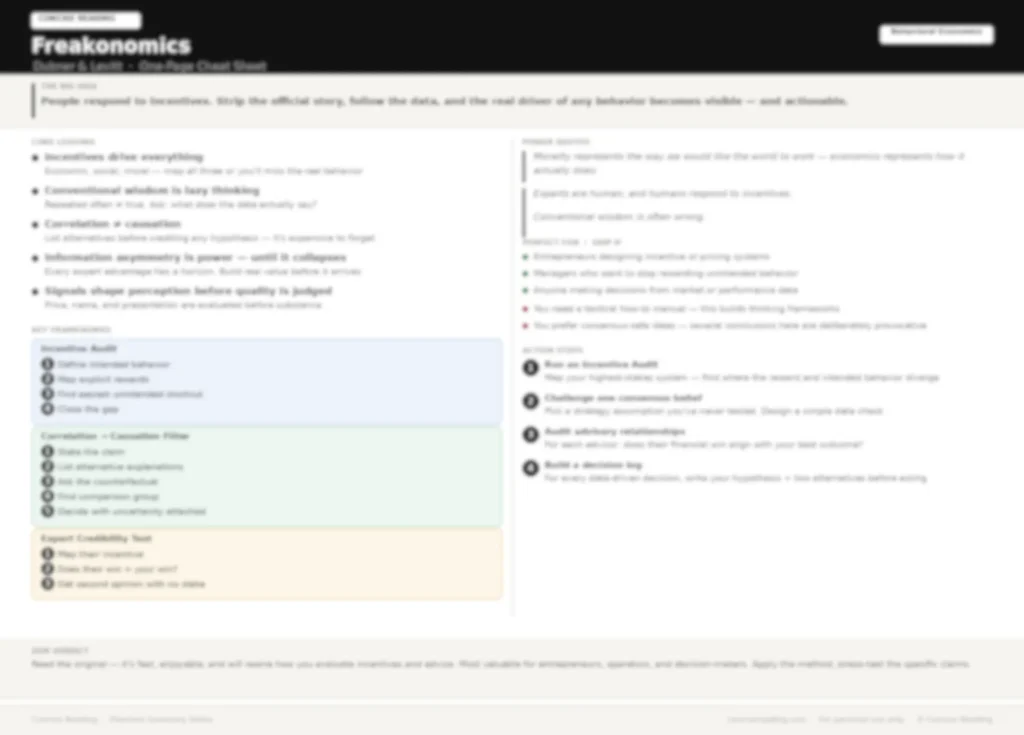
Premium Cheat Sheet Preview
About the Author
Steven D. Levitt is a Professor of Economics at the University of Chicago and winner of the John Bates Clark Medal — awarded to the most influential American economist under 40, and widely considered the stepping stone to the Nobel Prize. Stephen J. Dubner is an award-winning journalist and broadcaster whose Freakonomics Radio podcast has surpassed one billion downloads. Together, they built one of the most-read economics books of the 21st century by asking one question most economists were too cautious to ask: what does the data actually say?
Power Quote From the Book:
“Morality represents the way we would like the world to work — whereas economics represents how it actually does work.” — Steven D. Levitt & Stephen J. Dubner, Freakonomics
Who This Summary is For
- This is for you if…
- You are an entrepreneur or founder who wants to stop making decisions based on what sounds right and start making them based on what the evidence shows
- You are a manager or team leader who has designed an incentive structure and suspects — correctly — that it is producing behavior you never intended
- You are a marketer, analyst, or operator who needs to understand the difference between what caused a result and what merely coincided with it
- You want to think more clearly about any situation where someone with more information than you is advising you — and you need a framework to evaluate their advice honestly
- You are a curious, data-oriented reader who wants to understand human behavior at a level that most business books never reach
- Skip this if…
- You need a step-by-step tactical manual with fill-in-the-blank frameworks. Freakonomics builds thinking tools, not checklists — and this summary follows the same philosophy. If you want pure tactics, our Sales & Negotiation Pack or the Startup & Entrepreneurship Pack may be a better fit right now.
Social Proof
We are building this library one honest summary at a time — and the readers who find genuine value in it are the ones who tell us so in the comments below. If this summary changed how you think about even one decision, or if you found the premium version worth the upgrade, we’d love to hear it. Your feedback helps other readers decide whether this is the right summary for them — and it helps us make every future summary sharper. Drop your thoughts below. No fluff, no star ratings — just tell us what landed.
Freakonomics took Levitt and Dubner years of unconventional research and a career-defining partnership to produce. The Concise Reading premium summary gives you the complete system — every key argument, three actionable frameworks with step-by-step application, curated power quotes with practical commentary, an honest critical analysis, and a print-ready one-page cheat sheet — in under 23 pages and 45 minutes.
Related Summaries
- Thinking, Fast and Slow — Daniel Kahneman (Complements Freakonomics perfectly — where Freakonomics exposes flawed conventional wisdom, Kahneman explains the psychological machinery that creates it in the first place)
- The Tipping Point — Malcolm Gladwell (Same intellectual energy — using data and real-world cases to reveal non-obvious explanations for how ideas and behaviors spread)
- Predictably Irrational — Dan Ariely (Digs deeper into how hidden forces shape our economic decisions — the natural next read after Freakonomics)
[…] our Free Summaries library, where we publish summaries of popular books like Think and Grow Rich, Freakonomics, and The Psychology of […]
[…] Freakonomics […]
[…] Freakonomics […]
[…] Freakonomics […]
[…] You can explore hundreds of similar insights inside our Library, including summaries of books like Atomic Habits, The Psychology of Money, and Freakonomics. […]
[…] you’ve read summaries like Freakonomics or The Psychology of Money, you’ll notice a similar theme: human behavior and incentives shape […]
[…] exploring books like Freakonomics or […]
[…] judgment, estimates, and interpretation. This idea connects deeply with concepts discussed in Freakonomics and The Intelligent Investor, both available in our Free […]
[…] you’ve explored other insights from our Free Summaries library—like Freakonomics, The Psychology of Money, or The Big Short—you’ll notice a common theme: real-world economics […]
[…] that blends economics, policy, and innovation—similar to the ideas explored in books like Freakonomics and Capitalism and Freedom, both available in our Free Summaries […]