
The Big Short by Michael Lewis — Summary & Key Lessons
What this book will teach you in the next 10 minutes — and why it matters for your investments, your financial decisions, and your ability to spot the next crisis before it hits.
Read by investors, finance professionals, and curious minds in 40+ countries. Trusted summaries. No fluff. No filler. Just the ideas that matter.
Book Snapshot
- Author – Michael Lewis
- Category – Finance & Economics / Financial History / Investing & Risk
- Original Book – ~ 291 pages. Average read time approximately 7 to 9 hours.
- Free Summary – 08 pages
- Premium Summary – 26 pages. Estimated read time 60 to 75 minutes.
The Big Idea
The 2008 financial crisis was not a surprise to everyone. A small group of outsiders — a physician-turned-fund-manager, a combative Wall Street analyst, and two men working out of a garage — read the fine print that nobody else would touch, understood what it meant, and bet their careers on the system collapsing. They were right. Michael Lewis’s The Big Short is not really a book about mortgage bonds. It is a book about what happens when an entire industry’s incentives are structured to reward the wrong behavior, and how complexity becomes a tool for hiding risk rather than managing it. The lesson that survives long after the last page is this: the information needed to avoid a catastrophe was available. The problem was never access to the data. It was the will to look at it.
What You’ll Learn — Key Lessons Preview
- You will understand exactly how the 2008 financial collapse was built, brick by brick, by rational people following broken incentives — so you can recognize the same pattern the next time it appears in a different market.
- You will learn why the people who were supposed to protect the system — the rating agencies, the regulators, the risk managers — failed, and what structural flaw made their failure not just predictable but inevitable.
- You will see how a handful of contrarian outsiders held a correct view for two to three years while the market moved against them, and what psychological and financial tools they used to survive long enough to be proven right.
- You will walk away with a framework for evaluating any financial product, investment recommendation, or business proposal by mapping the incentives of the person presenting it to you — before you decide whether to trust their analysis.
- You will develop a clearer instinct for the difference between genuine complexity and deliberate obscurity, and why the inability to explain something simply is often a signal rather than a feature.
Free vs Premium Comparison
| Free – $0 | Premium – $4.99 (Recommended) |
| ➡ Book Snapshot ➡ The Big Idea ➡ Key Lessons ➡ Power Quotes ➡ 08 Pages | ✔ Everything in free + ✔ Full Chapter Breakdown ✔ Key frameworks & diagrams ✔ Action steps ✔ Critical analysis ✔ One-page cheat sheet ✔ 26 pages |
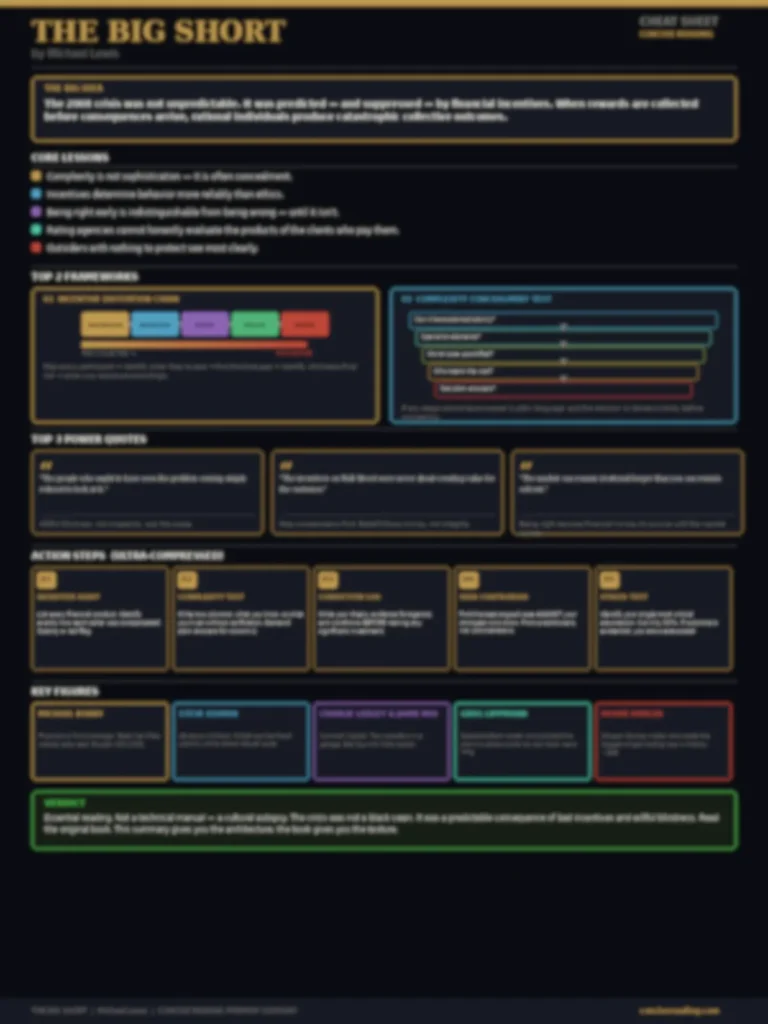
Premium Cheat Sheet Preview
About the Author
Michael Lewis is a former Salomon Brothers bond salesman turned financial journalist and the author of some of the most widely read books about money and markets ever published. He studied economics at Princeton and attended the London School of Economics, and his direct experience inside Wall Street gives his writing a credibility that no outsider could replicate. His books — including Liar’s Poker, Moneyball, Flash Boys, and The Blind Side — have collectively sold tens of millions of copies and several have been adapted into major films. When Lewis writes about Wall Street, he is writing about a world he inhabited.
Power Quote From the Book:
“The people who ought to have seen the problem coming simply refused to look at it.”
— Michael Lewis, The Big Short
Who This Summary is For
- This is for you if…
- You are an investor — retail or professional — who wants a human, ground-level understanding of systemic risk that goes beyond what a textbook or financial news report can give you.
- You are an entrepreneur or business owner who wants to understand how incentive misalignment destroys institutional quality over time, and how to build organizations that don’t replicate the same failure.
- You want to understand what actually happened in 2008 — not the sanitized political version, not the abstract economic version, but the specific, person-by-person account of how the machine was built and why it broke.
- You are someone who suspects that the financial system has not fundamentally changed since 2008 and wants a framework for thinking about where the next blind spot might be hiding.
- You are an analytical thinker in any field who wants to sharpen your ability to spot when a widely held consensus is being held together by financial interest rather than evidence.
- Skip this if…
- You are looking for a step-by-step technical manual on structured finance, a regulatory policy framework, or an academic treatment of macroeconomics. Lewis is a storyteller, not a textbook writer — and this summary reflects that. If you want purely quantitative tools, our summary of Value at Risk or Financial Risk Management will serve you better.
Social Proof
You have just read the free summary. If it gave you one idea you hadn’t considered before — about risk, incentives, or the way financial systems actually behave — we want to hear about it. Scroll to the comments below and share your biggest takeaway. Which lesson hit hardest? What are you thinking about differently now? Readers who engage here consistently tell us it deepens their retention of the material, and your perspective helps others in this community decide whether the premium version is right for them. Every comment, however short, builds something we can’t manufacture: an honest record of what real readers actually got from this work. If you found this useful, say so. If it changed something, tell us how.
The Big Short took Michael Lewis years of reporting, hundreds of interviews, and deep access to the most complex financial system in history to produce. The premium summary gives you the complete system — every framework, every chapter, every action step, and a one-page cheat sheet you’ll actually use — in under 75 minutes.
Related Summaries
- Liars Poker by Michael Lewis — The natural companion to The Big Short. Lewis’s first book puts you inside Salomon Brothers in the 1980s and shows you exactly how the Wall Street culture that produced the 2008 crisis was built from the ground up. If The Big Short made you angry, Liars Poker will show you why none of it should have been surprising.
- When Genius Failed by Roger Lowenstein — The story of Long-Term Capital Management, a hedge fund staffed by Nobel laureates that nearly collapsed the global financial system in 1998. Same themes as The Big Short: extreme leverage, misplaced confidence in models, and the systemic risk created when institutions are too interconnected to fail safely. Essential reading for understanding that 2008 was not a one-time anomaly.
- The Psychology of Money by Morgan Housel — Where The Big Short shows you how the financial system fails at the institutional level, The Psychology of Money shows you how individuals fail at the personal level. Risk, greed, short-term thinking, and the stories we tell ourselves about money — Housel covers all of it in accessible, practical terms. A strong counter-balance to Lewis’s structural critique.
[…] The Big Short […]
[…] deep investigative insights and real business stories, you can also explore related summaries like The Big Short, Billion Dollar Whale, and Barbarians at the Gate available in our Free Summaries […]
[…] economic booms often lead to crashes—an idea also explored in Irrational Exuberance and The Big Short (available in Free […]
[…] can also explore related summaries like “The Big Short”, “Flash Boys”, and “Against the Gods” inside our […]
[…] you’ve read The Big Short in your Free Summaries, you’ve seen how misunderstanding risk can lead to massive […]
[…] and clearly. If you enjoy deep financial insights like this, also explore related summaries like The Big Short and Fooled by Randomness in our […]
[…] Investing, and Financial Risk Management subgenres. It complements other powerful reads like The Big Short, Flash Boys, and Fooled by Randomness—all available in your learning journey at Concise […]
[…] value of learning from real-world financial cases. This book stands alongside powerful reads like The Big Short, Bad Blood, and Financial Shenanigans—all available in our Free Summaries […]
[…] amplify both gains and risks. Books like The Big Short (available in our library) show how misunderstanding these risks can lead to financial […]
[…] The Big Short […]
[…] you’ve explored insights from books like The Psychology of Money, Irrational Exuberance, or The Big Short in our Free Summaries, you’ll find this story connects the dots beautifully. It shows how human […]