Economics in One Lesson by Henry Hazlitt — Summary & Key Lessons
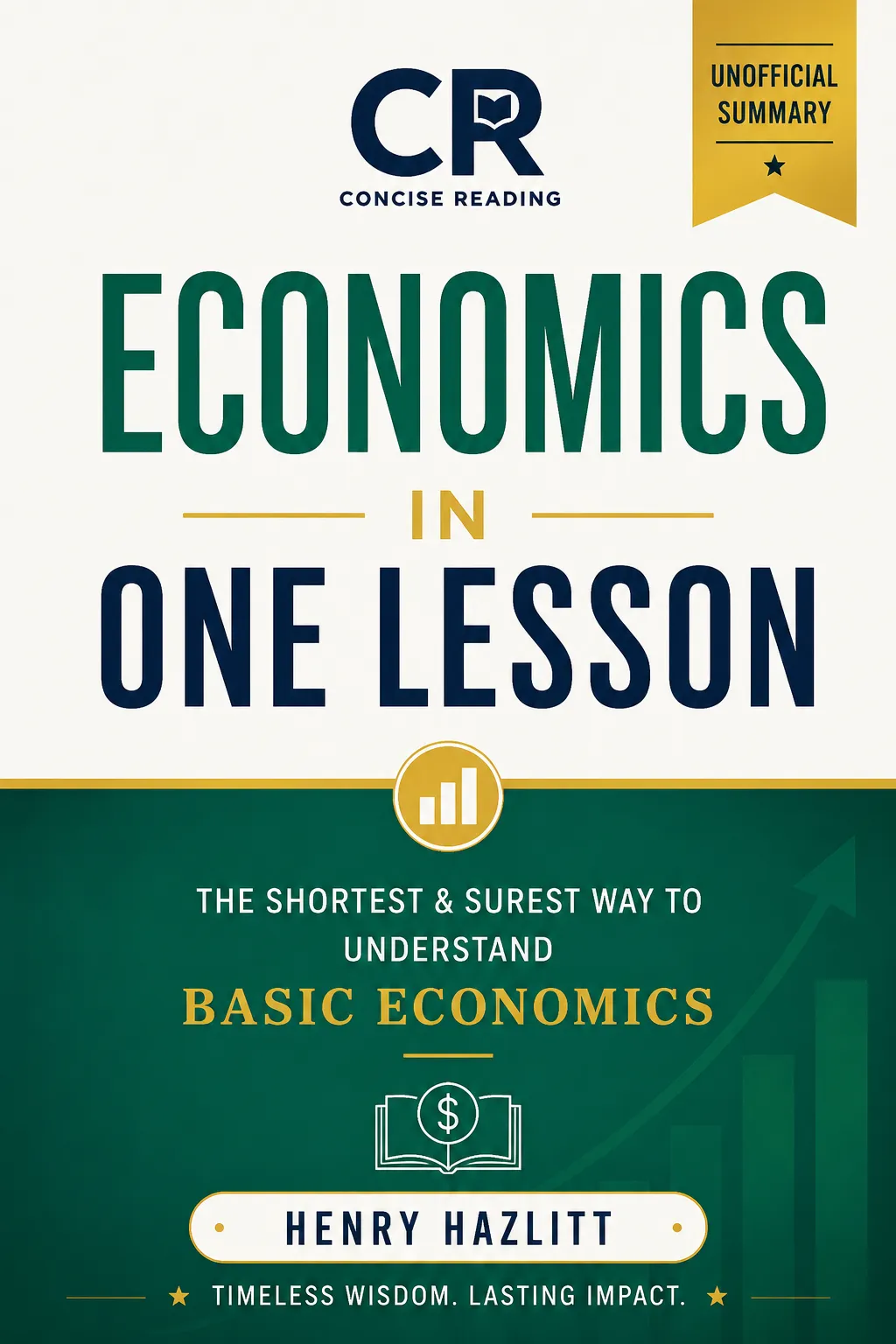
What this book will teach you in the next 10 minutes — and why it matters for every financial and business decision you will ever make.
Read by entrepreneurs, investors, and independent thinkers in over 40 countries. Part of the Concise Reading Economics & Economic Thinking collection — explore the full library at concisereading.com/library.
Book Snapshot
- Author – Henry Hazlitt
- Category – Economics / Economic Thinking / Policy & Society
- Original Book – ~ 218 Pages. Average read time: 4 to 5 hours.
- Free Summary – 08 pages
- Premium Summary – 32 Pages. Estimated read time: 35 to 45 minutes.
The Big Idea
Every economic policy has two sets of consequences: the ones you can see immediately, and the ones that stay invisible until the damage is done. Politicians show you the visible ones. Henry Hazlitt demands you look at both. In Economics in One Lesson, he argues that virtually every economic fallacy — every failed subsidy, every housing shortage caused by rent control, every job destroyed by a tariff that was supposed to protect jobs — comes from the same single error: stopping the analysis too early and looking at only one group instead of all of them. Master this one discipline and you will be able to see through economic arguments that mislead almost everyone else. It takes ten minutes to learn. It takes a lifetime to fully apply.
What You’ll Learn — Key Lessons Preview
- You will understand why the broken window fallacy is the single most dangerous idea in modern economic policy — and why governments use it constantly without anyone noticing.
- You will know exactly why tariffs, rent control, and minimum wage laws consistently harm the very people they are designed to protect — and what actually happens in the years after they are introduced.
- You will develop a permanent mental framework for evaluating any economic argument, government policy, or business decision — so you are never misled by partial analysis again.
- You will see why saving is not the enemy of economic growth but its foundation — and how this changes how you should manage your own money and business capital.
- You will walk away with a five-question diagnostic you can apply to every economic news story, policy debate, or investment thesis in under five minutes.
Free vs Premium Comparison
| Free – $0 | Premium – $4.99 (Recommended) |
| ➡ Book Snapshot ➡ The Big Idea ➡ Key Lessons ➡ Power Quotes ➡ 08 Pages | ✔ Everything in free + ✔ Full Chapter Breakdown ✔ Key frameworks & diagrams ✔ Action steps ✔ Critical analysis ✔ One-page cheat sheet ✔ 32 pages |
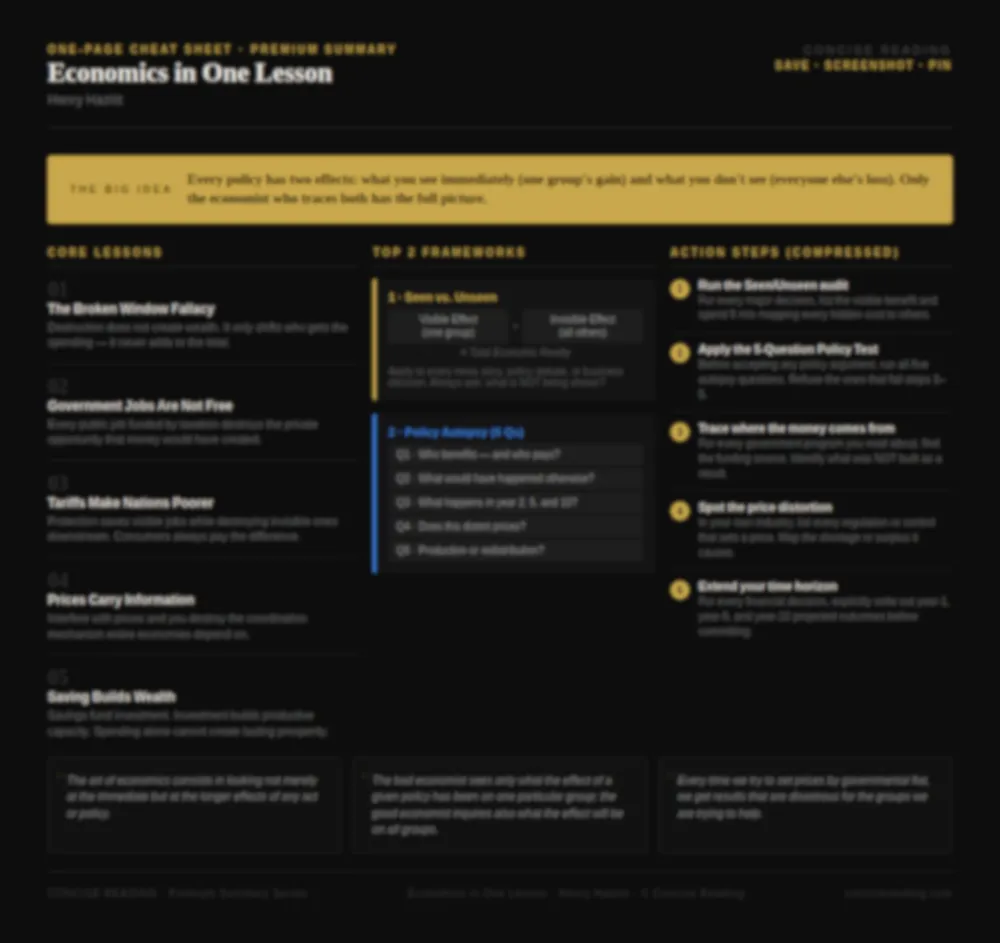
Premium Cheat Sheet Preview
About the Author
Henry Hazlitt (1894–1993) was a self-taught economist, journalist, and editor who wrote for The Wall Street Journal, The New York Times, and Newsweek for decades. He was a close associate of Ludwig von Mises and a founding contributor to the Foundation for Economic Education. Economics in One Lesson has sold over one million copies and has been in continuous print since 1946 — a track record that speaks for itself. If you enjoy this summary, the Basic Economics summary and The Wealth of Nations summary on Concise Reading sit naturally alongside Hazlitt’s work.
Power Quote From the Book:
“The art of economics consists in looking not merely at the immediate but at the longer effects of any act or policy; it consists in tracing the consequences not merely for one group but for all groups.”
— Henry Hazlitt, Economics in One Lesson
Who This Summary is For
- This is for you if…
- You are an entrepreneur, investor, or business owner who wants to understand why economic policies affect your market, your costs, and your decisions — without reading a 400-page textbook.
- You are someone who reads financial news and suspects that most of the economic commentary you consume is missing something important — and you want the analytical tool to identify exactly what.
- You want a thinking framework that applies to every economic debate you will ever encounter, regardless of who is in power or what the policy of the year happens to be.
- You are building financial literacy from the ground up and want a foundation that is rigorous, clear, and immediately applicable — not academic, not ideological, not condescending.
- You have already read The Psychology of Money or Rich Dad Poor Dad and want to understand the broader economic forces that shape the environment those personal finance lessons operate in. Both summaries are available in the Concise Reading library.
- Skip this if…
- You are looking for a neutral survey of all schools of economic thought. Hazlitt argues a position — clearly, logically, and without apology. If you want balance across Keynesian and free-market perspectives, pair this with the summary of The General Theory or Poor Economics also available in our library.
Social Proof
This summary is new to the Concise Reading library and we are building our reader community from the ground up — which means your voice matters more here than anywhere else. If you have read this free summary or purchased the premium version, we would genuinely like to know what you took from it. Did the seen/unseen framework change how you read an economic news story? Did one of the action steps cause real discomfort — in the right way? Drop your experience, reaction, or even a disagreement in the comments below. Real feedback from real readers is what helps the next person decide whether this summary is right for them. We read every comment. The best ones get featured. If you want to explore what other readers are saying about the broader Concise Reading library, the Start Here page is a good place to begin.
Economics in One Lesson took Henry Hazlitt a lifetime of economic journalism to distill — the Premium Summary gives you the complete system, three visual frameworks, a one-page cheat sheet, and five targeted action steps in 32 pages. If the free summary gave you one useful idea, the premium version will give you a permanent operating system for economic thinking — and at the price of a coffee, the only real question is why you would wait.
Related Summaries
- Basic Economics by Thomas Sowell — Sowell extends Hazlitt’s one lesson into every corner of modern economics with the same no-jargon directness. The natural next step after this book.
- The Wealth of Nations by Adam Smith — The original case for free markets and the price system. Reading this after Hazlitt gives you the historical roots of everything Hazlitt defends.
- Freakonomics by Steven D. Levitt and Stephen J. Dubner — Applies the same discipline of tracing hidden consequences and unseen incentives to social and everyday economic questions. A highly readable companion to Hazlitt’s framework.
[…] have to spend hours struggling through dense economic theory. You can also explore more titles like Economics in One Lesson and Basic Economics inside our Library → Free Summaries section to build a strong foundation in […]
[…] you’ve already explored foundational ideas in books like Economics in One Lesson or Capitalism and Freedom, this book takes your understanding to a deeper, more strategic […]