Corporate Finance by Ross, Westerfield & Jaffe — Summary & Key Lessons
What this book will teach you in the next 10 minutes — and why it matters for every investment, funding, and business decision you’ll ever make.
Part of the Financial Intelligence & Analysis collection at Concise Reading — where complex books get stripped to what actually matters.
Book Snapshot
- Author – Stephen A. Ross, Randolph W. Westerfield & Jeffrey Jaffe
- Category – Finance & Corporate Strategy / Business Education
- Original Book – ~ 950–1,000 pages | Average read time: 40–50 hours
- Free Summary – 08 pages
- Premium Summary – 39 pages | Estimated read time: 45–60 minutes
The Big Idea
Most business owners, managers, and even senior executives make financial decisions on instinct where they should be operating on principle. Corporate Finance by Ross, Westerfield, and Jaffe builds the framework that eliminates that guesswork. At its core, the book answers one question: does this decision create value or destroy it? To answer that, it gives you three tools that govern every corporate financial decision — how to evaluate investments using risk-adjusted returns, how to structure capital to minimize cost and maximize flexibility, and how to allocate surplus cash without destroying what you’ve built. These aren’t academic abstractions. In today’s high-interest-rate environment, where the cost of capital is real and visible again, every entrepreneur, analyst, and manager who doesn’t understand these principles is flying blind.
What You’ll Learn — Key Lessons Preview
- Why the source of your funding — debt or equity — changes your company’s risk profile and its total value, and how to find the balance that maximizes both
- How to calculate whether any investment, project, or acquisition is actually worth making — using the same framework CFOs at billion-dollar companies use daily
- Why the market only compensates you for one type of risk (and why taking the other kind is a mistake you pay for silently)
- How to set a real hurdle rate for your business — so you stop approving decisions that look good on paper but destroy value in practice
- What to do when your business generates more cash than it can profitably reinvest — and why the wrong answer here is one of the most common and costly mistakes in business
Free vs Premium Comparison
| Free – $0 | Premium – $4.99 (Recommended) |
| ➡ Book Snapshot ➡ The Big Idea ➡ Key Lessons ➡ Power Quotes ➡ 08 Pages | ✔ Everything in free + ✔ Full Chapter Breakdown ✔ Key frameworks & diagrams ✔ Action steps ✔ Critical analysis ✔ One-page cheat sheet ✔ 39 pages |
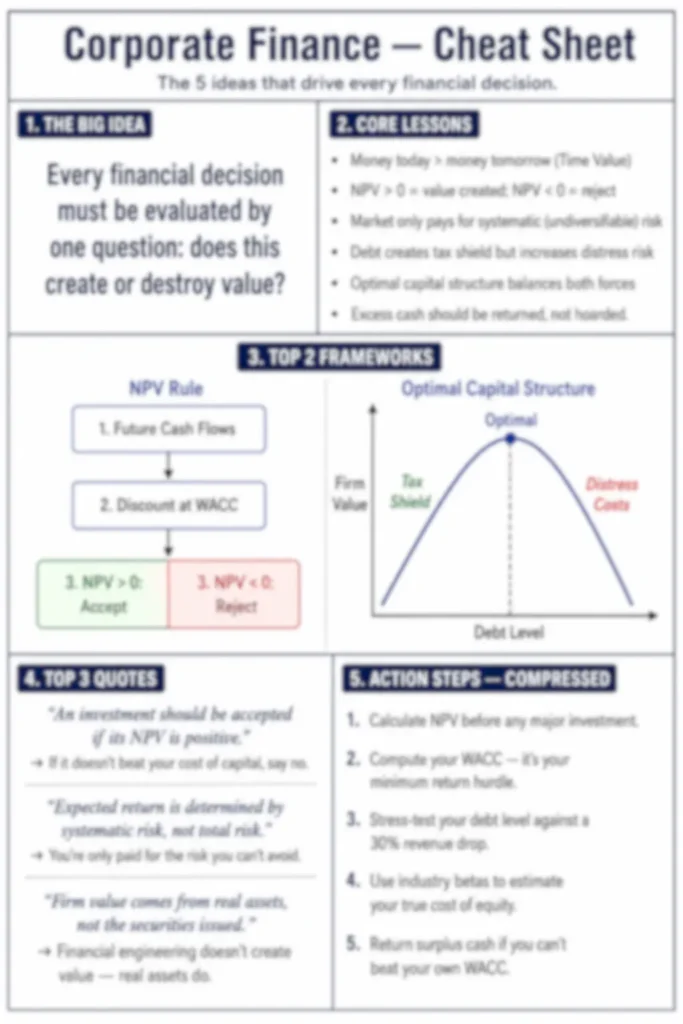
Premium Cheat Sheet Preview
About the Author
Stephen A. Ross, Randolph W. Westerfield, and Jeffrey Jaffe collectively represent one of the most credentialed author teams in the history of finance education. Ross was the Franco Modigliani Professor at MIT and the developer of Arbitrage Pricing Theory — one of the most cited contributions in financial economics. Westerfield served as Dean of USC’s Marshall School of Business. Jaffe is a Wharton professor whose research on market efficiency has shaped how practitioners and academics think about pricing. Their textbook is now in its 13th edition — a standard in MBA programs on every continent.
Power Quote From the Book:
“An investment should be accepted if the NPV is positive and rejected if it is negative.”
— Ross, Westerfield & Jaffe, Corporate Finance
Who This Summary is For
- This is for you if…
- You are a business owner or entrepreneur who makes investment, funding, or cash allocation decisions and wants to stop guessing
- You are a finance or MBA student who wants to understand the logic behind the formulas — not just pass the exam
- You are an analyst, associate, or aspiring CFO who wants a rock-solid conceptual foundation before stepping into a high-stakes role
- You are an investor who wants to understand how the companies you invest in actually think about capital, risk, and value
- You want to be the person in the room who understands what WACC, NPV, and capital structure actually mean — and can use them
- Skip this if…
- This is not a personal finance guide — it won’t tell you how to budget your salary or pay off your student loans. If you’re looking for that, start with our Personal Finance & Wealth Building collection instead.
Testimonials
This summary was built for one purpose: to give you the clearest, most useful distillation of a 1,000-page textbook that exists anywhere — free or paid. If you’ve read it, the free version, or the premium deep-dive, we’d genuinely like to know what you took from it. Drop your biggest takeaway, a question it raised, or how it changed a decision you were sitting on — in the comments below. Your experience helps other readers decide if this is the right next read for them. And if you’ve already explored other summaries in our Financial Intelligence & Analysis library, we’d love to hear how they compare.
Corporate Finance took three of the world’s leading finance professors — and over three decades of combined research and teaching — to write. The premium summary gives you the complete system: every major framework, a full chapter-by-chapter breakdown, five curated power quotes with context, action steps specific enough to be uncomfortable, a critical analysis that tells you what the book gets wrong, and a one-page cheat sheet worth pinning to your wall — all in under 25 pages, for $4.99.
If you found the free version useful, the premium summary will change how you evaluate every financial decision you make — in your business and your portfolio. You can also explore the full Financial Intelligence & Analysis Pack or the Financial Intelligence Playbook if you want the complete system across multiple books.
Related Summaries
- Financial Intelligence – Karen Berman & Joe Knight — Bridges the gap between raw financial data and managerial decision-making. Perfect companion to corporate finance theory.
- The Intelligent Investor – Benjamin Graham — Applies many of the same valuation principles from corporate finance to the investor’s perspective. The practical counterpart to the theoretical framework.
- Security Analysis – Benjamin Graham & David Dodd — Deep-dives into fundamental valuation, making it the natural next step for anyone who wants to apply corporate finance principles to real investment analysis.