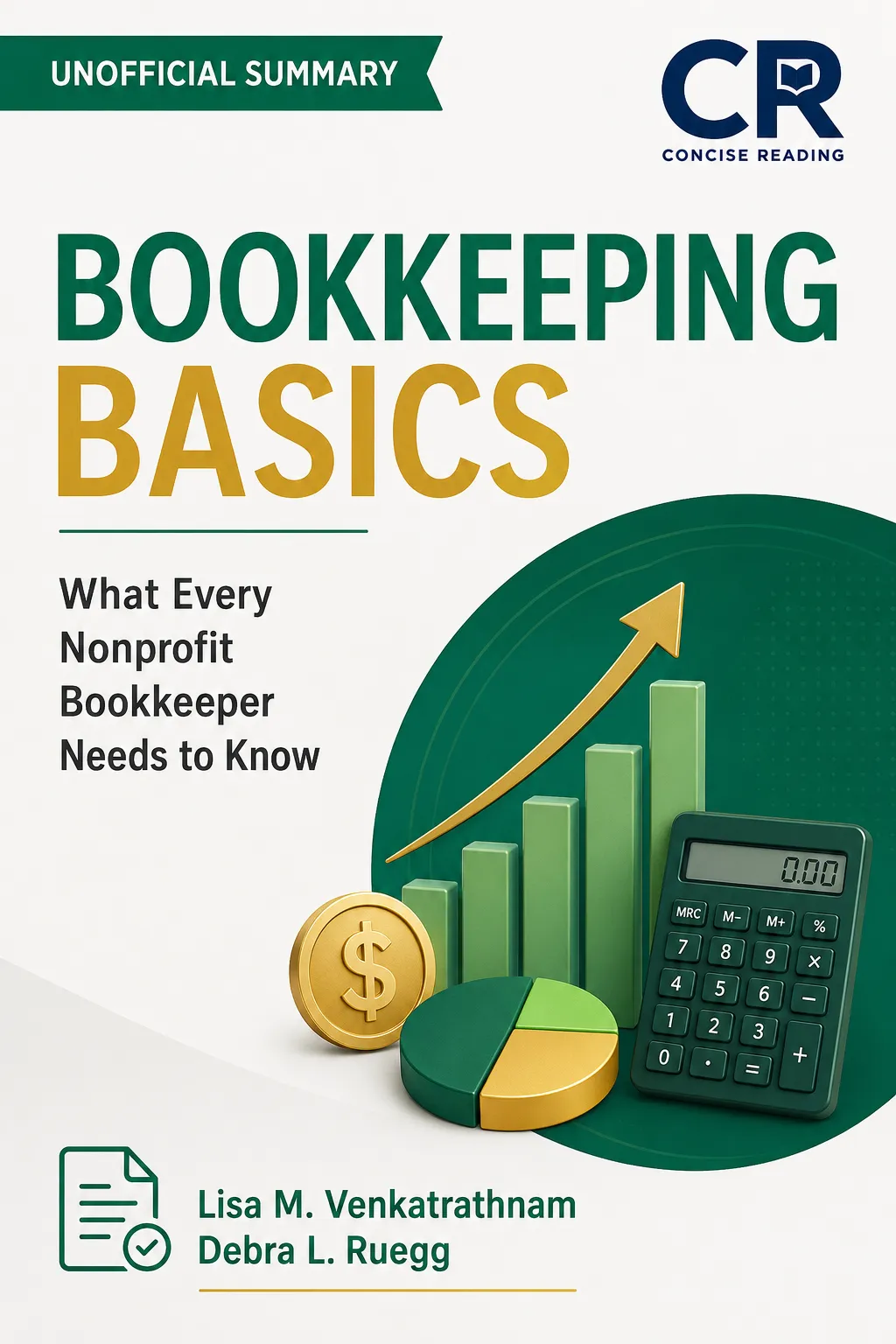
Bookkeeping Basics by Venkatrathnam & Ruegg — Summary & Key Lessons
What this book will teach you in the next 10 minutes — and why it matters for your business’s financial survival.
Part of the Accounting & Bookkeeping collection at Concise Reading — summaries written for business owners, not accountants.
Book Snapshot
- Author – Lisa M. Venkatrathnam, Debra L Ruegg
- Category – Finance & Accounting / Small Business Operations
- Original Book – ~ 272 pages | Average read time: 6–8 hours
- Free Summary – 07 pages
- Premium Summary – 36 pages | Estimated read time: 35–45 minutes
The Big Idea
Most small business owners are not failing because they lack customers. They are failing because they have no reliable record of where their money is going. Bookkeeping Basics strips away the intimidation around financial record-keeping and shows you that the entire system rests on one principle: record every transaction on two sides, consistently, and the financial picture of your business becomes clear. No accounting degree required. No expensive software necessary. Just the foundational literacy that turns financial anxiety into financial control. If you run a business and you are not confident in your numbers, this book — and this summary — is your starting point. Explore more foundational reads in our Financial Intelligence & Analysis category.
What You’ll Learn — Key Lessons Preview
- How the double-entry bookkeeping system works — and why it makes errors almost impossible to hide
- How to build a chart of accounts from scratch so every transaction has a home and your reports actually mean something
- Why bank reconciliation is the monthly habit that separates businesses with clean books from those with expensive surprises at tax time
- How to choose between cash-basis and accrual-basis accounting based on your specific business model — not a one-size-fits-all rule
- How to run three core financial reports every month so you always know whether your business is actually profitable
If these lessons connect to where you are right now, you may also want to look at our summaries of Profit First and Financial Intelligence — two books that build directly on this foundation.
Free vs Premium Comparison
| Free – $0 | Premium – $4.99 (Recommended) |
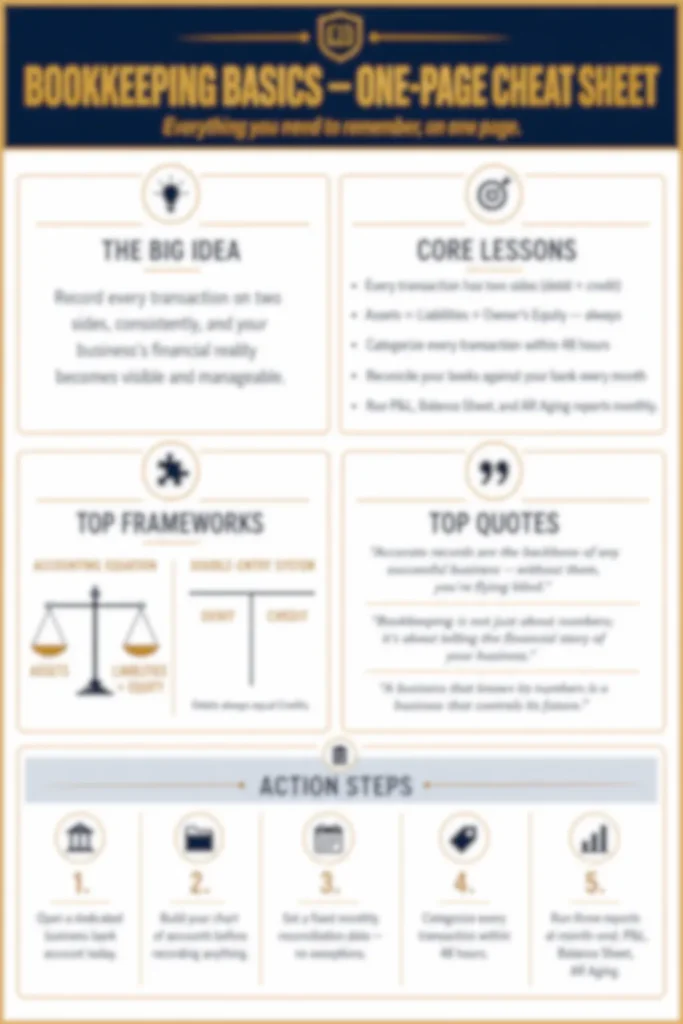
| ➡ Book Snapshot ➡ The Big Idea ➡ Key Lessons ➡ Power Quotes ➡ 07 Pages | ✔ Everything in free + ✔ Full Chapter Breakdown ✔ Key frameworks & diagrams ✔ Action steps ✔ Critical analysis ✔ One-page cheat sheet ✔ 36 pages |
Premium Cheat Sheet Preview
About the Author
Lisa M. Venkatrathnam is a certified public accountant with years of hands-on experience helping small businesses build functional financial systems. Debra L. Ruegg is a bookkeeping consultant and educator who has spent her career making accounting processes accessible to non-accountants. Together, they bring practitioner-level expertise — not academic theory — which is precisely what makes this book trustworthy and immediately applicable for business owners at any stage.
Power Quote From the Book:
“A business that knows its numbers is a business that controls its future.”
— Lisa M. Venkatrathnam & Debra L. Ruegg, Bookkeeping Basics
Who This Summary is For
- This is for you if…
- You are a first-time business owner handling your own finances and have no formal accounting background
- You are a freelancer or consultant who wants to stop guessing at profitability and start knowing it
- You are someone who has just started using QuickBooks or Wave but does not fully understand what you are recording or why
- You want to be able to have an informed conversation with your accountant instead of nodding along and hoping for the best
- You are building a business and want to start with clean, organized financial habits before things get complicated
- Skip this if…
- You already understand double-entry bookkeeping, know how to read a balance sheet, and are looking for advanced financial strategy or tax optimization. You would be better served by our Financial Statement Analysis or Managerial Accounting summaries instead.
Testimonials
We are building the Concise Reading library one high-quality summary at a time, and the most valuable feedback we get comes from readers like you. If you have read the free or premium version of this summary, we would genuinely like to know what landed, what you applied, and whether it changed how you manage your business finances. Drop your thoughts in the comments below. Whether you are a first-time business owner who just got clarity on debits and credits, or a freelancer who finally set up a proper chart of accounts — your experience helps other readers decide if this summary is right for them. No fluff needed. Just tell us what was useful. You can also browse what other readers are saying across our Library and Start Here pages if you want to explore more before you commit.
Bookkeeping Basics took its authors decades of hands-on client work to distill. The premium summary gives you the complete system — frameworks, action steps, cheat sheet, and chapter breakdown — in under 45 minutes, for $4.99.
If you are serious about running a financially visible business, the premium summary is not an optional upgrade. It is the faster path. And if bookkeeping is just one piece of what you are building, consider the Accounting & Bookkeeping Premium Pack — 12 summaries covering the full spectrum of business financial literacy at a fraction of the cost of buying each one separately.
Related Summaries
Based on the content of this book, here are three summaries from the Concise Reading library that pair directly with it:
- 1. Accounting Made Simple — If Bookkeeping Basics got you comfortable with recording transactions, Accounting Made Simple takes the next step and shows you how those records turn into financial statements and business decisions.
- 2. Profit First — Once your books are in order, this book shows you how to redesign your business’s cash flow system so profitability becomes automatic, not accidental. A natural next read after getting your bookkeeping foundation right.
- 3. Financial Intelligence — Written for non-financial managers, this book teaches you how to read and interpret financial statements with confidence — the logical continuation of everything you learned about recording and organizing your numbers.