Free to Choose by Milton Friedman — Summary & Key Lessons
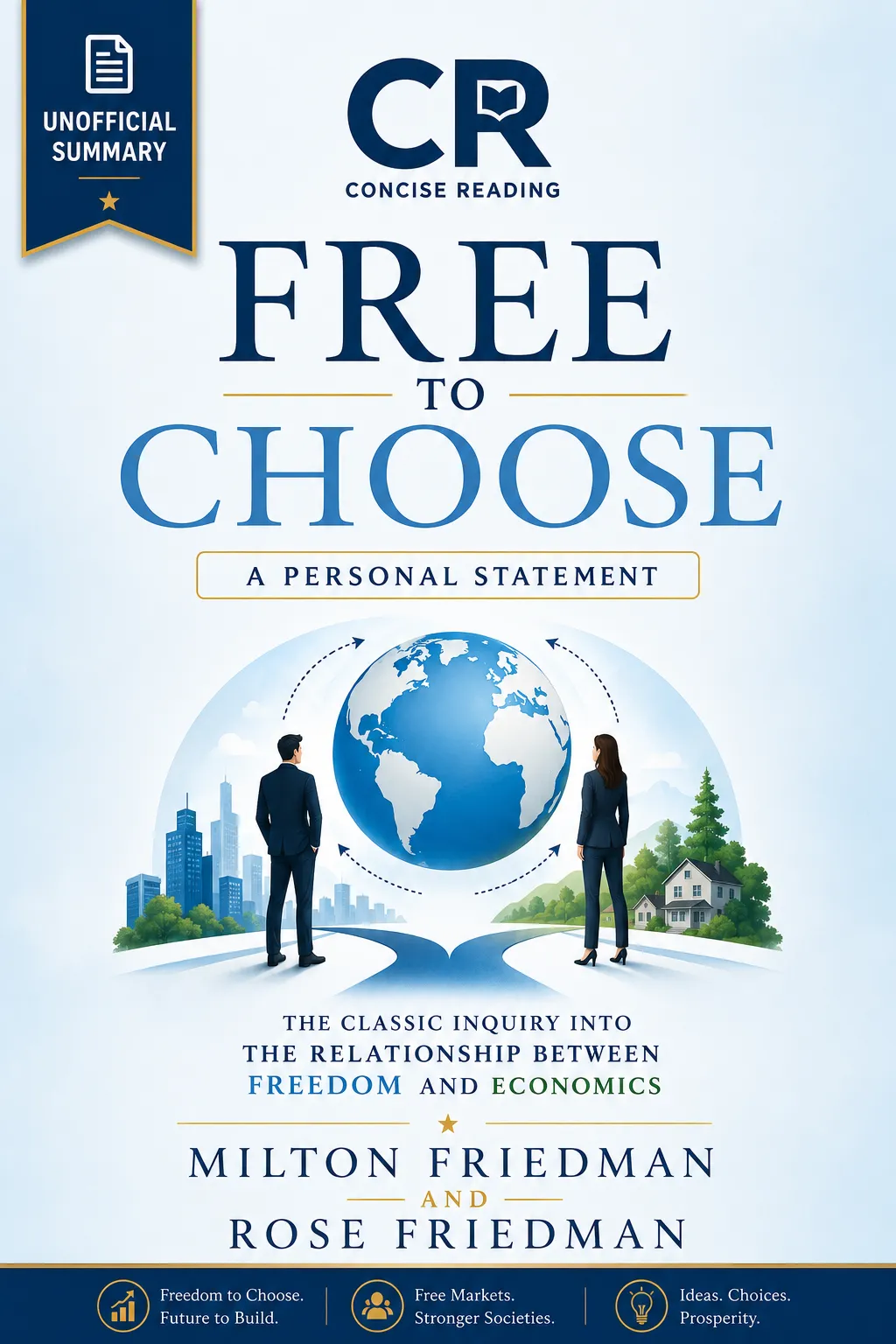
What this book will teach you in the next 10 minutes — and why it matters for your money, your business, and your financial independence.
Trusted by thousands of readers who choose clarity over fluff. No filler. No padding. Just the ideas that matter — distilled and ready to use.
Book Snapshot
- Author – Milton Friedman and Rose Friedman
- Category – Economics / Political Economy / Personal Finance & Freedom
- Original Book – ~ 338 pages. Average read time: 8–10 hours.
- Free Summary – 08 pages
- Premium Summary – 27 pages. Estimated read time: 45–60 minutes.
The Big Idea
Milton Friedman’s core argument is both simple and radical: when people are free to make their own economic choices, markets work. When governments intervene — setting prices, running schools, printing money, expanding welfare programs — they almost always produce results that are the opposite of what they promised. Not because politicians are dishonest, but because no central authority can process the millions of signals that a free market handles automatically every single day. This book is not just about economics. It is about power — who holds it, how they get it, and what it costs you when you hand it over.
What You’ll Learn — Key Lessons Preview
- You will understand exactly why prices matter more than most people realize — and why every government attempt to control them ends in shortages, black markets, and wasted resources.
- You will see the predictable pattern behind every failed government program — from farm subsidies to rent control to welfare — and be able to spot the next one before it fails.
- You will know the real cause of inflation (it is not corporations, not oil prices, not supply chains) — and what you can do right now to protect your savings from the hidden tax that government never tells you about.
- You will understand why economic freedom and political freedom cannot be separated — and why every society that surrendered one has always, without exception, lost the other.
- You will walk away with four practical frameworks you can apply immediately — to your investment decisions, your business, your career, and how you evaluate any policy headline you read.
Free vs Premium Comparison
| Free – $0 | Premium – $4.99 (Recommended) |
| ➡ Book Snapshot ➡ The Big Idea ➡ Key Lessons ➡ Power Quotes ➡ 08 Pages | ✔ Everything in free + ✔ Full Chapter Breakdown ✔ Key frameworks & diagrams ✔ Action steps ✔ Critical analysis ✔ One-page cheat sheet ✔ 27 pages |
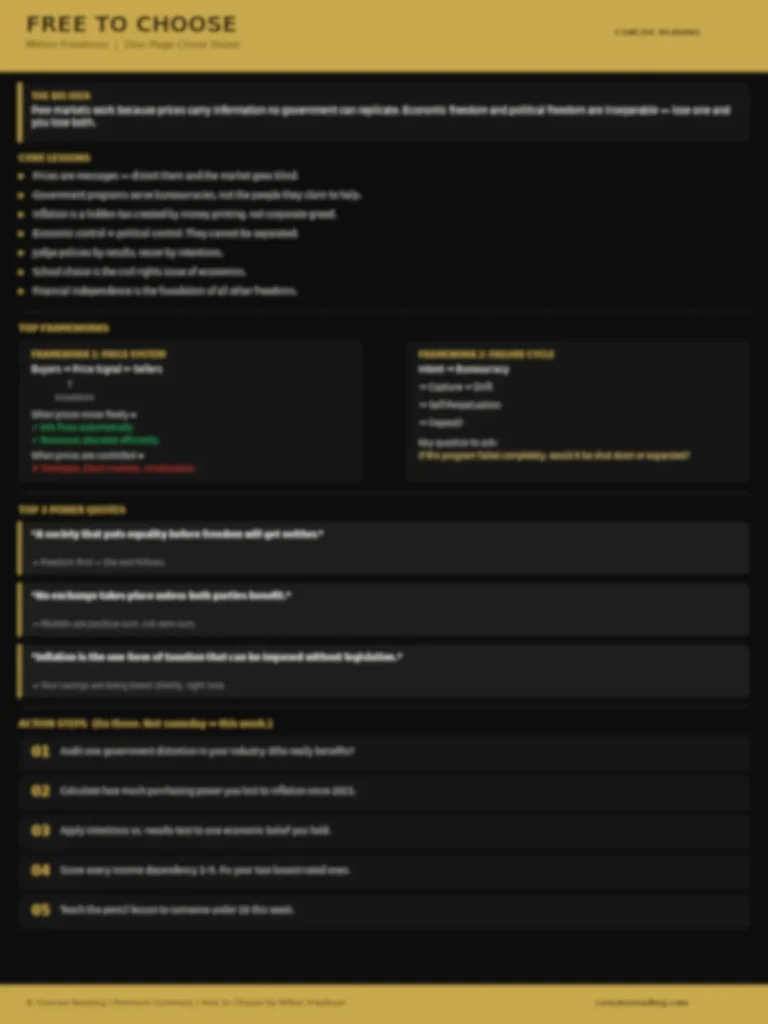
Premium Cheat Sheet Preview
About the Author
Milton Friedman (1912–2006) was awarded the Nobel Prize in Economic Sciences in 1976 and spent over three decades at the University of Chicago building the most influential economics department in the world. He advised Presidents Nixon and Reagan, co-authored A Monetary History of the United States — the book that changed how central banks understand the Great Depression — and reached millions through the PBS television series that accompanied this book. He is one of the most cited economists in history.
Power Quote From the Book:
“A society that puts equality before freedom will get neither. A society that puts freedom before equality will get a high degree of both.”
— Milton Friedman, Free to Choose
Who This Summary is For
- This is for you if…
- You are an entrepreneur or business owner who wants to understand the economic environment your business operates in — not just hustle tactics, but the system itself.
- You are an investor who wants a rigorous mental framework for evaluating inflation, government policy, and macroeconomic risk — not just stock picks.
- You are a self-educated professional who is tired of political noise and wants to think more clearly about why economies succeed or fail.
- You want to understand why your savings seem to shrink despite working harder — and what is actually responsible for it.
- You are someone who has read books like Rich Dad Poor Dad (concisereading.com/rich-dad-poor-dad-summary-robert-kiyosaki), The Millionaire Fastlane, or Capitalism and Freedom (concisereading.com/capitalism-and-freedom-summary-milton-friedman) and wants a deeper, more rigorous intellectual foundation for the financial mindset those books describe.
- Skip this if…
- You are looking for investment tactics, a personal finance how-to, or a step-by-step wealth-building system. This book operates at the level of economic systems and thinking frameworks — not individual strategies. If that is what you need right now, our summary of I Will Teach You to Be Rich (concisereading.com/i-will-teach-you-to-be-rich-summary) or The Total Money Makeover (concisereading.com/the-total-money-makeover-summary) may be a better starting point.
Social Proof
This summary is newer than most on our shelves — which means we are still collecting reader experiences. If you read the free summary below or picked up the premium version, we would genuinely love to hear what landed for you. Did a framework shift how you see a current economic headline? Did an action step make you uncomfortable in the right way? Drop your experience in the comments below. Your feedback helps other readers decide, and it helps us make every summary sharper. The most useful reviews are specific — what changed for you, and why.
Free to Choose took Milton Friedman thirty years of research, a Nobel Prize, and a lifetime of intellectual battle to write. The premium summary gives you the complete system — every chapter, four visual frameworks, five curated power quotes, five action steps designed to cause productive discomfort, a critical analysis that tells you exactly where Friedman was right and where his argument has limits, and a one-page cheat sheet worth printing and keeping — in under 60 minutes.
If you are the kind of reader who browses our Library regularly, you already know that the premium versions are where the real leverage lives. This one is no different.
The Economics and Economic Thinking Pack also includes this summary alongside our summaries of Economics in One Lesson, Basic Economics, The Road to Serfdom, Capitalism and Freedom, The Wealth of Nations, and more — at a significant discount over buying individually.
And if you want the deepest possible treatment, The Economics Playbook synthesizes insights from the ten most important economics books ever written into a single unified guide. That is where frameworks from Friedman, Hayek, Sowell, and Keynes are put into direct conversation with each other.
New to Concise Reading? Start here to understand exactly how our summaries are built and what makes the premium versions worth it.
Related Summaries
- The Road to Serfdom by F.A. Hayek — Hayek makes a parallel argument: central economic planning inevitably leads to political tyranny. Where Friedman is empirical and data-driven, Hayek is philosophical and historical. Together they form the two strongest pillars of the free-market intellectual tradition.
- Basic Economics by Thomas Sowell — If Free to Choose lit the fire, Basic Economics is the fuel. Sowell methodically walks through every major economic topic — prices, wages, housing, healthcare, trade — and shows, with zero jargon and brutal clarity, what economic thinking actually looks like versus what politicians pretend it looks like. An essential companion.
- Economics in One Lesson by Henry Hazlitt — Written in 1946 but more relevant today than most 2024 books, Hazlitt’s core lesson is: every economic policy must be judged not just by its visible, immediate effects, but by its invisible, long-term consequences. One idea. Applied relentlessly to taxation, tariffs, minimum wage, subsidies, and more. Readers who want Friedman in condensed, punchy form will love this.
[…] Free to Choose […]
[…] Free to Choose (available in Free Summaries) […]
[…] Free to Choose (available in Free Summaries) […]
[…] you’ve explored summaries like Capitalism and Freedom or Free to Choose, this book offers a contrasting perspective—making it essential for a balanced […]
[…] you’ve read summaries like Free to Choose or Capitalism and Freedom in our Free Summaries section, you’ve already experienced his powerful […]
[…] you’re interested in similar economic perspectives, you can also explore summaries like Free to Choose and Basic Economics available in our Free Summaries […]
[…] see similar thinking in Capitalism and Freedom and Free to Choose, both available in our Economics […]