Measure What Matters by John Doerr — Summary & Key Lessons
What this book will teach you in the next 10 minutes — and why it matters for your team’s focus, alignment, and ability to execute on what actually moves the needle.
Read by founders, managers, and operators at Google, Intel, and thousands of scaling businesses. Now distilled into a summary that gives you the system without the 320 pages.
Book Snapshot
- Author – John Doerr
- Category – Business Strategy, Leadership & Management, Productivity
- Original Book – ~ 320 pages | Average read time: 6–7 hours
- Free Summary – 07 pages
- Premium Summary – 34 pages
The Big Idea
Most teams don’t fail because of bad people or weak ideas. They fail because everyone is working hard on different things. John Doerr’s OKR framework — Objectives and Key Results — solves this with a deceptively simple discipline: you decide what matters most this quarter, you attach measurable proof that you achieved it, and you make both visible to everyone on your team. No more vague goals that fade by week three. No more quarterly reviews that measure activity instead of outcomes. When Google’s Larry Page made his OKRs visible to every engineer in the building, something changed. Alignment replaced politics. Focus replaced busyness. This is the system that scaled Google from 40 people to 100,000 — and it works at any size.
What You’ll Learn — Key Lessons Preview
- You’ll know exactly how to write a goal that forces accountability — the precise structure of an Objective and Key Result that leaves no room for “we were kind of on track.”
- You’ll understand why tying OKR scores to salaries destroys the entire system — and what to do instead to build a performance culture that doesn’t reward sandbagging.
- You’ll be able to run your first OKR cycle from scratch — including how to set the cadence, hold the check-ins, and score results without turning it into bureaucracy.
- You’ll see why making goals public isn’t a threat to your team — it’s the mechanism that creates genuine alignment across roles, departments, and levels of seniority.
- You’ll learn the CFR system — the Conversations, Feedback, and Recognition framework that keeps OKRs from dying after the first quarter, which most implementations skip entirely.
Free vs Premium Comparison
| Free – $0 | Premium – $4.99 (Recommended) |
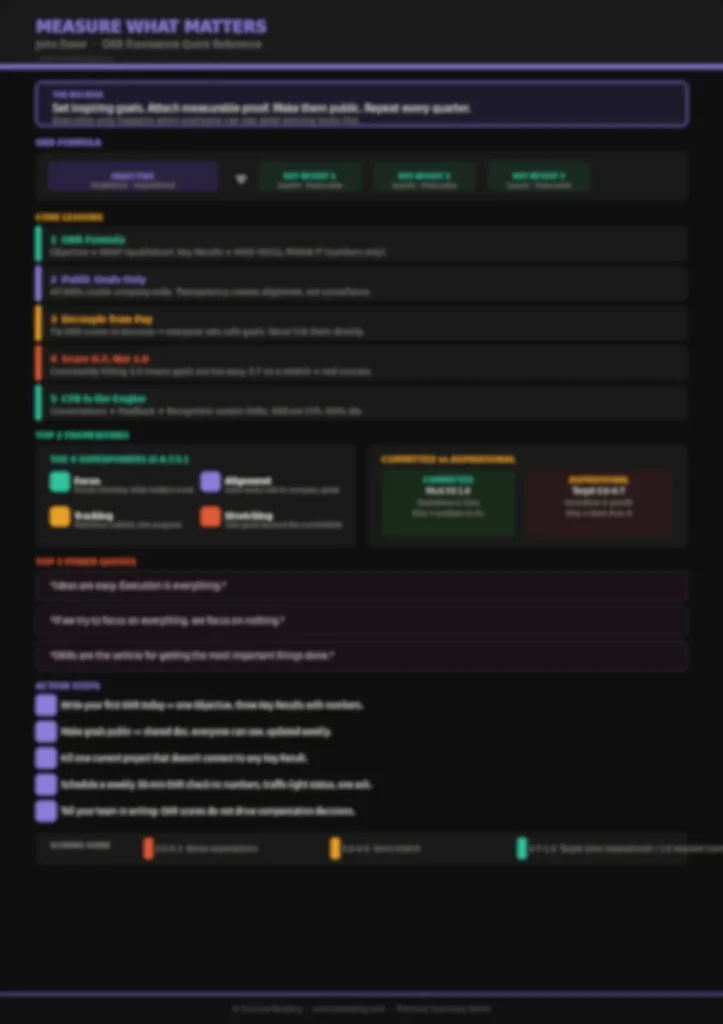
| ➡ Book Snapshot ➡ The Big Idea ➡ Key Lessons ➡ Power Quotes ➡ 07 Pages | ✔ Everything in free + ✔ Full Chapter Breakdown ✔ Key frameworks & diagrams ✔ Action steps ✔ Critical analysis ✔ One-page cheat sheet ✔ 34 pages |
Premium Cheat Sheet Preview
About the Author
John Doerr is a venture capitalist at Kleiner Perkins who learned OKRs directly from Intel’s Andy Grove in 1975 — and introduced them to Google in 1999 when the company had fewer than 40 employees. He has backed companies generating over $1 trillion in combined market value, including Google, Amazon, and Intuit. Measure What Matters is his first and only book — the distilled product of five decades watching what separates companies that execute from companies that plan.
Power Quote From the Book:
“Ideas are easy. Execution is everything.” — John Doerr, Measure What Matters
Who This Summary is For
- This is for you if…
- You are a founder or CEO managing a team larger than five people and your quarterly planning feels like it evaporates by week four
- You are a team lead frustrated that everyone seems busy but the important things never seem to get done
- You want a practical, repeatable system for turning strategy into measurable execution — not another motivational framework
- You are building a performance culture and need something that works without micromanagement
- You want to understand the goal-setting system behind Google, Intel, the Gates Foundation, and Bono’s ONE Campaign — and implement a version of it starting this week
- If you’ve already read our summaries of Good to Great or The 4 Disciplines of Execution, this is the logical next read — it gives you the operating system that sits underneath both.
- Skip this if…
- You’re a solo operator with no team yet — OKRs require multiple people to generate their value, and this framework won’t be useful until you’re building with others. If personal productivity is what you’re after, our summaries of Deep Work or Essentialism will serve you better right now.
Social Proof
We believe the most useful feedback on a summary comes from readers who’ve actually used it — not a curated set of five-star quotes. If you read this summary and implemented even one idea from it, we’d genuinely love to hear what changed. Leave a comment below: what did you take away? What did you actually do differently? Your experience helps other readers decide whether this is the right summary for them — and it helps us make every summary sharper. The best reviews on this page aren’t stars. They’re results.
Measure What Matters took John Doerr over four decades of front-row observation across hundreds of companies to write. The premium summary gives you the complete OKR system — every framework, every failure mode, and a one-page cheat sheet you’ll actually use — in under 45 minutes.
Related Summaries
- 1. Traction (EOS Business System) — Gino Wickman OKRs give you goals. EOS gives you the full operating system. This book is the natural companion — it covers how to build accountability structures, run effective meetings, and create the organizational clarity that makes OKRs actually stick.
- 2. The 4 Disciplines of Execution — Chris McChesney, Sean Covey & Jim Huling Directly addresses the gap between strategy and execution. Focuses on “Wildly Important Goals,” lead vs. lag measures, and keeping a compelling scoreboard — all ideas that reinforce and deepen what Doerr teaches.
- 3. Good Strategy Bad Strategy — Richard Rumelt Before you set OKRs, you need a real strategy. Rumelt cuts through vague mission statements and forces you to define the actual insight driving your business and the coherent actions that flow from it. Read this first if your OKRs feel disconnected from each other.
[…] Readers interested in data-driven decision making may also enjoy our summaries of Moneyball and Measure What Matters. […]
[…] ideas align with many lessons discussed in other popular titles such as Getting Things Done and Measure What Matters, which focus on structured productivity and goal […]
[…] This principle is essential in modern digital marketing and is reinforced in books like Measure What Matters. […]
[…] increase in cost or decrease in sales can drastically reduce profits. This idea is also explored in Measure What Matters and Hacking […]
[…] aligns with ideas from Measure What Matters and Execution, where systems and tracking drive […]
[…] you’ve already explored strategy-focused works like Good Strategy Bad Strategy or Measure What Matters, this framework takes things a step further by giving you a complete execution […]