
Antifragile by Nassim Nicholas Taleb — Summary & Key Lessons
What this book will teach you in the next 10 minutes — and why it matters for how you build wealth, run a business, and make decisions when the future is uncertain.
Read by investors, entrepreneurs, and independent thinkers in 40+ countries · Trusted summary, not a shortcut — a smarter way in.
Book Snapshot
- Author – Nassim Nicholas Taleb
- Category – Mental Models & Decision-Making, Risk Management, Philosophy, Economics
- Original Book – ~ 519 pages · ~ 14–16 hours average read time
- Free Summary – 08 pages
- Premium Summary – 34 pages · 45–60 minutes read time
The Big Idea
Most advice tells you to avoid risk, seek stability, and predict what’s coming. Nassim Taleb argues this is precisely wrong. The real world doesn’t reward the cautious — it rewards those who are positioned to benefit from disorder. In Antifragile, Taleb introduces a concept beyond resilience: systems, people, and portfolios that don’t just survive shocks, they grow stronger because of them. The core argument is simple and radical — fragility is something you can measure, locate, and eliminate. And antifragility is something you can deliberately build.
If you’ve found value in our summaries of The Black Swan or Thinking in Bets, this is the book that ties those ideas into a complete operating system for uncertainty.
What You’ll Learn — Key Lessons Preview
- Why “playing it safe” is often the most fragile strategy of all — and the structural change that actually protects you
- How to use the Barbell Strategy to position your finances, career, or business so that volatility becomes your advantage, not your enemy
- The one question to ask before any major decision that instantly reveals whether you’re building strength or accumulating hidden risk
- Why the age of a strategy matters more than how clever it sounds — and how to use the Lindy Effect to filter out fragile advice before it costs you
- How to demand accountability from every advisor, partner, and system in your life — and why misaligned incentives are the root cause of most catastrophic failures
Free vs Premium Comparison
| Free – $0 | Premium – $4.99 (Recommended) |
| ➡ Book Snapshot ➡ The Big Idea ➡ Key Lessons ➡ Power Quotes ➡ 08 Pages | ✔ Everything in free + ✔ Full Chapter Breakdown ✔ Key frameworks & diagrams ✔ Action steps ✔ Critical analysis ✔ One-page cheat sheet ✔ 34 pages |
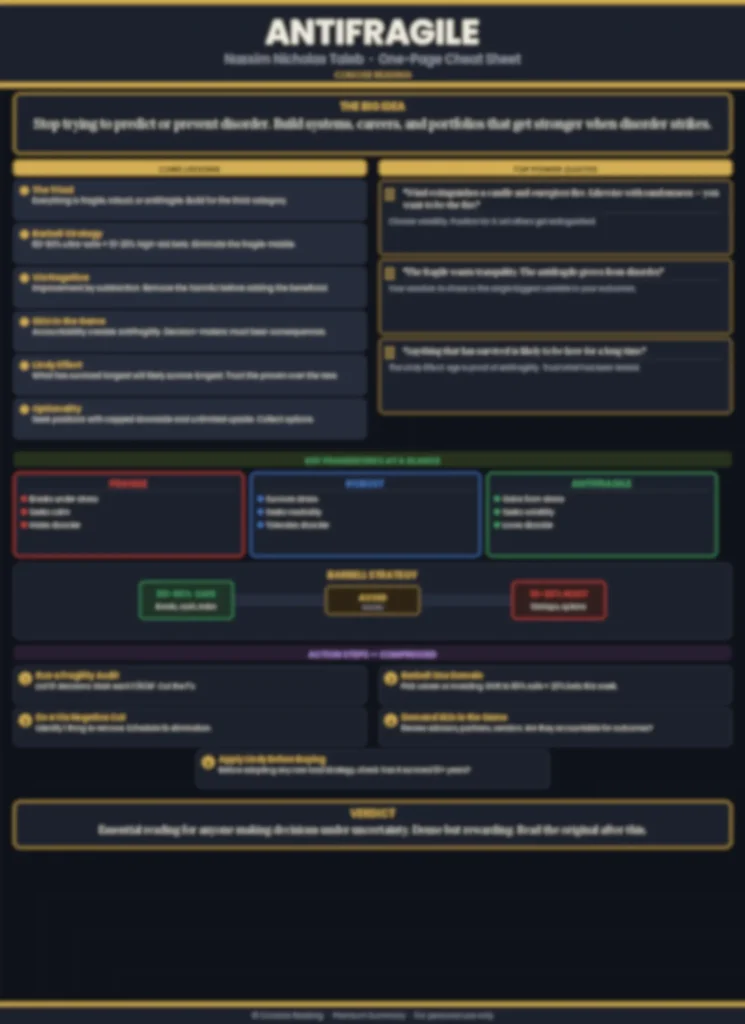
Premium Cheat Sheet Preview
About the Author
Nassim Nicholas Taleb spent over two decades as a derivatives trader on Wall Street, where he built and tested his theories on probability and tail risk using real money in real markets — not academic models. He holds a PhD in Management Science and an MBA from Wharton. Antifragile is the fourth volume in his landmark Incerto series, which has influenced central banks, hedge funds, military strategists, and some of the world’s most successful investors. He is one of the few thinkers who predicted and profited from the 2008 financial crisis.
Want to read the full Incerto series? Start with our summaries of Fooled by Randomness and The Black Swan — the books that set up everything Antifragile delivers.
Power Quote From the Book:
“Wind extinguishes a candle and energizes fire. Likewise with randomness, uncertainty, and chaos: you want to be the fire and wish for the wind.” — Nassim Nicholas Taleb, Antifragile
Who This Summary is For
- This is for you if…
- You are an entrepreneur or business owner who wants to build systems that don’t collapse when conditions change
- You are an investor who is tired of strategies that assume a stable, predictable market
- You want a mental model for risk that actually holds up in the real world — not just on a spreadsheet
- You are curious about why some businesses, ideas, and people thrive in chaos while others fall apart
- You want to read smarter, not just read more — our Start Here guide explains exactly how Concise Reading summaries are built
- Skip this if…
- You want a quick motivational read with a 5-step system and daily affirmations. Taleb is deliberately challenging, and this summary respects that. If you’re new to business books and want an easier entry point, start with our Atomic Habits summary or browse the Library for something matched to your current goals.
Social Proof
We don’t pad this page with fake reviews. If you’ve read this summary — free or premium — we’d genuinely like to know what landed for you. Did the Barbell Strategy change how you think about your portfolio? Did the Triad framework shift how you evaluate risk in your business? Leave a comment below. Real feedback from real readers is the only social proof worth having, and it helps others decide whether this is the right summary for them. If you found it valuable, share it with one person who needs to read it.
You can also explore what other readers are saying about our work on the About page or check our FAQs if you have questions about how premium summaries are structured.
Antifragile took Nassim Taleb a lifetime of trading, research, and intellectual combat to write. The premium summary gives you the complete system — every framework, every action step, and the full chapter breakdown — in under an hour.
If you’re building a serious reading stack, the premium Antifragile summary pairs powerfully with our Thinking in Bets summary and The Black Swan summary. Or, if you want everything on risk and decision-making in one place, explore The Mindset & High Performance Pack or The Investing Playbook — both include Antifragile as a core text.
Related Summaries
- The Black Swan — Nassim Nicholas Taleb Antifragile is actually the sequel to this. The Black Swan explains why we can’t predict rare, high-impact events. Reading both together gives you the complete picture: why prediction fails, and how to build for unpredictability instead.
- Thinking in Bets — Annie Duke A practical, decision-focused book that complements Taleb’s philosophy. Duke teaches you how to make better decisions under uncertainty — not by seeking certainty, but by thinking probabilistically and separating good decisions from bad outcomes.
- The Black Swan already listed — replacing with:
- Fooled by Randomness — Nassim Nicholas Taleb The first book in Taleb’s Incerto series. Where Antifragile gives you the solution, Fooled by Randomness diagnoses the problem: humans are systematically blind to the role of luck and randomness in success and failure.
[…] Antifragile […]
[…] you enjoy books that challenge conventional thinking—like Fooled by Randomness, Antifragile, or even The Psychology of Money—then The Black Swan is essential […]
[…] idea resonates strongly with books like Antifragile and The Hard Thing About Hard Things, which you can also explore in our Free Summaries […]
[…] like Antifragile and The Black Swan also explore how uncertainty shapes […]
[…] mindset is also discussed in books like Antifragile and The Black […]
[…] due diligence is like ignoring risk in Antifragile or The Black Swan. Always […]
[…] can apply immediately—alongside connections to other powerful summaries like The Black Swan and Antifragile, both available in your Free Summaries […]
[…] lead to major violations. This connects deeply with insights from The Psychology of Money and Antifragile, which you can explore in our […]
[…] can also compare these ideas with Antifragile and The Black Swan available in our Free […]
[…] resilience is essential. Just like in Antifragile, growth comes from challenges. The more you face setbacks and continue forward, the stronger you […]
[…] like The Black Swan and Antifragile (available in our Free Summaries) show how unexpected events impact markets—but this book reveals […]