
Das Kapital by Karl Marx — Summary & Key Lessons
What this book will teach you in the next 10 minutes — and why it matters for understanding where profit, wages, and economic crises actually come from in your business and the economy around you.
Used as the intellectual foundation of modern economic debate. Read by business owners, economists, investors, and policymakers across 150+ years. Now distilled into a clear, practical summary — no ideology required.
Book Snapshot
- Author – Karl Marx
- Category – Economics / Political Economy / Social Theory
- Original Book – Approximately 2,500 pages across three volumes. Average read time: 80–120 hours for a careful reading.
- Free Summary – 09 pages
- Premium Summary – 99 pages
The Big Idea
Every dollar of corporate profit has a source. Karl Marx’s answer — backed by 30 years of primary research into factory records, wage data, and classical economics — is that profit originates from workers producing more value than they are paid for. Capital is not a neutral reward for hard work. It is accumulated unpaid labor, compounding over time. And the widening gap between productivity and wages, the recurring economic crises, the relentless concentration of wealth in fewer hands — Marx argued these are not failures of capitalism. They are exactly how the system is designed to work. Whether you agree with his conclusions or not, understanding this framework makes you a sharper thinker about every business, market, and economy you will ever encounter. If you want to understand why the world’s wealth keeps moving in the direction it moves, this is where the explanation lives. Browse our full economics collection in the Library to see how Das Kapital sits alongside other foundational economic works we have summarized.
What You’ll Learn — Key Lessons Preview
- You will understand exactly where corporate profit comes from at its most fundamental level — and why the standard explanation leaves out the most important part.
- You will see why wages stay suppressed even when productivity and profits hit record highs — and why this is structural, not accidental.
- You will learn why economic crises keep recurring despite better technology, smarter management, and more sophisticated financial systems — and how to see them coming before most people do.
- You will grasp why capital naturally concentrates into fewer hands over time, and what the compounding math behind wealth inequality actually looks like.
- You will walk away with five analytical frameworks you can apply to your own business, investments, and economic analysis — immediately.
- For more foundational economics thinking, also see our summaries of The Wealth of Nations, Capital in the Twenty-First Century, and The General Theory — three books that directly respond to or extend Marx’s framework. If you want the full collection in one place, the Economics & Economic Thinking Premium Pack includes all of them.
Free vs Premium Comparison
| Free – $0 | Premium – $4.99 (Recommended) |
| ➡ Book Snapshot ➡ The Big Idea ➡ Key Lessons ➡ Power Quotes ➡ 09 Pages | ✔ Everything in free + ✔ Full Chapter Breakdown ✔ Key frameworks & diagrams ✔ Action steps ✔ Critical analysis ✔ One-page cheat sheet ✔ 99 pages |
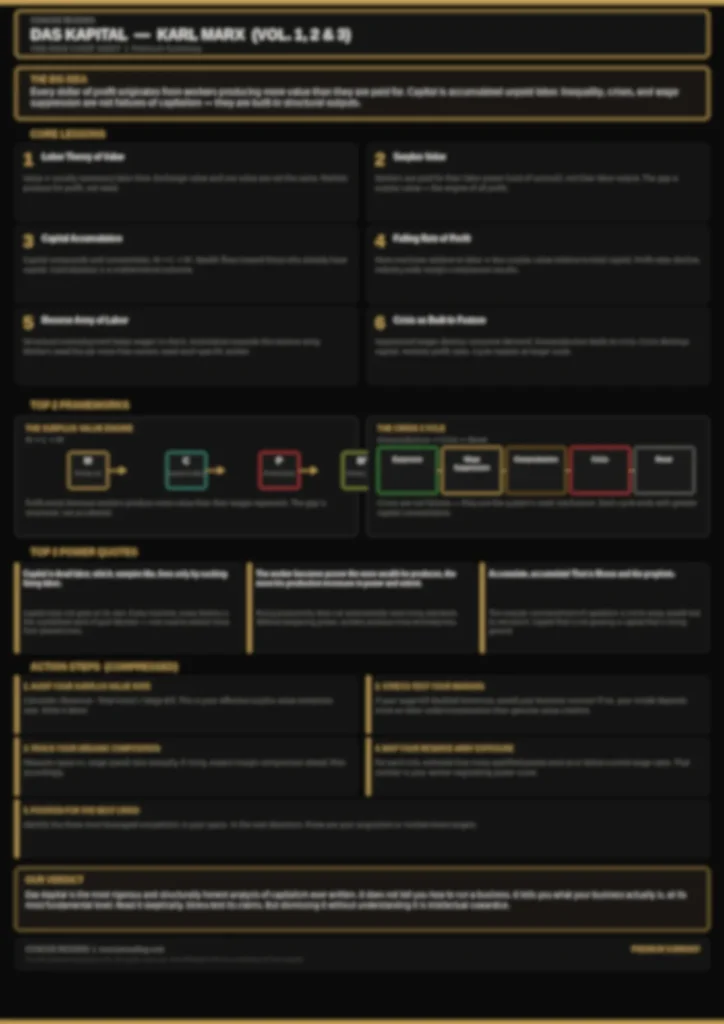
Premium Cheat Sheet Preview
About the Author
Karl Marx (1818–1883) spent over 30 years researching and writing Das Kapital, conducting primary analysis of British factory records, Parliamentary reports, and the work of every major economist before him. He earned his doctorate in philosophy from the University of Berlin and produced one of the most systematically developed bodies of social and economic thought in history. Das Kapital remains one of the most cited works in academic economics and political science worldwide, over 150 years after its first publication.
Power Quote From the Book:
“Capital is dead labor, which, vampire-like, lives only by sucking living labor, and lives the more, the more labor it sucks.”
— Karl Marx, Das Kapital
Who This Summary is For
- This is for you if…
- You are a business owner or entrepreneur who wants to understand the structural mechanics behind profit, wages, and margins — not just the surface-level how-to.
- You are an investor or analyst who wants to stress-test mainstream economic assumptions and understand why industries experience margin compression, crises, and consolidation cycles.
- You are a student of economics, history, or philosophy who wants Marx explained clearly and fairly — without ideological filters in either direction.
- You want to understand the intellectual foundation behind every serious debate about income inequality, labor markets, and economic policy happening in the world today.
- You are a serious reader who believes that understanding your opponents’ best arguments makes you sharper — and that dismissing a 150-year-old framework without reading it is intellectual laziness.
- Skip this if…
- You are looking for a quick tactical business book with step-by-step revenue growth tips — Das Kapital is a work of political economy, and this summary reflects that. If that is what you need right now, our Startup & Entrepreneurship Pack or The Startup Playbook will serve you better. Also skip this if you are approaching it to confirm a pre-existing political opinion — this summary is written for thinkers, not for either side.
Social Proof
We are building this library for readers who want more than a three-bullet highlight reel. If you have read this summary — free or premium — we want to know what landed for you, what challenged your thinking, and what you would add. Drop your thoughts in the comments below. Your honest reaction helps other readers decide whether this is the right summary for them right now, and it helps us make future summaries sharper. Every comment from a real reader is worth more than a hundred anonymous ratings. If this summary changed how you think about profit, wages, or markets, tell us exactly how — that specificity is what other serious readers are looking for.
Das Kapital took Karl Marx over 30 years to research and write across more than 2,500 pages in three volumes — the Premium Summary gives you the complete system, all five frameworks, five power quotes with analysis, five discomfort-level action steps, a full critical analysis, and a one-page printable cheat sheet in 20 focused pages. If you want to go deeper on the economics of how wealth is built and concentrated, pair this with our Financial Intelligence Playbook or explore the full Economics & Economic Thinking Premium Pack — both pull together the most important economic thinking across multiple books into one unified resource.
Related Summaries
Related Book Summaries You Should Read Next
- The Wealth of Nations by Adam Smith — The foundational text Marx was directly responding to. Smith’s case for free markets and division of labor is the starting point for understanding why Marx’s critique was so radical. Reading both back to back gives you the complete picture of how capitalist economic theory developed and where it fractures.
- Capital in the Twenty-First Century by Thomas Piketty — The modern empirical counterpart to Marx. Piketty uses 200 years of data to show that returns on capital consistently outpace economic growth, causing wealth concentration to increase over time. He arrives at conclusions strikingly similar to Marx using entirely different methods, which makes this a powerful companion read.
- The General Theory by John Maynard Keynes — Keynes wrote the 20th century’s most influential response to the kind of economic crises Marx predicted. Where Marx said crises were fatal to capitalism, Keynes said they could be managed through government intervention. Understanding Keynes gives you the dominant mainstream alternative to Marx’s diagnosis and the intellectual basis for most modern economic policy.

[…] Das Kapital […]
[…] you’ve explored similar ideas in Das Kapital (Vol 1) or Basic Economics, this book builds on those foundations with modern data and practical […]