
The Psychology of Money by Morgan Housel — Summary & Key Lessons
What this book will teach you in the next 10 minutes — and why it matters for every financial decision you’ll make for the rest of your life.
Read by 4M+ people worldwide · Summarised by Concise Reading · Free version available instantly · Premium version: 32 pages, zero fluff
Book Snapshot
- Author – Morgan Housel
- Category – Personal Finance & Wealth Building / Behavioral Economics, Psychology
- Original Book – ~ 256 pages | ~ 5–6 hours average read time
- Free Summary – 07 pages
- Premium Summary – 32 pages | ~ 45–55 minutes estimated read time
The Big Idea
Most people assume they’re bad with money because they don’t know enough. Morgan Housel argues the opposite: you already know what to do. The problem is how you behave when markets crash, when your peers upgrade their lifestyle, or when impatience wins over patience. The Psychology of Money is not a book about investment strategy or financial planning formulas. It is a book about the hidden psychological forces — fear, ego, envy, and short-term thinking — that quietly destroy wealth even when income is rising. Fix the behavior. The numbers follow.
Want to go deeper? Browse our Personal Finance & Wealth Building Pack — which includes this summary alongside 10 other essential finance reads in one bundle.
What You’ll Learn — Key Lessons Preview
Why earning more rarely makes you wealthier — and the single shift in mindset that changes what you do with every rupee or dollar you earn from today forward
How to stay calm and invested when the market is terrifying — using a simple buffer system that removes emotion from your biggest financial decisions
Why the people who look richest are often the furthest from actual wealth — and how to stop measuring your financial progress against the wrong people
The one number you must define before you invest another dollar — without it, you will spend your entire life chasing a finish line that keeps moving
Why starting mediocre at 25 beats starting brilliant at 45 — and the compounding math that makes this one of the most important ideas in personal finance
These are five of the core ideas from this summary. For the full chapter-by-chapter breakdown, including frameworks, action steps, and the one-page cheat sheet, see the Premium Version below.
Free vs Premium Comparison
| Free – $0 | Premium – $4.99 (Recommended) |
| ➡ Book Snapshot ➡ The Big Idea ➡ Key Lessons ➡ Power Quotes ➡ 07 Pages | ✔ Everything in free + ✔ Full Chapter Breakdown ✔ Key frameworks & diagrams ✔ Action steps ✔ Critical analysis ✔ One-page cheat sheet ✔ 32 pages |
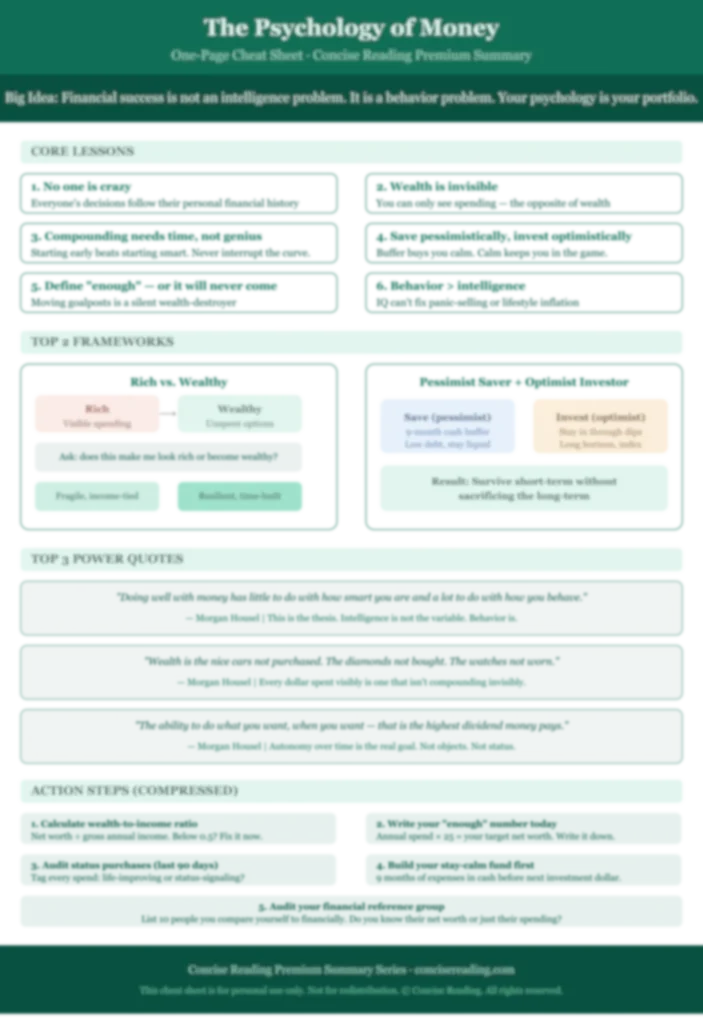
Premium Cheat Sheet Preview
About the Author
Morgan Housel is a partner at the Collaborative Fund and a former columnist at The Wall Street Journal and The Motley Fool, where he spent over 15 years studying how psychology shapes financial outcomes. He is a two-time winner of the Best in Business Award from the Society of American Business Editors and Writers. The Psychology of Money has sold over four million copies and been translated into more than 50 languages — making it one of the most widely read personal finance books of the last decade.
Also by Morgan Housel: Same as Ever — his follow-up on the patterns of human behavior that never change, available in our Library.
Power Quote From the Book:
“The ability to do what you want, when you want, with who you want, for as long as you want to — that is the highest dividend money pays.”
— Morgan Housel, The Psychology of Money
Who This Summary is For
This is for you if…
- You are a professional or entrepreneur who earns reasonably well but cannot explain why your savings haven’t kept pace with your income
- You want to understand why you make emotional financial decisions — and build the self-awareness to stop making them
- You are an early investor who knows the theory but found yourself panicking, selling, or second-guessing during the last market correction
- You are tired of financial content that talks about what to do but never addresses why you consistently fail to do it
- You want a sharp, practical summary you can read in under an hour — and immediately apply
If you’re building your financial reading list from scratch, start with our Start Here page — it maps the best books for your specific situation.
Skip this if…
This summary is not for you if you are looking for specific stock picks, portfolio allocation percentages, or a step-by-step investment plan. Housel deliberately wrote a psychology book, not a tactics manual. If you want the tactical layer, pair this with our summary of I Will Teach You to Be Rich or The Intelligent Investor — both available in the Library.
Social Proof
We launched this summary recently and we are building our reader community here at Concise Reading. If you read the free or premium version of this summary, we would genuinely value your honest feedback in the comments below — what landed, what you applied, what you wish had gone deeper. Every comment helps us improve future summaries and helps other readers decide if this one is right for them. If this summary changed how you think about money — even one idea — tell us which one. That’s the kind of signal that matters to us more than any rating system.
Already a fan of the format? Browse our full Library of 231 summaries — or check out our blog post on The Psychology of Money’s 20 most important lessons for a different angle on the same book.
Morgan Housel spent years synthesizing decades of financial history, behavioral research, and real-world case studies into 256 pages. The Concise Reading Premium Summary gives you the complete system — every chapter broken down, four key frameworks with visual diagrams, five power quotes with context, and five action steps specific enough to cause mild discomfort — in 32 focused pages. That is the entire intellectual infrastructure of one of the most important personal finance books ever written, compressed into a single focused read. If you found even one idea in the free version useful, the premium version will be worth ten times what you pay for it.
Not sure which format is right for you? Read our blog post: Free vs Premium Book Summaries — What’s the Difference and Which Should You Get?
Related Summaries
1. The Intelligent Investor — Benjamin Graham If The Psychology of Money explains the behavioral side of wealth, The Intelligent Investor gives you the timeless rational framework. Together, they’re the complete picture.
2. Rich Dad Poor Dad — Robert Kiyosaki A foundational look at how your money mindset — shaped by the “poor dad” vs “rich dad” worldview — determines your financial trajectory. Directly complements Housel’s behavioral thesis.
3. I Will Teach You to Be Rich — Ramit Sethi Where Housel explains why you behave badly with money, Sethi tells you exactly what to do in practical, step-by-step terms. The natural next read after this one.
[…] you enjoy reading powerful insights like those in our summaries of Atomic Habits, The Psychology of Money, and Influence, you will find this book especially […]
[…] you are interested in similar financial ideas, you may also enjoy our summaries of The Psychology of Money, The Millionaire Next Door, and The Richest Man in Babylon, all available in our Free Summaries […]
[…] The Psychology of Money by Morgan Housel […]
[…] The Psychology of Money […]
[…] The Psychology of Money […]
[…] you enjoy powerful insights like those found in summaries such as Outliers, The Psychology of Money, and Good to Great, then this book will transform how you think about […]
[…] The Psychology of Money […]
[…] insights, explore other popular summaries in our Free Summaries library like Rich Dad Poor Dad, The Psychology of Money, and The Intelligent […]
[…] The Psychology of Money […]
[…] hundreds of similar insights inside our Library, including summaries of books like Atomic Habits, The Psychology of Money, and […]
[…] like Think and Grow Rich and The Psychology of Money highlight how beliefs influence financial […]
[…] of additional insights inside our Library, including summaries from books like Atomic Habits, The Psychology of Money, and The Lean […]
[…] mindset, and business thinking, explore more titles inside our Free Summaries, including The Psychology of Money, Zero to One, and […]
[…] The Psychology of Money […]
[…] Trust is built through proof, not claims. This principle is also seen in analytical works like Freakonomics and The Psychology of Money. […]
[…] long-term thinking, check The Psychology of Money and Good to […]
[…] Popular summaries (like Atomic Habits or The Psychology of Money) […]
[…] you’ve read summaries like Freakonomics or The Psychology of Money, you’ll notice a similar theme: human behavior and incentives shape […]
[…] you’re interested in similar economic thinking, you can also explore summaries like “The Psychology of Money”, “A Random Walk Down Wall Street”, and “The Intelligent Investor” in our Free Summaries […]
[…] you’ve explored summaries like The Psychology of Money, The Intelligent Investor, or Fooled by Randomness, you already know that understanding uncertainty […]
[…] you’ve explored summaries like The Intelligent Investor or The Psychology of Money in our Free Summaries section, this book takes you to the next level—into the professional world […]
[…] you’ve read The Psychology of Money, you’ll recognize a similar theme: behavior matters, but systems matter even […]
[…] Readers of books like The Psychology of Money […]
[…] deeper learning, combine this with summaries like The Intelligent Investor and The Psychology of Money available in our Best […]
[…] is part of our Free Summaries section, where you can access powerful insights from books like The Psychology of Money and Rich Dad Poor Dad. Instead of spending hours reading, you get the most valuable ideas in […]
[…] many investors lose money by trusting misleading numbers. Books like The Intelligent Investor and The Psychology of Money teach mindset—but Financial Shenanigans teaches […]
[…] books in your Finance & Investing collection (like The Psychology of Money or One Up on Wall Street) indirectly highlight this—but this book explains it in […]
[…] At Concise Reading, our mission is to make complex ideas simple and actionable. That’s why this summary is available in our Free Summaries section inside the Library, alongside other powerful reads like Rich Dad Poor Dad and The Psychology of Money. […]
[…] a broader perspective on money psychology, check out The Psychology of Money in our Free Summaries […]
[…] insights in a structured and actionable format. If you’ve already explored summaries like The Psychology of Money, Rich Dad Poor Dad, or Financial Intelligence in our Free Summaries, this one will perfectly […]
[…] Free Summaries collection, where you can explore other powerful insights like Rich Dad Poor Dad, The Psychology of Money, and Financial […]
[…] you’ve explored other insights from our Free Summaries library—like Freakonomics, The Psychology of Money, or The Big Short—you’ll notice a common theme: real-world economics is deeply human. This […]
[…] you enjoy books like Drive, you’ll also benefit from summaries like The Psychology of Money, Start with Why, and Good to Great available on our […]
[…] financial thinking, explore The Psychology of Money and Rich Dad Poor Dad in our Personal Finance […]
[…] Summaries section, you’ll find similar powerful insights from books like Influence, Nudge, and The Psychology of Money—all of which complement the ideas in […]
[…] you enjoy learning from experts like her, you can also explore similar insights in our summaries of The Psychology of Money, Rich Dad Poor Dad, and The Millionaire Next Door available in our Free Summaries […]
[…] tax burden. If you’ve explored other financial classics like Rich Dad Poor Dad or The Psychology of Money available in our Free Summaries, you’ll notice a similar theme: financial education changes […]
[…] you’ve explored insights from books like The Psychology of Money, Irrational Exuberance, or The Big Short in our Free Summaries, you’ll find this story connects […]
[…] you enjoy learning from powerful books like Atomic Habits, Think and Grow Rich, or The Psychology of Money, you will find this summary incredibly […]