Capitalism and Freedom by Milton Friedman — Summary & Key Lessons
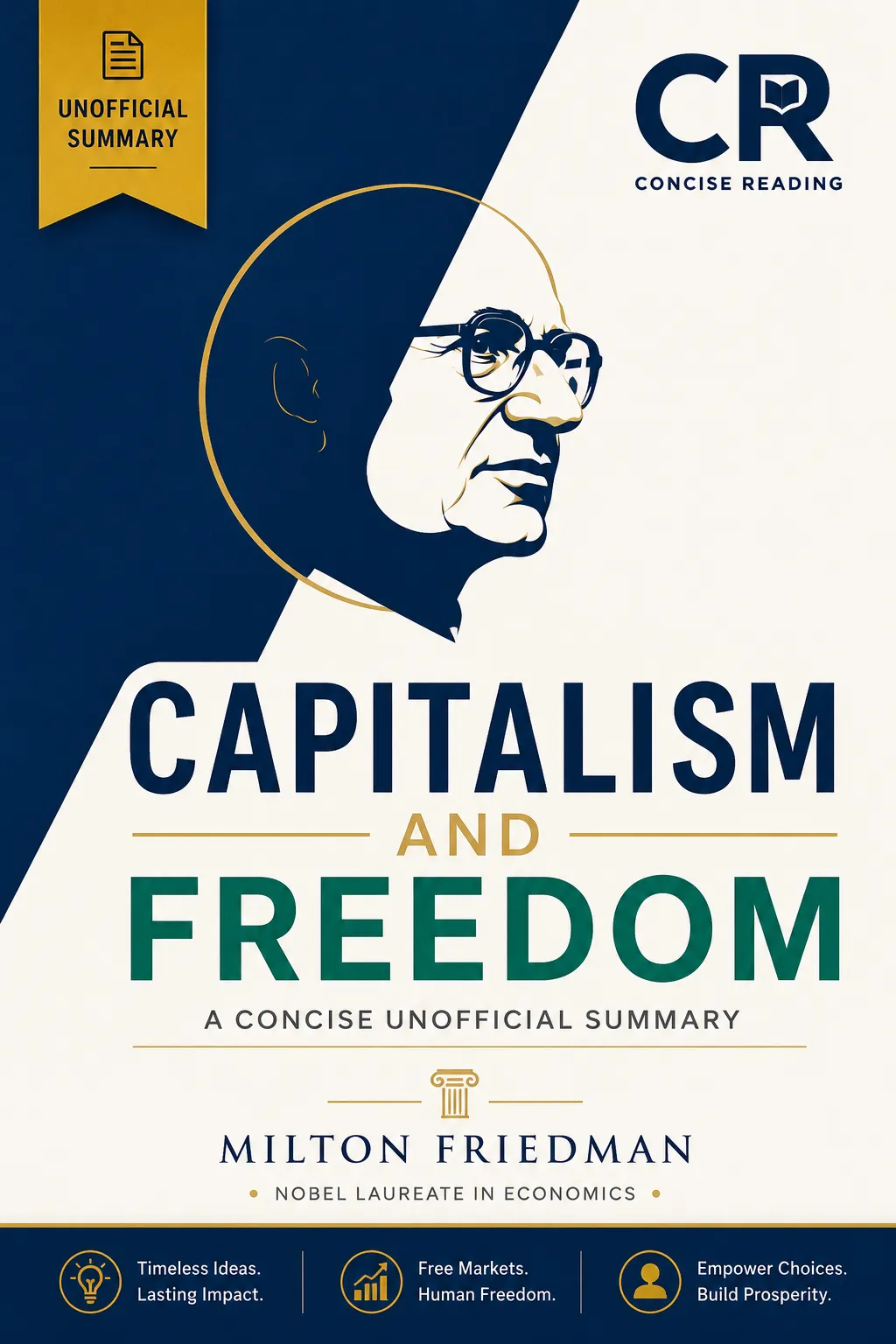
What this book will teach you in the next 10 minutes — and why it matters for your money, your business, and every economic decision you will make this year.
Read by entrepreneurs, investors, and independent thinkers. Summarized without the jargon. Delivered in a format you will actually use.
Book Snapshot
- Author – Milton Friedman
- Category – Economics / Political Philosophy / Personal Freedom
- Original Book – ~ 230 pages. Average read time approximately 6 to 8 hours.
- Free Summary – 08 pages
- Premium Summary – 30 pages. Estimated read time 45 to 60 minutes.
The Big Idea
Milton Friedman’s argument is simple and uncomfortable: you cannot have personal freedom without economic freedom. Every time a government takes control of an economic decision — your income, your business, your savings — it takes a piece of your liberty with it. Written in 1962 and more relevant today than ever, Capitalism and Freedom is not a political book. It is a framework for thinking clearly about money, markets, and power — and why most government programs quietly cost far more than they deliver. If you want to understand why inflation keeps rising, why regulation keeps growing, and why the economy so often seems to work for everyone except you, this book is where the answers begin. This is the foundational text of free-market economics, and our summary gives you the full system without the academic weight.
What You’ll Learn — Key Lessons Preview
- You will understand exactly why economic freedom and personal freedom cannot be separated — and what that means for every financial decision you make.
- You will know how to use Friedman’s Four Ways to Spend Money framework to immediately see why government programs cost more and deliver less — and how to apply the same logic to your own business spending.
- You will understand how inflation is a hidden tax engineered by government policy, how to see it coming before the headlines confirm it, and how to position your savings and pricing strategy to protect yourself.
- You will be able to apply the Licensing Capture Test to your own industry and determine whether the regulations you comply with protect your customers or protect your competitors from you.
- You will walk away with a coherent, bias-free framework for reading economic news, evaluating policy, and making business and investment decisions that most people — including most professionals — never develop.
Free vs Premium Comparison
| Free – $0 | Premium – $4.99 (Recommended) |
| ➡ Book Snapshot ➡ The Big Idea ➡ Key Lessons ➡ Power Quotes ➡ 08 Pages | ✔ Everything in free + ✔ Full Chapter Breakdown ✔ Key frameworks & diagrams ✔ Action steps ✔ Critical analysis ✔ One-page cheat sheet ✔ 30 pages |
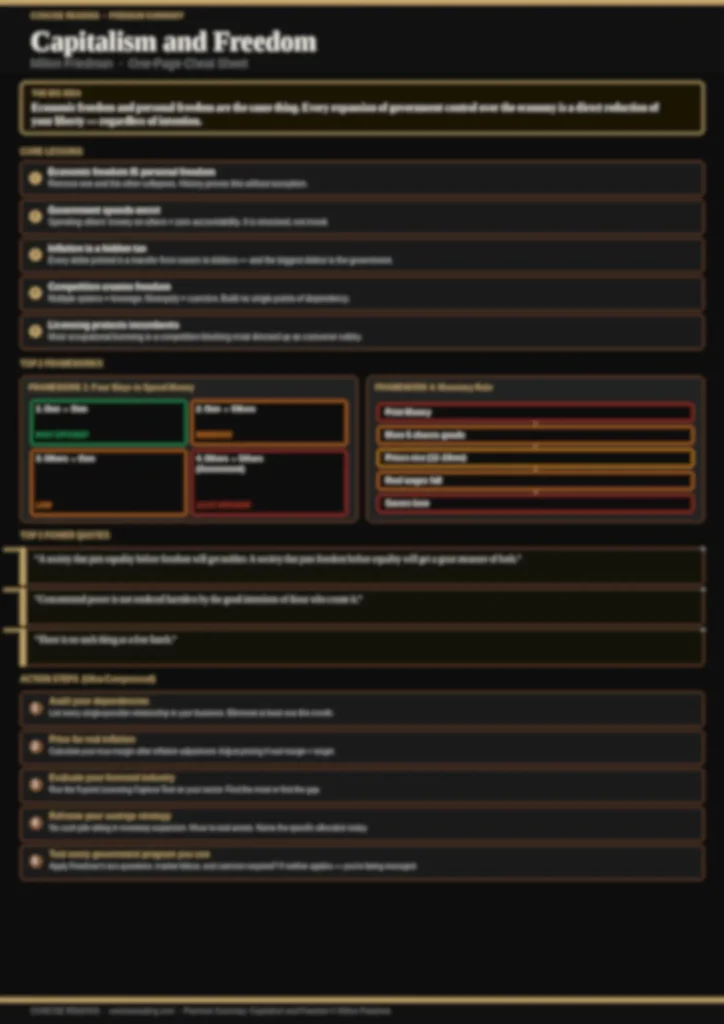
Premium Cheat Sheet Preview
About the Author
Milton Friedman (1912–2006) was one of the most consequential economists of the twentieth century. A professor at the University of Chicago for over thirty years, he received the Nobel Prize in Economic Sciences in 1976 and served as an economic advisor to both Ronald Reagan and Margaret Thatcher. His predictions about inflation and monetary policy — dismissed by mainstream economists in the 1960s — proved precisely correct twice over. When Friedman argues about free markets and freedom, he does so as someone whose ideas reshaped the economic policies of entire nations.
Power Quote From the Book:
“A society that puts equality before freedom will get neither. A society that puts freedom before equality will get a great measure of both.”
— Milton Friedman, Capitalism and Freedom
Who This Summary is For
- This is for you if…
- You are an entrepreneur who wants to understand the economic forces shaping your business environment — regulation, inflation, licensing, and government policy — at a level deeper than headlines.
- You are an investor who senses that monetary policy is the real risk in your portfolio and you want a rigorous framework, not just a news feed, to understand why.
- You want to think about economics and government independently, without being told what to believe by media that has a stake in your reaction.
- You are building wealth and want to understand the structural forces — inflation, taxation, regulation — that quietly work against you, so you can position yourself ahead of them.
- You have read personal finance books like The Psychology of Money or Rich Dad Poor Dad and want the deeper economic foundation that sits behind all of them. (Our summary of The Psychology of Money and our summary of Rich Dad Poor Dad are good starting points if you want to see how these ideas connect.)
- Skip this if…
- You are looking for a step-by-step tactical guide to making money. This summary operates at the level of frameworks and principles, not stock tips or business scripts. If you want that, our summary of $100M Offers or The Lean Startup will serve you better right now.
Social Proof
We do not have a wall of testimonials to show you. What we have is a commitment to earning yours. If you read this summary — free or premium — and it changes how you think about even one financial or business decision, we would genuinely like to hear about it. Leave your thoughts in the comments below. What landed? What challenged you? What will you do differently? Your experience helps other readers decide if this summary is right for them, and it helps us make every future summary sharper. The most useful feedback we receive always comes from people who were skeptical going in. If that is you, we are especially interested in what you think.
Capitalism and Freedom took Milton Friedman a lifetime of research, decades of teaching at the University of Chicago, and the hard-won credibility of a Nobel Prize to produce. The Premium Summary gives you the complete system — five visual frameworks, five power quotes with analysis, five specific action steps, a full chapter-by-chapter breakdown, and a one-page cheat sheet you can save, print, and reference in under two minutes — in 22 pages and under an hour. If you found the free summary useful, the premium version is the one you will actually use.
If you want to go further after this, our Economics and Economic Thinking Pack brings together the most important works in this space — including our summaries of The Road to Serfdom, Basic Economics, Free to Choose, and The Wealth of Nations — in one bundle at a significant discount. Or if you want the synthesized system across all of economic thinking, The Economics and Economic Thinking Playbook is where everything comes together in one unified framework. You can explore our full library of Business and Money summaries in the Concise Reading Library.
Related Summaries
If this summary challenged how you think about money, freedom, and markets, your next reads should be:
- The Road to Serfdom by F.A. Hayek — Hayek makes a complementary argument: central planning doesn’t just fail economically, it inevitably produces authoritarian outcomes. Read this alongside Capitalism and Freedom for a complete picture.
- Basic Economics by Thomas Sowell — Sowell takes Friedman’s ideas and makes them ruthlessly practical. No graphs, no jargon. Just clear thinking about how economic decisions actually play out in the real world. If Capitalism and Freedom is the philosophy, Basic Economics is the application.
- The Wealth of Nations by Adam Smith — This is where the entire intellectual tradition Friedman is building on began. Smith’s argument for voluntary exchange and specialization is the foundation of everything in modern free-market economics. Essential context.
[…] Capitalism and Freedom (available in Free Summaries) […]
[…] Capitalism and Freedom (available in Free Summaries) […]
[…] Monetary Policy and Subgenre → Macroeconomics pages, where you’ll find related summaries like Capitalism and Freedom and Free to […]
[…] you’ve read summaries like Free to Choose or Capitalism and Freedom in our Free Summaries section, you’ve already experienced his powerful […]
[…] economics, policy, and innovation—similar to the ideas explored in books like Freakonomics and Capitalism and Freedom, both available in our Free Summaries […]