
The Intelligent Investor by Benjamin Graham — Summary & Key Lessons
What this book will teach you in the next 10 minutes — and why it matters for every investment decision you’ll ever make.
Used as a core investing text at Columbia Business School. Called “by far the best book on investing ever written” by Warren Buffett. Condensed here into the clearest summary you’ll find anywhere.
Book Snapshot
- Author – Benjamin Graham
- Category – Personal Finance & Investing / Behavioral Economics / Business Strategy
- Original Book – ~ 640 pages | Average read time: 18–22 hours
- Free Summary – 08 pages
- Premium Summary – ~ 36 pages | Estimated read time: 45–60 minutes
The Big Idea
Most people lose money in markets not because they lack information — but because they trust their emotions more than their analysis. Benjamin Graham’s central argument in The Intelligent Investor is that the stock market is not a pricing machine but a mood machine, and the investor who understands this has an enormous edge over one who doesn’t. The market doesn’t know what your shares are worth. It offers you a price every day based on crowd psychology, not on business fundamentals. Your job isn’t to follow that price — it’s to decide, rationally and without panic, whether it represents a bargain or a trap. Master that discipline, and almost everything else in investing takes care of itself.
For more context on how Graham’s ideas fit into the broader world of value investing, read our blog post on The Complete Guide to Value Investing: Lessons From Graham, Buffett and Lynch. And if you’re exploring which investing books to read first, our guide to The 15 Best Investing Books for Beginners is a good starting point.
What You’ll Learn — Key Lessons Preview
- How to never panic-sell again — Graham’s Mr. Market framework rewires how you think about falling prices, so your first instinct becomes opportunity rather than fear
- How to know if a stock is actually worth buying — Learn the margin of safety principle that Warren Buffett built his entire fortune on, and apply it to any investment before you commit a single rupee
- The one question that separates investors from speculators — and why most people who call themselves investors are actually doing something much riskier without knowing it
- How to build a portfolio that survives market crashes — Graham’s 25/75 allocation rule creates the mechanical discipline that forces you to buy low and sell high without relying on willpower
- Why your temperament matters more than your IQ — and the specific mental frameworks that protect you from your own worst financial instincts
Free vs Premium Comparison
| Free – $0 | Premium – $4.99 (Recommended) |
| ➡ Book Snapshot ➡ The Big Idea ➡ Key Lessons ➡ Power Quotes ➡ 08 Pages | ✔ Everything in free + ✔ Full Chapter Breakdown ✔ Key frameworks & diagrams ✔ Action steps ✔ Critical analysis ✔ One-page cheat sheet ✔ 36 pages |
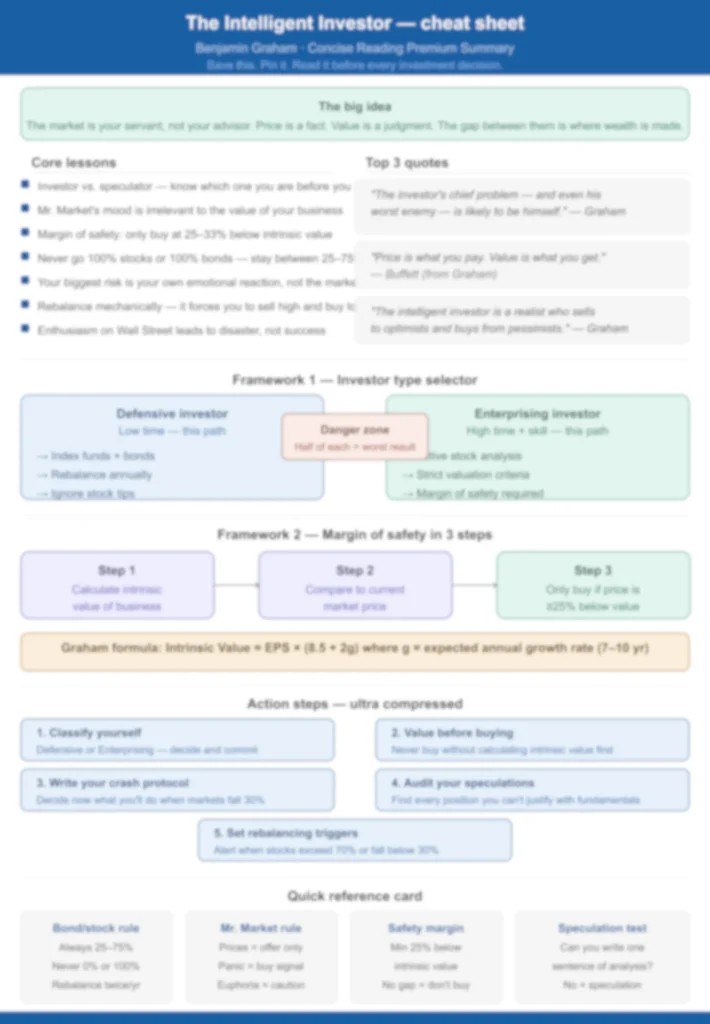
Premium Cheat Sheet Preview
About the Author
Benjamin Graham (1894–1976) was an economist, investor, and professor at Columbia Business School who is widely regarded as the father of value investing. He managed money professionally for decades, surviving the 1929 crash and rebuilding — converting hard experience into rigorous methodology. His most notable legacy is Warren Buffett, who studied directly under Graham and called him the most important intellectual influence on his investing career. If you trust Buffett’s results, you’re looking at the mind behind the method.
Graham also wrote Security Analysis (1934), the professional-grade companion text to this book — available separately in our Library.
Power Quote From the Book:
“The investor’s chief problem — and even his worst enemy — is likely to be himself.”
— Benjamin Graham, The Intelligent Investor
Who This Summary is For
This is for you if…
- You are a salaried professional or business owner who invests money but relies mostly on gut feeling, market news, or someone else’s recommendation — and suspects there’s a better way
- You want a clear, proven framework for evaluating any stock or investment before you commit money to it — not tips, but a thinking system
- You are someone who has panic-sold during a market crash, or excitement-bought at the top, and want to make sure it never happens again
- You want to understand how Warren Buffett thinks about money — because this is the book and the man who shaped him
- You are building long-term wealth and want a strategy grounded in fundamentals, not in the financial media’s daily noise
This summary pairs naturally with our Psychology of Money summary — Graham covers the strategy; Morgan Housel covers the emotional architecture underneath it. Together they’re the most complete framework for individual investors we’ve found across our entire Library.
If you’re serious about investing, you should also explore The Investing Fundamentals Pack — which bundles this summary with others including One Up on Wall Street, A Random Walk Down Wall Street, and The Warren Buffett Way. Or if you want the deepest possible synthesis, The Investing Playbook draws insights from 10 investing classics — including this one — into a single unified framework.
Skip this if…
You are a professional fund manager or CFA-trained analyst who already operates within a formal valuation framework — the foundational philosophy here will be familiar territory. This summary is designed for individual investors building their first coherent system, not for those refining an advanced one.
Social Proof
We’re building a community of readers who think seriously about money — not just accumulate information about it. If you’ve read this summary (free or premium), we’d genuinely like to know what shifted for you. Did the Mr. Market framework change how you react to market news? Did the margin of safety calculation stop you from making a bad buy? Leave a comment below — your experience is useful to every other reader working through the same questions. The best financial education isn’t a course or a certificate. It’s a conversation between people who are paying attention.
Already read other summaries on Concise Reading? You can find the full collection in our Library, or check our Start Here page if you’re figuring out where to begin.
The Intelligent Investor took Benjamin Graham a lifetime of market crashes, financial losses, and decades of teaching and research to write. The premium summary gives you the complete system — every framework, every chapter breakdown, every action step, and the one-page cheat sheet — in 20 pages and under an hour.
If you still have questions about what’s included in a premium summary, the FAQs page and our blog post What is a Premium Book Summary? Everything Included Explained cover it in full detail. And if you found this summary genuinely useful, you’ll want to see what we’ve built across the rest of the collection — starting with The Intelligent Investor vs A Random Walk Down Wall Street: Which Should You Read First? for your next logical step.
Related Summaries
- The Psychology of Money — Morgan Housel | Deepens your understanding of how emotions and behavior drive financial decisions — the human side of what Graham warned about
- One Up on Wall Street — Peter Lynch | A practical, real-world companion to Graham’s theory — how an ordinary investor finds great stocks hiding in plain sight
- A Random Walk Down Wall Street — Burton Malkiel | Challenges and complements Graham’s approach, giving you the full picture of active vs. passive investing strategies
[…] The Intelligent Investor […]
[…] The Intelligent Investor […]
[…] book has become one of the most influential works in personal finance, alongside classics like The Intelligent Investor and Think and Grow […]
[…] is why many successful business books—including The Intelligent Investor and Freakonomics—combine research with […]
[…] The Intelligent Investor […]
[…] you enjoy books about investing and financial markets, you may also find our summaries of The Intelligent Investor, One Up on Wall Street, Market Wizards, and The Psychology of Money helpful. These books provide […]
[…] The Intelligent Investor• One Up on Wall Street• A Random Walk Down Wall […]
[…] The Intelligent Investor• The Big Short• Flash Boys• Den of Thieves• Market […]
[…] inside our Library, or check out foundational reads like Atomic Habits, Rich Dad Poor Dad, and The Intelligent Investor in our Free Summaries […]
[…] principle is widely used in investing books like The Intelligent Investor and One Up on Wall Street, available in our Investing & Stock Market Mastery […]
[…] The Intelligent Investor […]
[…] you’ve explored summaries like The Psychology of Money, The Intelligent Investor, or Fooled by Randomness, you already know that understanding uncertainty is the foundation of […]
[…] deeper insights, explore summaries like The Intelligent Investor and Principles in our Best Sellers […]
[…] you’ve read summaries like The Intelligent Investor or The Psychology of Money in our Free Summaries, you’ll notice similar philosophies—but […]
[…] you’ve explored summaries like The Intelligent Investor or The Psychology of Money in our Free Summaries section, this book takes you to the next […]
[…] and interpretation. This idea connects deeply with concepts discussed in Freakonomics and The Intelligent Investor, both available in our Free […]
[…] does this matter? Because many investors lose money by trusting misleading numbers. Books like The Intelligent Investor and The Psychology of Money teach mindset—but Financial Shenanigans teaches […]
[…] The balance sheet shows assets, liabilities, and equity. It’s the starting point for everything—whether you’re analyzing a startup from The Lean Startup or evaluating companies like in The Intelligent Investor. […]
[…] you want to go deeper into investing and cash management, check out The Intelligent Investor in our […]
[…] you’re interested in mastering finance further, you can also explore summaries like The Intelligent Investor, A Random Walk Down Wall Street, and Market Wizards in our Free Summaries […]
[…] like The Intelligent Investor reinforce this […]
[…] build a complete understanding, combine this with summaries like The Intelligent Investor and Principles—both available on Concise […]
[…] you’ve already explored popular investing classics like The Intelligent Investor, One Up on Wall Street, or A Random Walk Down Wall Street in our Free Summaries section, this book […]
[…] like A Random Walk Down Wall Street and The Intelligent Investor (available in our Stocks and Investing sections) strongly warn against this […]